St Matthias Day, Thursday 14th May 2020

Propers for St Matthias Day 
Very little is known about St Matthias. The Acts of the Apostles tells us that he had been a disciple of Jesus throughout Jesus’ ministry, and that he was chosen to replace Judas Iscariot as the twelfth Apostle. Apart from this brief appearance in the New Testament, we have no definite information about Matthias, although there are several ancient traditions about him. One early Church tradition speaks of Matthias preaching the Gospel in Judaea, another that he took the Gospel to Ethiopia. Another tradition says that he preached in Cappadocia (eastern Turkey) and in the area of the Caspian Sea. He is believed to have been martyred, possibly in Colchis (western Georgia) on the eastern shore of the Black Sea.

Entrance Antiphon
You have not chosen me; I have chosen you. Go and bear fruit that will last, alleluia.

The Collect
Almighty God,
Who in the place of the traitor Judas,
chose your faithful servant Matthias to be of the number of the Twelve;
preserve your Church from false apostles
and, by the ministry of faithful pastors and teachers,
keep us steadfast in the truth:
through Jesus Christ your Son our Lord,
who is alive and reigns with you,
in the unity of the Holy Spirit,
one God, now and for ever.
Amen.

The Readings

Missal (St Mark’s)       Acts 1:1-17,20-26       
                                 Psalm 113
                                
John 15:9-17

RCL (St Gabriel’s)      Acts 1:15-26
                                Psalm 15
                               
1 Corinthians 4:1-7
                               
John 15:9-17


Fifth Sunday of Easter 10th May, 2020

Photo by Arturo Rey on Unsplash

One of the questions I’m asked from time to time, and have been since I was ordained, is whether I’m a vicar or a priest? Actually, since I was inducted as the incumbent of St Mark’s and St Gabriel’s, I’ve been both! But, have you ever wondered what the difference is? For many people, the difference is denominational; Roman Catholic clergymen are priests and Church of England ministers are vicars. However, that’s not right. Unusually amongst Reformed Churches, the Church of England has continued to call its clergy ‘priests’ and so, the Church of England still ordains priests. Priests though, may or may not be vicars. A priest becomes a vicar when they become a parish priest, that is, when they’re inducted as the incumbent of a parish. So why do we call parish priests, vicars?

Well, quite simply, a parish priest is called a vicar because they hold a vicarious ministry. A vicarious ministry is one that’s performed or exercised on behalf of someone else and, in the case of a parish priest, that someone else is their diocesan bishop. In effect, a vicar is given the authority to carry out the bishop’s ministry in the parish because the bishop, being unable to be in more than one place at once, can’t do it. But vicarious can also mean to experience, or enjoy, something through another person and it’s very important that this meaning of vicarious is not applied to the ministry of a vicar. Because, whilst a vicar carries out their ministry on behalf of their bishop, they don’t carry out their ministry on behalf of the people of their parish. What a vicar does in their parish is, of course, done on behalf of the people of the parish but it’s not done for the people in a vicarious way, and shouldn’t be seen that way. I’ll give you an example of what I mean.

A few years before I was ordained, some people at the parish church I used to attend were trying to drum up support for a Bible Study. But, when they asked one man, a stalwart of the Church there, he said, “Why do I want to study the Bible? That’s what we pay yon man (the rector) to do for us.” That’s an example of someone in the Church who wanted to do something vicariously, through the parish priest; in this case, understand the Scriptures. Of course, it’s part of the vicar’s ministry to teach the Christian faith, and explaining the Scriptures is part and parcel of that. But that doesn’t mean people shouldn’t read and study the Scriptures themselves too.

And it’s the same with lots of other things that a vicar does. The vicar leads the people in worship, but the vicar doesn’t worship God on behalf of the people; the people can’t worship vicariously, through the parish priest, they must worship God themselves. A vicar prays for the people of the parish, but they’re the subject of the vicar’s prayers, the vicar doesn’t pray for the people so that they don’t have to pray; they must pray themselves. And perhaps above all, whilst a priest has offered themselves to the service of God and his people, and in that sense is ordained for others, they don’t offer themselves for ordination, nor are they ordained, on behalf of others. All Christians are called, in various ways, to offer themselves in service of God and his people. And they can’t do that vicariously, through someone else.

The ordained priesthood is a particular vocation within the Church’s ministries. Those who are called to it are, in a sense and to a certain degree, called to be set apart from the preoccupations of everyday life so that they can concentrate on the things of God and the spiritual and pastoral need of others. Those who are vicars are called to carry out this ministry in a particular place and time. But the ordained priesthood is a specific vocation within the more general vocation of all Christian people. All Christians are called to devote themselves to the things of God and the needs of others. They’re called to read the Scriptures, to worship God and to pray regularly. Above all, they’re called to offer their lives to the service of God and his people. They are all called to live Godly lives and to show the love of God to those around them. That is what it means to be

“…a chosen race, a royal priesthood, a holy nation, a people for (God’s) own possession…”

as the first Letter of St Peter puts it. It’s what it means to be part of the priesthood of all believers from whom the ordained priesthood is chosen and called to a more specific ministry.

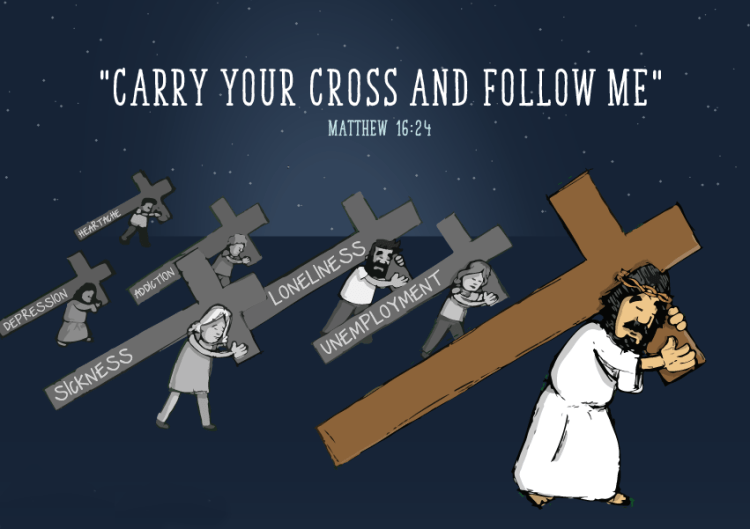
All Christians are part of this ‘royal priesthood’ of all believers and because all are ‘priests’ in that sense, none can exercise their ministry vicariously, through another, they have to carry out their ministry for themselves. Jesus himself tells us as much in the Scriptures. He tells us that to be Christians, his disciples, we must take up our cross and follow him. He doesn’t tell us to let someone else to carry our cross for us and follow him on our behalf, so that we don’t have to. And indeed, Jesus tells us in this morning’s Gospel that, if we are his disciples, we will do what he calls us to do:

“Truly, truly, I say to you, whoever believes in me will also do the works that I do…”

So, all Christians are called to carry out their own ‘priestly’ ministry, and it’s important that we do carry it out because, whatever that ministry is, it is ours and no one else’s. No one else can carry out our ministry for us and if we don’t carry it out, it will never be carried out because each and everyone of us is special and unique: none of us can or will ever be replaced because there never has been and will never be anyone else exactly like us. That’s something Jesus hints at in this morning’s Gospel when he says that there are many rooms in his Father’s house, there are rooms  for many different people, and elsewhere in the Gospels when he says that even the hairs of our heads are numbered.  

So, we all have our own priestly ministry to carry out. We might not know what that ministry is but, so long as we try to follow Jesus’ example each and everyday of our lives, we won’t go far wrong in carrying it out. And the present situation we find ourselves in, doesn’t stop us from carrying out our ministry. God knows the situation, and he knows us, intimately, and so he will present us with ways to be about his business. It might be helping someone with shopping or a phone call to someone who lives alone. And it doesn’t matter if other people could do that, or have done that, they won’t do those things in the way we do them: their voice is not our voice, their words will not be our words. It could just be that our voice and our words will mean much more to the person who hears them than we realise and will help them in ways we’d not even considered. One thing we can be sure of though, is that one day, we will be told what our own unique ministry has been. So, let’s make sure we’ve at least tried to carry it out, and perhaps above all, let’s make sure we’ve not let someone else try to carry it out for us.

Amen.


You will find the Propers for the Fifth Sunday of Easter here.

Fourth Sunday of Easter 3rd May, 2020

Easter cacti

There is a well-known saying, that the first casualty of war is the truth. And so, it was perhaps inevitable that, during the ‘war’ we’re currently fighting against coronavirus, truth would also, if not exactly go out of the window, then at least take a back seat to expediency. And we’re seeing the proof of this in many ways.

We have people, both in our own country and others, looking to make political capital out of the situation, criticising the way governments have responded to the pandemic (although they’re usually very short on details of what they would, or could, have done differently). We have people looking to shift responsibility for the crisis onto others by playing the ‘blame game’, usually accusing China of responsibility for the pandemic, which has resulted in China threatening economic reprisals against those countries who are accusing them. In a number of instances, this has resulted in those countries changing tack and withdrawing their accusations against China as the practical business of economics demands that the pursuit of wealth takes precedence over the search for truth. But it’s not only countries who have gone down that road: there are numerous reports of people trying to make financial gains from the pandemic by offering ‘quack’ remedies and treatments for coronavirus, remedies which, at best, won’t be of any benefit to anyone who tries them and, at worst, could cause a great deal of harm to those who try them. And, inevitably in this day and age, we have no shortage of conspiracy theorists and armchair experts offering their opinions and advice via the internet and social media. And in all of this, truth seems to come secondary to the purposes of those involved.

But, if we think about it from the point of view of our Christian faith, the situation we find ourselves in during the current pandemic, is not too dissimilar to the one we find ourselves in every day of our lives. Every day of our lives we’re in danger from a pandemic disease that surrounds us wherever we go, and we call that disease, ‘sin’. Sin is a disease we’re all susceptible to and, unlike many other diseases, we can succumb to this disease many times because, no matter how many times we’re exposed to it or succumb to it, we have no immunity to it. But, if we’re always susceptible to the disease of sin, the good news is that we do have an antidote, ultimately, a cure, and there are some precautions we can take to minimise our risk of succumbing to sin.

The symptoms of sin are damaged relationships, an alienation from God and our neighbours, and very often a feeling of uneasiness within ourselves, because sin causes us to be at odds with ourselves due to the tension between what we know we should do, and what we actually do. As St Paul puts it in his letter to the Romans,

For I know that nothing good dwells in me, that is, in my flesh. For I have the desire to do what is right, but not the ability to carry it out. For I do not do the good I want, but the evil I do not want is what I keep on doing. Now if I do what I do not want, it is no longer I who do it, but sin that dwells within me. So I find it to be a law that when I want to do right, evil lies close at hand. For I delight in the law of God, in my inner being, but I see in my members another law waging war against the law of my mind and making me captive to the law of sin that dwells in my members. Wretched man that I am! Who will deliver me from this body of death?
Thanks be to God through Jesus Christ our Lord!

As St Paul says, it is our Lord Jesus Christ who is both the antidote and ultimate cure to the disease of sin. Through his Passion and Cross, Jesus has exposed himself to the disease of sin so that an antidote and cure could be found. Because of his Passion and Cross, Jesus himself has become the antidote to the disease of sin and no matter how many times we succumb to it, we know that we only have to turn to him and ask for forgiveness, and we can be put right with God, our neighbours and ourselves again, our damaged relationships can be healed and restored to their former health. Ultimately, Jesus is also the final cure for sin because, through his Resurrection, we can be raised to eternal life too and then, when our frail and weak bodies of flesh are transformed into spiritual bodies, we will no longer be susceptible to the disease of sin and we can live, free of it, for ever.

That full cure of sin though, must wait until our earthly journey is over. But, in the meantime, we not only have the antidote for sin, there are also some precautions we can take to lessen our chances of succumbing to sin. Just as with the precautions we’ve been asked to take to lessen our risk of succumbing to coronavirus, the precautions we need to take against succumbing to sin, are lifestyle changes. And the lifestyle changes we need to make to guard against sin, are set out for us in the Scriptures, especially in the teaching and example of Jesus.

One of the great problems we have as human beings though, is that we don’t really like being told what to do, do we? We’d much rather do what we want to do, wouldn’t we? We’ve seen this in the way some people have responded to the lockdown during the current pandemic. Some people have simply ignored the advice, and even direct instructions, to observe social distancing measures, to stay at home and work at home, and to go out only when essential. We’ve seen it in criticism of the decision to extend the lockdown, even of the need to have a lockdown at all, and the calls to end it or relax it, even if that means simply letting people take their chances with coronavirus. And that’s something we’ve also seen throughout the Church’s history too.

One way we’ve seen that in the Church’s history, is in the way people have distorted the Scriptures, or even written their own ‘scriptures’ in order to make them say what they want them to say, rather than what they actually do say. The Church has always taught that those who call themselves Christians should amend their lives in accordance with the teachings and example of Christ, as revealed in Scripture. But those who’ve changed and distorted the Scriptures, or written their own scripture have, in essence, attempted make the Scriptures, and thereby also make God and Jesus, condone their existing way of life so that they don’t have to change their ways, and so that they can carry on doing what they want to do rather than doing what Jesus taught us to do.

It’s about such things and such people that Jesus warns us in today’s Gospel. He warns us that these things will happen so that we won’t be led astray when they do and when we come across them. Jesus called the people who do things like this ‘thieves and brigands’ or ‘bandits’. The word we translate as ‘brigand’ or ‘bandit’ has a political connotation. It’s the same one Jesus used in Gethsemane when he was arrested. Then he asked if they had come to arrest him as a ‘bandit’. Given that Jesus was executed as the ‘King of the Jews’, it seems that the people Jesus is referring to in today’s Gospel are not simply thieves, but false Messiahs. They come to steal people away from his own flock, to kill by them by leading them away from the path of eternal life, and to destroy because they sow division and dissension rather than working to build up God’s people. And Jesus not only warns us about such things and such people, he says that those who truly are of his flock will not listen to them.

We profess a belief that Jesus is the way, the truth, and the life. If we truly do believe that, and we want to be his people, members of his flock, we won’t listen to those who change, distort or add to his words and example. And why would we? Jesus is the one who suffered and died to become for us the antidote to sin. He is the one who rose from the dead to become the cure for sin and offer us eternal life. He is the who gave us the way, the truth and the life to follow if we want to protect ourselves from sin. He is the one who came that we might have life in all its fulness and abundance, not only in this life, but in the eternal life to come. So, no matter how easy, or attractive, the ways of others may seem to be, let’s not be led astray from Jesus, but listen to him, and follow him, and no other.  

Amen.  


You will find the Propers for the Fourth Sunday of Easter here.