When we were last in our churches, on 3rd Sunday of Lent this year, I don’t suppose any of us thought that it would be another 20 weeks before we’d be able to come together in church again, to worship the Lord. But, as we know, that is what has happened. But even today, as we’re finally able to return to church, we’re still not able to do what we used to do and would like to do in church, and the one-way system, the no-entry signs, the changes we’ve had to make to our services and so on, are very visible signs that things are far from returning to normal just yet. And more than that, in our own area of the country, we’re returning to church under a shadow, the looming threat that a second lockdown will be imposed on us, in which case, our churches will have to be closed again.
Now, if we weren’t happy about our churches closing in March, I’m sure we’d be equally, if not more unhappy, if they had to close again but I think what would make a second closure of our churches even worse than the first, is the reason that it would have to happen.
The first lockdown and closure of our churches was the result of what we might call the random, unconscious action of a virus. But, a second lockdown and closure of our churches would be largely the result of the deliberate and selfish actions of human beings. Because, whilst most people have tried their best to adhere to the advice we’ve been given about social distancing, limiting the number of people we meet, and more recently, wearing masks and so on, a few people have simply ignored that advice and, with no regard to the welfare of others, and not much for their own either if it comes to that, have simply carried on as though coronavirus/Covid-19 doesn’t exist. What these people have said, and some of them have actually said these things on social media and in conversations with their family and friends, I know because I’ve heard and read them, is that they don’t care what anyone says, no one is going to stop them from doing what they want to do. But of course, as what they want to do, and actually have done, has been done without regard to the consequences, what these people have shown is that they don’t really care about anyone or anything apart from their own enjoyment; they’ve certainly shown that they don’t care about their neighbours.
And what a contrast that is with the attitudes shown in this morning’s Gospel. Today’s Gospel reading starts with Jesus hearing about the death of John the Baptist. Now, we know that Jesus and John were related, we think they were possibly cousins, and we know how it feels when one of our relations dies, so we have a good idea of how Jesus felt when he heard the news of John’s death. No doubt, what made it even worse was the way John had died, beheaded for speaking out against the king’s sinfulness: to all intents and purposes, murdered for doing God’s will. And that surely must have given Jesus a sharp reminder of what eventually lay in store for him. And so it’s no surprise that Jesus wanted to spend some time alone to grieve and to think and to pray. But that’s not what the crowds wanted him to do, so they followed him, in fact they actually headed him off because the Gospel tells us that they were waiting for Jesus when he got to where he was going. In the circumstances, it would have been perfectly understandable if Jesus had told them to go away and come back later, or tomorrow, but that’s not what he did. Despite his own situation, Jesus’ compassion for these people took precedence over his own feelings and over what he wanted to do, and so, instead of having the time alone he wanted, he went back to work, healing the sick, caring for others rather than putting his own wishes first.
What happens next is what we usually call the miracle of the Feeding of the Five Thousand but, if we read what the Gospel actually says, we realise that there were more than five thousand people fed. The Gospel says that there were about five thousand men present, but that figure doesn’t include the women and children who were there too. So there were a lot more than five thousand people fed that day.
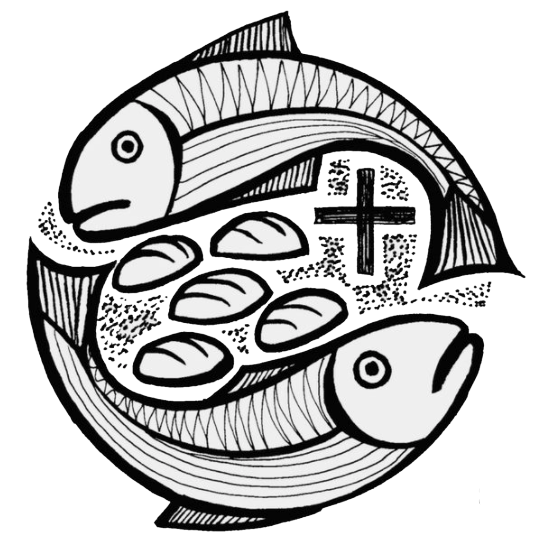
And all these people were fed because Jesus encouraged his disciples to show that same unselfish attitude in caring for these crowds that he’d shown in caring for them. At first, no doubt thinking in very practical terms, the disciples wanted to send the crowds away to find something to eat, but Jesus said ‘No, you give them something to eat.’ I’m sure the disciples must have looked at each other and wondered just what Jesus expected them to do with five loaves and two fish.
The Gospel doesn’t tell us how many disciples were there that day, we know Jesus had a lot more than the twelve we often read about, but even if it was just the twelve, five loaves and two fish wouldn’t have been a great feast even for them, so they probably wondered how far Jesus expected that to go amongst such a big crowd of people. But they did what Jesus asked them to do and handed them over to him. And if we think about that, what they did was gave to Jesus everything they had. They didn’t say that they had to think about themselves or put themselves first and keep these few loaves and fish for themselves. They may well have thought ‘Well, now we’re going to go hungry too!’, but they handed them over, for sake of others, anyway. It wasn’t much, but in Jesus hands, their unselfishness and sacrifice were enough to see everyone fed and satisfied.
So in this Gospel story, we find a great contrast between the unselfishness and care for others of a few, Jesus and his disciples, working for the good of a great many others, and the situation we find ourselves in today in our own communities where the selfishness of a few is working to the detriment of a great many others.
As Christians, we’ve chosen, or have been chosen, to be amongst those who act unselfishly, and when necessary, sacrificially, for the good of others and so it’s up to us to set an example in this present situation. I’m not saying that our example will inspire others to follow suit because I doubt that people who won’t listen to either national or local government, to health professionals or to medical scientists will listen to the Church or individual Christians, but nevertheless, we should set an example because that is part of our calling as disciples of Christ. And that means that we shouldn’t be doing anything that might prolong or worsen the present situation. It means we should do everything we can to protect others, even if that means we still have to wait a while longer yet, to do some of the things we like and want to do. And it means we should do everything we can to look after and protect one another when we come into church too. That’s why we’ve had to make all these changes, so that we can look after and protect each other when we come to church.
I’m sure nobody likes the changes we’ve had to make and it’s not what we wanted to do, but it is what we’ve had to do so that we can come together again in church to worship the Lord. The alternative is that our churches would have to remain closed.
We must all hope that the selfishness of a few people in our communities doesn’t lead to a worsening of the coronavirus outbreak in our area because not only will that lead to our churches having to be closed again, but it will lead to further suffering in our communities. As Christians, those are things we can’t want to see and should be doing all we can to avoid. We might not be able to exert much influence over those who don’t care about these things, but if we do all we can to avoid them, then when this is all over, as it one day will be, at least we’ll know and be we’ll be able to say that we did our best to protect other people and care for them and that, in very difficult circumstances, we did our best to be good disciples of Christ and to follow his example by loving our neighbours as much as we love ourselves.
Amen.
You will find the Propers for the 18th Sunday of Ordinary Time (Trinity 8) here.