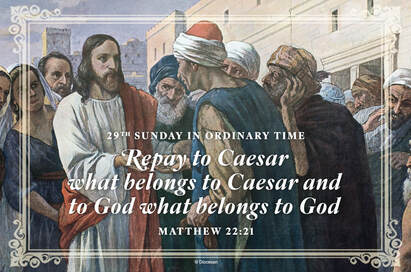
In this morning’s Gospel Jesus is asked a question that has a great deal of relevance for us as we go about the business of living out our faith today. Jesus was asked about the legality of paying taxes to Caesar. Of course, that’s something that doesn’t directly apply to us today because the Roman Empire and the Caesars came to an end a long time ago. But, nevertheless, the underlying question contained in that specific question and specific set of circumstances is still relevant to us. That is, what do we do when something is legal, but we disagree with it on account of our faith? Do we do that thing because it is legal, or do we take a stand against it because it goes against what we believe to be right?
This really was the dilemma that Jesus’ interrogators tried to put him in. At that time, the part of the world that Jesus lived in was part of the Roman Empire and so paying taxes to Caesar was the law. It was a very unpopular law, but then isn’t that always the case when it comes to paying taxes! But for the Jews it was especially unpopular. Jewish nationalists hated it because it represented their subjugation under Roman rule. And to devout Jews it was offensive because the Roman coinage it had to be paid in was both idolatrous and blasphemous. The tax was a kind of poll tax, one denarius, per person. But the denarius bore the image of the emperor Tiberius, an idolatrous image. And the inscription on the denarius was even worse because it read ‘Tiberius Casaer, august son of the divine Augustus, high priest’ although in Latin, of course. And to ascribe divinity to a human being, even the emperor of the mighty Roman empire, was blasphemy to the Jews. So it seemed that whichever way Jesus answered he’d be in trouble. If he said it was unlawful to pay the tax, he’d be in trouble with the Romans, and the Herodians, the supporters of king Herod too because they owed their position to Rome. If, on the other hand, he said it was lawful to pay the tax, he’d be in trouble with his own people.
Jesus got out of this dilemma by turning his answer into something of a spiritual challenge. As the Roman coinage belongs to Casaer anyway, let him have it, but give to God the things that belong to God. And, as any Jew would know, and the Great Commandment reminds us, what belongs to God is our love, our heart and soul and mind. To put it very briefly, Jesus’ answer was, you can give Casaer his money, but give yourselves to God. So how do we apply that in our own lives?
I think something that can help us to do that, is a promise that I and Fr Alex, and all Anglican clergy made at the time of our ordination. It’s called The Oath of Canonical Obedience which says,
I, (name), do swear by almighty God that I will pay true and canonical obedience to the Lord Bishop of, (diocese), and his successors in all things lawful and honest: so help me God.
A very important part of that oath is that we only swear obedience in all things lawful and honest. We don’t swear obedience to, nor are we obliged to show obedience to anything unlawful, immoral, dishonest or corrupt, nor anything that falls outside the Church’s canon law. And this is something that we can apply whenever we’re faced with the question of obedience to something that we don’t agree with or we think is wrong on account of our faith.
Despite the difficulties we face as Christians in this country, and I’m not going to go into that because these things are well publicised, we don’t face official sanction for practicing our faith. It’s not illegal to be a Christian. We’re free to belong to the Church and come to church to worship when we want to. But in many places, for much of the Church’s history, that’s not been the case, and in some places it’s still not the case today. And in those cases and those places, the only way Christians can give to God what belongs to God is by doing what the secular authority says is illegal, they have to break the law. And many have and do.
We also know, very sadly, that some people in the Church have acted illegally and unlawfully for their own ends. People who abused their position and authority and harmed others in doing so. These are examples of things that scripture tells us are abhorrent to God so they’re not only illegal and unlawful from a secular point of view but they’re a failure to give to God what belongs to God, and a failure to love others as Christ commanded us to. Again, I don’t want to go into these things because many of these are also well publicised. But for us, the problem is far more likely to be one of honesty, of ignoring a law because it suits us to ignore it, or of applying the law in a dishonest or immoral way. And this also happens.
One of the things I’ve often spoken about and against is the way in which people can be discriminated against in local congregations. The way in which people in a congregation can get a bit too big for their boots and start to ‘Lord it’ over others in direct contradiction of Christ’s teaching.So, for example, one of the church wardens in this benefice is actually a vicar’s warden, I appointed them to the post. That being so, I have the right to appoint someone else to that post. But would it be right for me to do that simply because I’d had a disagreement with the present warden? And I have known people removed from posts for just that reason. On the other hand I’ve also come across a situation in which a parish office holder said, at the end of an interregnum, that if they (and that was a collective they) don’t get on with the new vicar they’ll make his life so unbearable that he’ll leave. While strictly speaking this kind of thing isn’t illegal, no one is going to go to prison for it, it may well be unlawful in that it goes against accepted, and acceptable standards of behaviour. It certainly goes against the teaching of Christ and so it’s an example of people not giving to God the things of God. It’s an example of people not giving themselves to God, heart, soul and mind but of acting as those who belong to Caesar, to the world, act rather than how those who belong to God act.
But perhaps where we see people in the church applying the law in a dishonest or immoral way most of all is where that thing of Caesar’s we read about today is involved, where money is involved. In fact, the example I mentioned a few moments ago about someone being removed from their post was brought about by a disagreement about whether the church should spend a rather large amount of money or not. But the example that springs most readily to my mind concerns a funeral I was asked to do at a church which was in interregnum at the time. The funeral took place in the church and was followed by a burial in the churchyard and as I was chatting to the funeral director after the burial, I was absolutely astonished when he told me the fee that church had charged for the funeral. I won’t mention the figures, but it was almost 60% more than the same service would have cost at the church I was serving in at the time.
Every year the Church Commissioners produce a list of fees that we are obliged to charge for the various services we carry out. In addition to the statutory fees that we have to charge, there are also fees that the PCC can set, fees for heating, a verger, a choir if we have one, bell ringers if we have them, and so on. So fees can vary from church to church. But for the life of me, I cannot understand how one church can charge 60% more than another for the same service. And to me, this is an example of a law, if not being applied in a dishonest way, then certainly in a rather immoral way by exploiting a pastoral situation, not to mention a bereaved family, in order to make money. A few extra denarii to give to Caesar PCC bank account. The family concerned may well have been able to afford that funeral without difficulty, I don’t know. But that’s hardly the point. We’re called to support widows and orphans and the fatherless, to carry one another’s burdens, to mourn with those who mourn. We’re not called to exploit the law so that we can boost the parish’s bank balance at their expense. That’s Caesar’s way, the world’s way, it’s not God’s way and so it shouldn’t be our way.
So, is it lawful to pay tax to Caesar, or not? In other words, do we obey the law even though we disagree with it? Although Jesus’ answer to that question shifts the focus from the temporal towards the spiritual, he answers it well enough. The answer is ‘Yes’. Acting lawfully only becomes a problem for us if the law prevents us from fulfilling our duty to give to God the things that belong to God. If the law prevents us from following our faith as we know we should. The bigger problem for us is in how we apply the law in our lives as Christians. We’re not called to ignore the law because it suits us to ignore it and neither are we called to apply the law in a dishonest or immoral way to suit our own ends. We’re called to act lawfully at all times, but for us, to act lawfully is to act according to the teaching and example of Christ. To love as he did and to give ourselves heart, soul and mind to God, as he did. We can give to Caesar, what belongs to Caesar, to the world what belongs to the world, but we always have to remember to give to God what belongs to God. And we belong to God.
Amen.
Propers for the 29th Sunday in Ordinary Time, 18th October 2026
Entrance Antiphon
To you I call; for you will surely heed me, O God;
turn your ear to me; hear my words.
Guard me as the apple of your eye;
in the shadow of your wings protect me.
The Collect
Almighty ever-living God,
grant that we may always conform our will to yours
and serve your majesty in sincerity of heart.
Through our Lord Jesus Christ, your Son,
who lives and reigns with you in the unity of the Holy Spirit,
God, for ever and ever.
Amen.
The Readings
Isaiah 45:1, 4-6
Psalm 96:1, 3-5, 7-10
Thessalonians 1:1-5
Matthew 22:15-21
Prayer after Communion
Grant, O Lord, we pray,
that, benefiting from participation in heavenly things,
we may be helped by what you give in this present age
and prepared for the gifts that are eternal.
Through Christ our Lord.
Amen.