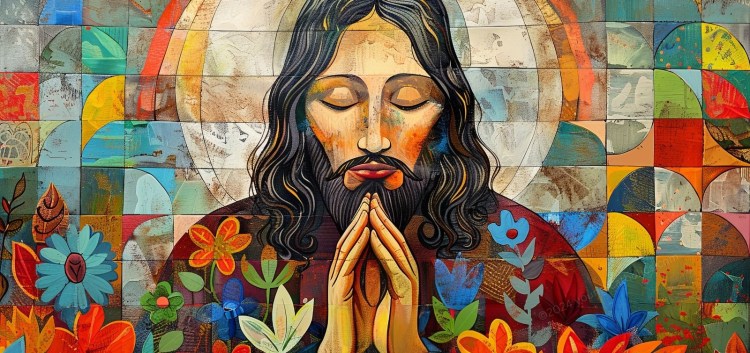
In this morning’s Gospel, Jesus talks quite a lot about glory. He speaks about the glory he’s given to the Father and asks that the Father will now glorify him. And towards the end of the reading Jesus states that he is glorified in his disciples. So what can we make of all this? What does Jesus mean when he speaks of glory and glorification?
First of all, what is glory? Although we can talk about glory in a few different ways such as fame and honour, great beauty, great rejoicing even, and praise and worship, what we can’t do is talk about glory without putting it into some kind of context, without having a reason for giving glory. So, for example, we can glorify people for their successes and achievements; we can talk about the glory of a building because of its beauty or magnificence; we can glory in something, which is what we do when we celebrate and rejoice in a situation; and we can give glory to God because we believe he’s worthy of our praise and worship. But because we have to have a reason for giving or receiving glory, then it follows that to glorify someone or something involves saying something, and something good, positive and praiseworthy about who or what we’re glorifying. And this is the context in which we have to read this morning’s Gospel.
Earlier in John’s Gospel, in answer to the disciple Philip’s request to see the Father, Jesus had said,
“Have I been with you so long, and you still do not know me, Philip? Whoever has seen me has seen the Father. How can you say, ‘Show us the Father’? Do you not believe that I am in the Father and the Father is in me? The words that I say to you I do not speak on my own authority, but the Father who dwells in me does his works. Believe me that I am in the Father and the Father is in me, or else believe on account of the works themselves.”
And in this morning’s Gospel Jesus says to the Father,
“I glorified you on earth, having accomplished the work that you gave me to do.”
So the Father is glorified through the work that Jesus has done, but the work that Jesus has done is not his own work but the Father’s, and the work is the Father’s to the extent that to have seen and heard Jesus work is to have seen and heard the Father himself work.
So then Jesus has glorified the Father by revealing him to the world. In other words, Jesus has glorified the Father by saying something about the Father and showing something of the Father to the world.
But then Jesus goes on to pray,
“And now, Father, glorify me in your own presence with the glory that I had with you before the world existed.”
This is both a prayer and a statement about Jesus’ own glory. It’s a statement about Jesus’ glory because it reveals that Jesus, the Son, existed with the Father before the creation of the world. He truly is, as John had stated at the beginning of his Gospel, the Word who was in the beginning with God and was God, now made flesh for all to see. And it’s a prayer that works on two levels. On one level, it’s a prayer that Jesus will be returned to his original state of glory, but on another level, it’s a prayer that the Father will glorify Jesus by revealing to the world who he really was and is. Because this is exactly what will happen through Jesus’ Resurrection and Ascension. And this has to happen because the disciples must believe in Jesus and understand who he is if they are going to glorify him through their words and actions; if they are going to go out into the world and tell people about him when he leaves the world. Which is what Jesus says they will do when he says,
“I am glorified in them.”
The fact that we’re here in church this morning tells us that this is what those disciples did; they went out into the world and glorified Jesus by telling people about him and doing the works that he himself had done. But of course, today, that charge, falls to us. Today, we are the ones who have to glorify Jesus through our words and actions. So how do we do that.
Well one way is to be here in church to worship the Lord. When we do that, we glorify Jesus because we’re saying to the world who we believe Jesus was and is. When we come to church, we’re glorifying the Father because we’re saying to the world that we believe he’s worthy of our praise and worship, and the content of our prayers, express why we think that, most wonderfully of course because he sent his Son into the world to redeem us from our sins and lead us to everlasting life. That we pray at all glorifies both the Father and the Son because it shows that we believe they hear and answer our prayers. So we do glorify God in many ways through what we do and say in church. But there are other things that go on in churches which call into question just who exactly it is whose glory we are seeking.
We know that, at times, things happen in churches that shouldn’t happen. We have disagreements that lead to arguments and fall outs, which shouldn’t happen in church because everything we do in church should be to the glory of God, but they do happen. But if we really look at these things, aren’t they invariably rooted in pride? Someone wants something, someone else doesn’t want it, someone can’t have their own way, and so there’s a problem and trouble. But whose glory are these things all about? Do things like this say anything at all about Jesus or about the Father, or about the Holy Spirit, the Trinity, the God who is three persons in one God head who exist in perfect loving relationship? Or do they rather reveal and say something about our own failure to live in loving relationship with others? At a simple level, it might be the old chestnut, “Nobody does more for that church than me!” but isn’t that rooted in the pride of someone who feels that they should be getting a bit of praise, a bit of glory, for something they do and aren’t getting the glory they think is due to them? At a more serious level, it might be a problem caused when someone in the church gets a bit too big for their boots and starts to throw their weight around because they think that they and what they want are far more important than someone else and what they want. Sometimes, it leads to people being bullied and leaving a parish church, or even the Church itself. We all know these things happen, but do these things glorify God? How do they glorify Jesus who laid aside his heavenly glory to come to earth to suffer and die for us? Do these things in any way reveal anything about God, or do they say far more about us and our pride and efforts at self-glorification, our lack of love and our and Godlessness? We say that what we do in church is to the glory of God. But if we’re going to say that, then we’d better make very sure that what we’re doing does say something true and glorious about God. And if it doesn’t, we need to ask ourselves whose glory we are seeking, his or our own. And if it’s not his, then we really shouldn’t be doing it at all.
And that goes for what we do outside church too. As disciples of Jesus, we shouldn’t just be glorifying God in church for an hour or so, once a week, on Sunday morning, our whole lives should be lived to the glory of God. If out discipleship goes no further than the doors of the church, what does that say about our glorification of God? That he’s only worthy of being glorified for an hour, once a week, and no more? God is worthy of more than that surely. All we do and say, each and every day, wherever we go, should say something to others about who we are and about what we believe. They should reveal to the world something of the truth about God.
This is really what the Church is driving at when it talks about developing missional leaders in our churches. Of course we want to grow our congregations, we want people giving glory to God in our churches, but also people who will take that out into the world and give glory to God outside their churches too. People who can, and will, go out and glorify God in the world through their words and actions so that other people will come to know and believe in our Lord Jesus Christ and, in turn, also give glory to God in church and in their own lives. And perhaps that is the very best way of all that we can give glory to God, to do what Jesus did and charged those first disciples to do, to make God known, really known, to people so that they will believe and set out on the road to eternal life themselves.
Amen.
Propers for the 7th Sunday of Easter, 17th May 2026
Entrance Antiphon
O Lord, hear my voice, for I have called to you;
of you my heart has spoken: Seek his face;
hide not your face from me, alleluia.
The Collect
Graciously hear our supplications, O Lord,
so that we, who believe that the Savior of the human race is with you in your glory,
may experience, as he promised,
until the end of the world,
his abiding presence among us.
Who lives and reigns with you in the unity of the Holy Spirit,
God, for ever and ever.
Amen.
The Readings
Acts 1:12-14
Psalm 27:1, 4, 7-8
1 Peter 4:13-16
John 17:1-11
Prayer after Communion
Hear us, O God our Saviour,
and grant us confidence,
that through these sacred mysteries,
there will be accomplished in the body of the whole Church
what has already come to pass in Christ her Head.
Who lives and reigns for ever and ever.
Amen.

