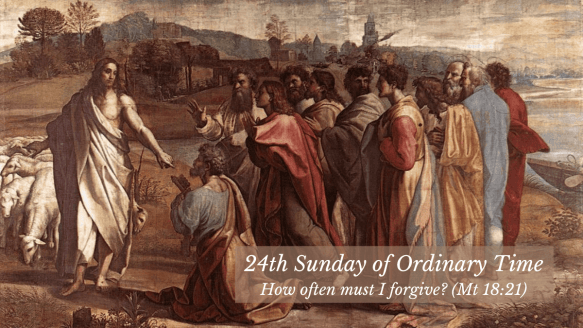
Our readings this morning are all about sin and forgiveness. And it shouldn’t be at all surprising that sin and forgiveness should be spoken of together because these two things are inextricably linked. That’s quite obvious, I think, because without sin, if people didn’t act in ways they shouldn’t, there wouldn’t be any need for forgiveness. But what is sin? What is it that we’re so in need of forgiveness for ourselves and that we ourselves are called to forgive others for?
In one sense I think that’s quite easy to explain. As I said in my sermon last Sunday, sins are a failure to love God and love our neighbour as we should and as we’re called to do. But we can go a little deeper than that and differentiate between sin and sins. Sin is a state of being that predisposes us to fail when it comes to love. Sin, as a state of being, predisposes us to be self-centred and to love ourselves more than we love God and our neighbour. This is why we sin and in need of forgiveness. Sins, plural, are the actual things we do that show our self-centredness and lack of love.
But I think this is where we often run into problems because what actually constitutes an act of lovelessness, an individual example of a sin? And that’s not such a straightforward question to answer as it might seem because what we do in love may very well not seems like that to the one on the receiving end of it, at least at that time. For example, when my children were still children, I called into a shop with them to get them some sweets. As we came out of the shop, my daughter ran to cross the road back to my car, just as another car was coming along. So I grabbed her and yanked her back out the road, to stop her from running in front of the car. But in doing that, I dragged her back by the hair, just because that’s what I caught hold of as I made a grab for her. Of course, that hurt her and she started crying. When we got back home, her mum could see she’d been crying and asked her why, and my daughter said because I’d dragged her across the pavement by the hair! And of course, I got it in the neck for that. But what should I have done? Even though what I did caused pain and upset, it was no sin, it was an act of love because it saved my daughter from running into the road in front of a car and potentially being run over and seriously hurt or even killed. In that instance, not causing the pain and upset would have been the sin.
And I’m sure we can all think of examples like that when we’ve done something that might have seemed to involve a lack of love, and therefore to be sinful, that have actually been done in love because they’ve been done to avoid a greater harm to the other person involved. We do it all the time with our children as they’re growing up.
That’s one problem we can have with deciding what’s an act of sin and what isn’t, and that obviously causes problems for us when it comes to deciding who needs forgiveness and who needs to ask for forgiveness. And I think this is becoming an increasingly difficult problem for us in our modern society in which so many people seem to think that anybody who does, says or even thinks something they don’t agree with has hurt or offended them, or to put it in biblical terms, has sinned against them.
But while this might be a growing problem, it’s certainly not a new problem. In fact, it’s one we’re all too familiar with in the Church because how many ‘holier than thou’ people have taken it upon themselves over the years to tell others what constitutes a sin and what doesn’t? And how many of those who’ve done this have based their list of sins on nothing more than their own, personal likes and dislikes? The problem with people who do this is that they try to turn the Christian faith into a kind of moral code of conduct, but they base it on their own morals which, in many, many cases, they themselves can’t live up to. Such as the case of the person I knew in one parish who rained hell fire on the clergy for agreeing to hold a weekly lottery to raise money. Such things were sinful, they said and we ought to be ashamed of ourselves for encouraging people to gamble. Strangely enough, the same person had absolutely nothing to say when, a few weeks later, they won said lottery! That’s quite an amusing example, I think, but people who do this kind of thing can cause all sorts of problems, not to mention hurt and upset, and be the cause of people leaving the Church. And yet, in my experience, they never see themselves as the sinner in any case. They never see themselves as the one who needs to ask for forgiveness from their neighbour but as the one who is righteous enough in God’s eyes to tell others what they ought to be asking for forgiveness for.
So deciding what constitutes an act of sin isn’t always so easy. Last Sunday we heard St Paul saying that love causes no harm to a neighbour, and yet we can act in love and still hurt people. We can hurt them physically in trying to save them from danger.
We can act in love and hurt people emotionally, we can upset them, because they really don’t want to hear what we’re saying to them, no matter how true it might be, no matter if we’re only trying to save them from deeper hurt and upset in the future. And we always have the problem of people thinking that anything they don’t agree with is a sin, regardless of whether it really is or not. But I think we can cut through some of this, at least, and get a better understanding of what constitutes a sin if we look at the accurate meaning of the Greek word in the New Testament that we translate as ‘sin’.
The word used almost invariably for ‘sin’ in the New Testament is hamartano, or a derivative of it. And what hamartano actually means is ‘to miss’; it means to miss the mark and, by extension, to lose out on sharing in the prize because the mark’s been missed. And if we think about sin in those terms, we can say that we sin when we miss what we’re aiming for and because we’ve missed what we’re aiming for, we’re not going to share the prize for hitting the target. And I think we can turn to St Paul again to shed a bit more light on this because, as he writes in his Letter to the Romans,
‘…all have sinned (hamartano) and fallen short of the glory of God.’
So what we’re aiming at, what we need to hit if we’re going to share in the prize, is the glory of God. And, where we see the glory of God is in the teaching and example of Christ. The prize, of course, is eternal life and so if we want to share in that prize, we have to aim at being like Jesus Christ. But we often fail to be like him because we live in a state of sin and the sins we commit are the specific instances of when we miss what we’re aiming at, when we’re not like Jesus Christ.
But we have to be clear about just what that means. Jesus was sinless, anamartetos. He lived, as the old hymn says, a perfect life of love. And yet, by the world’s standards, Jesus was not always a particularly loving person. Think about it. When he cast out demons, the people he was helping were thrown into convulsions. What he said and did frightened people. He must have hurt people by what he said because he spoke the truth and the truth does hurt those who are wrong. He upset people by what he said and did. What he said and did was seen as scandalous. All these things were what led people to conspire against him and put him to death. And yet he loved perfectly and was sinless.
So, if we hurt someone in order to help them in the long run, is that a sin? No. But if we allow someone to come to harm or risk that to avoid hurting them in the short term, is that a sin? Yes, because ultimately, that shows a lack of love. If we say something that upsets someone because they don’t like it or don’t want to hear it, is that a sin? As long as we are speaking the truth, surely not. But if we don’t speak the truth simply to avoid upsetting someone when they’re going wrong, being led astray or leading others astray, is that a sin? Yes, because again it shows a lack of love for those concerned. If we do something that someone else doesn’t like it because it offends their moral code, is that a sin? If it is simply a matter of their morals and there’s nothing objectively wrong what we’re doing, no. In fact in those cases, we’re probably the ones who are being sinned against because didn’t Jesus reserve his fiercest criticism for those who set themselves up on pedestals, the self-appointed holier than thou people who laid the law down to others while ignoring it themselves and put their own ways above God’s ways?
The essence of this morning’s Gospel is that Jesus tells us to forgive as often as we need to, no matter how often that is. And we have to do that if we want to be forgiven because we’re all sinners who’ve fallen short of the glory of God many, many times ourselves. But we do need to understand when we need to forgive and when we need to be forgiven ourselves, and so we need to understand when we’ve committed sins and when we’ve been sinned against and we can’t judge that simply by what others think about what we’ve said or done.
Sins are not what happen when we hurt or upset someone because we’ve acted in love. Sins are what happen when, through a lack of love, we miss the mark we’re aiming for, and that mark is the glory of God as seen in Jesus Christ. So, in every situation and every circumstance, let’s try to keep that mark in sight and aim for it to give ourselves the best chance of enjoying a share in the prize on offer, the prize of eternal life.
Amen.
Propers for the 24th Sunday in Ordinary Time, 13th September 2026
Entrance Antiphon
Give peace, O Lord, to those who wait for you,
that your prophets be found true.
Hear the prayers of your servant,
and of your people Israel.
The Collect
Look upon us, O God,
Creator and ruler of all things,
and, that we may feel the working of your mercy,
grant that we may serve you with all our heart.
Through our Lord Jesus Christ, your Son,
who lives and reigns with you in the unity of the Holy Spirit,
God, for ever and ever.
Amen.
The Readings
Sirach 27:30-28:7
Psalm 103:1-4, 9-12
Romans 14:7-9
Matthew 18:21-35
Prayer after Communion
May the working of this heavenly gift, O Lord, we pray,
take possession of our minds and bodies,
so that its effects, and not our own desires,
may always prevail in us.
Through Christ our Lord.
Amen.

