God himself is my help. The Lord upholds my life. I will offer you a willing sacrifice; I will praise you name, O Lord, for its goodness.
The Collect
Lord of all power and might, the author and giver of all good things: graft in our hearts the love of your name, increase in us true religion, nourish us with all goodness, and of your great mercy keep us in the same; through Jesus Christ your Son our Lord, who is alive and reigns with you, in the unity of the Holy Spirit, one God, now and for ever.
I’m sure that, at one time or another, most of us will have heard someone say that they wouldn’t mind being a teacher, and the reason they’ve given for saying that is that teachers get so many holidays. Perhaps we’ve even said it ourselves! But do teachers really get so many holidays? I’m sure that anyone who is or has been a teacher will know that they don’t. They know that just because the children are on holiday and the schools are closed, that doesn’t mean that teachers are on holiday, it doesn’t mean that teachers aren’t still working.
Another profession, if we can call it that, that’s similarly thought of in terms of holidays is the ordained ministry. Wherever I’ve been, both before and since my own ordination, whenever a priest has mentioned taking a holiday, someone has had a sarcastic or even derogatory comment to make about the priest taking time off. For example, when I took my post Easter break this year, on the Sunday I went to Mass at a church in Accrington. When the churchwarden there, whom I’ve known for many years, saw me he was obviously surprised but said it was good to see me. But, when I explained that I was on my post-Easter break, he replied, immediately,
“Another holiday! You lot get more time off than teachers!”
That Sunday 9th May, was in fact, the first Sunday I’d had off for 6 months, since 6th December, and between then and my post Easter break, I’d taken the grand total of 3 days annual leave.
I’m sure that this kind of comment and attitude is caused because a lot of what teachers, and especially the clergy, actually do is done behind the scenes. People know teachers are working when the schools are open and, in the same way, they know the clergy are working when they’re in church taking a service. But when they’re not doing something that’s in the public domain, so to speak, people don’t know what they’re doing and so, some people at least, seem think they’re not doing anything at all.
Of course, teaching and the ordained ministry aren’t jobs as such. Many teachers I know see teaching as a vocation and the ordained ministry most certainly is a vocation. That means that these are things that people feel called to do and, although some misguided clergy do see the ordained ministry as a job (and I did come across priest who said that he only ‘did’ 39 hours a week, for example), most do see being a member of the clergy as the vocation it undoubtedly is. Nevertheless, even if we are doing something that we feel called to do, we still need to take the time to stop doing and to simply be.
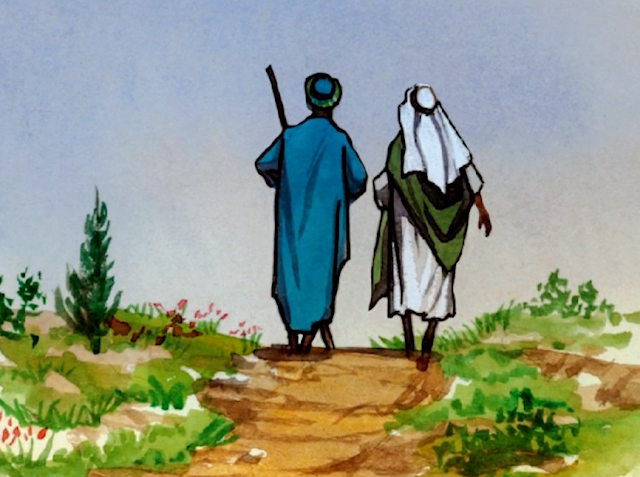
If some people think that doesn’t apply to the clergy, I would direct their attention to the Gospel we read this morning at St Mark’s and last Sunday at St Gabriel’s. We read there that Jesus sent the twelve disciples out, in pairs, to proclaim the Gospel and heal the sick. Later, after St Mark tells the story of the beheading of John the Baptist, we’re told that the disciples returned to Jesus and told him what they’d done and taught. But what was Jesus doing whilst the disciples were out and about preaching and healing the sick? He clearly wasn’t with them. The answer is, we don’t know. But does that mean he wasn’t doing anything? Perhaps he was doing other things that the disciples knew nothing about. Or perhaps he took the time to stop doing and to simply be. What we do know is that when the disciples returned to Jesus, he told them to,
“Come away by yourselves to a desolate place and rest a while.”
And he said that because,
‘… many were coming and going, and they had no leisure even to eat.’
And so,
‘… they went away in the boat to a desolate place by themselves.’
We notice that Jesus told the disciples to ‘come away’ not ‘go away’. So it was an invitation to go with him. So what was Jesus doing while the disciples were out working? Perhaps he was taking some time to be alone in a desolate place where no one could find him? No doubt he spent time in prayer and some time to stop doing and to simply be. But perhaps he did that too by taking some leisure time? Perhaps Jesus was taking a holiday?
We read in the Gospels that there were a number of occasions when Jesus went off alone. We’re told that he did that at times to pray. But at other times, such as the one I’ve just spoken about, we don’t know what Jesus was doing while he was away from the disciples and the crowds, when he was away from the public eye. We know he must have met up with people in relation to his ministry, to arrange for the use of the room where he ate the Last Supper, for example. We know he spent time with friends, such as Martha, Mary and Lazarus. In other words, just because Jesus wasn’t doing something in public, that doesn’t mean he wasn’t still working. But he wasn’t always working. Jesus needed time to stop doing and to simply be, and so do we. Jesus needed a break, leisure time, a holiday, from time to time, and so do we. And by ‘we’ I mean all of us not just the clergy.
So why I have I chosen this as the theme for my sermon? No doubt some of you will have seen the recent news about the Church’s initiative to create 10,000 new churches, or worshipping communities, over the next 10 years. There does seem to be some confusion about what is actually being proposed in these plans. The Archbishop of York has spoken about creating 10,000 new worshipping communities by 2030 and, at the same time, an unofficial initiative called ‘Myriad’ is speaking about creating 10,000 lay led churches over the same time period. These are apparently, two different ideas about how to reverse the decline in Church attendance over the next decade. But whichever way you look at it, these plans must involve a lot more work for both the clergy, at a time when the Church is cutting the number of clergy, and for the laity, at a time when, and with no disrespect intended to anyone, the vast majority of the Church’s lay membership is made up of people who are of an age when they ought to be enjoying more leisure time rather than having more work and responsibility loaded on to them.
Of course, it’s envisaged that much of this will be led by the younger members of the laity. But the Church readily admits that Church attendance is falling faster in younger age groups than in any other. I think the first question must be then, where are churches with very few young people in their congregations going to find these leaders? Also, will these plans actually mean that parishes, already bereft of young people, will lose even more young people to these new communities and churches? It’s all very well for the Church to say that these new communities and churches will come from and run alongside the existing parishes, but people only have a finite amount of time to offer, and they can’t be in two places at the same time, so when are these new communities and churches going to meet for worship? And, if they’re intended to be lay led but under the oversight of the clergy, and as they are intended to be sacramental communities and churches they must be under the oversight of the clergy, how much more load will that place on the shoulders of the clergy whom, by the Church’s own admission, already have enough, and more than enough, to do?
In recent times the Church has become very concerned with clergy wellbeing. In line with that has been, if not an actual insistence, then at least a very strong recommendation that the clergy do take their full entitlement of annual leave. I do wonder though, just how the Church expects the clergy to do that whilst at the same time they’re cutting the number of clergy and asking more and more of those who are left. It seems that one way they’re looking to do this is to pass some of the load, at least, on to the laity. I wonder what they will do if and when the laity reminds the Church that they are, on the whole, volunteers who are either working and have more than enough to do already, or who have already worked a lifetime and are now retired, and they say enough is enough?
It must be said that these plans have caused a storm of criticism from both the clergy and the laity. Questions are also starting to be raised about the Church’s penny-pinching ways and about how it uses its vast fortune. Because, yet again, as is so often the case when the Church comes up with a new initiative these days, it all seems to be about money.
In the Vision and Strategy paper which is being presented to the General Synod when these proposals are debated, it’s stated that none of this will happen unless the Church finds a way of becoming financially sustainable. It also states that the financial savings these plans will create will enable more money to go to what the paper calls ‘frontline ministry’. All of which seems to contradict the Church’s insistence that these plans are not about cost-cutting.
The paper says that the vision behind these proposals is of a Church which is ‘Simpler, Humbler and Bolder’. Well, I think it’s about time the Church stopped doing business and took some time out to simply be. To take some time out so that it can remember what its vocation is. And I think the time for plain speaking has come too. And what I say to the Church’s latest proposals is, in the words of one of my favourite fictional characters, ‘Bah, humbug!’ If the Church wants to be simple, humble and bold, why doesn’t it do something really simple, humble and bold, and much more in keeping with the Gospel too? Instead of acting like Ebenezer Scrooge, instead being miserly and working its clergy and laity to death, why doesn’t it get its ample posterior off its multi billion pounds fortune and try to address its problems by spending some of that on frontline ministry?
Amen.
The Propers for the 15th Sunday of Ordinary Time (Trinity 6) can be viewed here.
Last Tuesday, 29th June, was the feast day of St Peter and St Paul. Because of the date of that feast of the Church, this time of year is often referred to as Petertide, and it’s the time of the Church’s year in which ordinations to the sacred ministry usually take place. Ordinations do take place at other times too, at Michaelmas which is in late September and gets its name from the feast day of St Michael and All Angels on 29th of that month, but most ordinations will have taken place over the past week during Petertide.
Part of the service of ordination involves those being ordained taking sacred vows and one of the things the clergy are asked to do during Holy Week, is to attend a Chrism Mass where they renew their ordination vows on an annual basis. But in addition to that, the anniversary of their ordination is a time when the clergy often like to think about their ordination vows and to perhaps reflect on how well they have, and are, keeping them.
That’s certainly something I’ve done this week and having done that, when I read this morning’s readings in preparation for this morning’s services, it brought the difficulty of keeping one ordination vow in particular, very much into focus. It’s the vow, or declaration as they’re now called, in which those being ordained are asked by the bishop, “Will you endeavour to fashion your own life and that of your household according to the way of Christ, that you may be a pattern and example to Christ’s people?” To which they answer, “By the help of God, I will.” The greatest difficulty with this vow is that, in addition to the help of God and our own endeavour, keeping it also requires the understanding and cooperation of our household and, as I’m sure we all know, our families can very often be the hardest of all people to proclaim the Gospel to because they know only too well how often we fail to fashion our own lives on the way of Christ.
The way of Christ, of course, is the way of God, and so to call people to fashion their lives on the way of Christ is a prophetic call. When we speak about prophecy today, we usually mean some kind of fortune telling or prediction of the future. But whilst the biblical prophets did make that kind of prophecy, their main role was to call a people who’d gone astray and who were neglecting God and his ways, to turn from their sins and live as God intended them to live. But, when we try to fulfil that prophetic call by urging people to turn to Christ, and it’s a calling that all Christians share, not just the ordained, we’re quite likely to be met with the response that the prophet Ezekiel was warned to expect, by God, in this morning’s first reading: it’s very likely that we won’t be listened to.
There’s no sense in Ezekiel that he wasn’t listened to because of his own previous life or behaviour. Ezekiel was a priest, albeit a priest in exile in Babylon, but a priest nonetheless and so he was probably a respected member of the Jewish community and faith. It seems that the people’s unwillingness to listen to him was rather a matter of hard-heartedness, stubbornness on their part, and a refusal to listen because they preferred their own ways to God’s ways. But if we ask members of our own family to change their ways, it’s quite likely that one of the main reasons they won’t listen to us, is because they know all about our own un-Godly ways. I certainly remember an occasion, not too long after I’d returned to Church in my late teens, when I was witness to a few members of the parish congregation taking part in some really quite nasty name calling and gossiping about other members of the congregation. When I pointed out that this wasn’t the way Christians should be carrying on, I was told very bluntly, by a member of my own family, to shut up. I was reminded that I’d only been going to Church for ‘5 minutes’ whereas they’d been going for years and so I was told that I had no right to tell them what to do. And that was followed by a litany of un-Christian things I’d done during my teenaged years when I wasn’t going to Church!
If we’re honest, we all know about the un-Christian things we’ve done in the past, and we’re all aware of the un-Christian things we incline towards in the present. Like St Paul, we might call our un-Christian inclinations our ‘thorns in the flesh’. We all have them. No doubt we all wish we didn’t because we’d be able to fashion our lives more closely on Christ if we didn’t. We might think that, if we could get rid of our thorns in the flesh and be better Christians ourselves, perhaps then people might be more inclined to listen to us when we ask them to fashion their lives more closely on Christ. But would they really? God’s warning to Ezekiel that people might not listen to him tells us that there’s no guarantee that people will listen to us, no matter how closely we fashion our lives on Christ. And the Lord’s answer to St Paul, suggests that it’s for our own good that we’re not perfect ourselves.
For one thing, it stops us from being too proud of ourselves and it also allows those who want to listen and see, to understand that the Gospel life we proclaim is from God, not from us. Our faults and failings, our thorns in the flesh, allow those who want to see and hear to understand that the Gospel life we proclaim isn’t about urging them to follow our example, but about urging them to follow the example of Christ.
And urging members of our own household to fashion their lives on Christ, in spite of any difficulty or opposition we may face from them, is in itself fashioning our lives on Christ because it’s something Jesus himself did. We read about it in this morning’s Gospel when Jesus tried to teach the people of his hometown. Rather than listening to what he had to say and taking it to heart, the people there, the people who thought they knew him so well, responded by saying what amounted to ‘Who does he think he is? He’s just a carpenter! We know him.’ In a way, that’s a similar response to the one I received when I questioned those people from my own parish and family about their name-calling and gossiping but it also reminds me of a story I was once told by a now retired priest. A good number of years ago, he’d been asked to consider becoming the vicar of the parish in which he’d grown up but, after he went to have a look round the parish, as you do when you’re asked to consider taking a parish on, he decided against it. And the reason he gave was that he didn’t think he would be able to command enough respect to be the vicar in a parish where so many people knew and remembered him but, where so many people had reminded him during his visit, they only knew and remembered him as a ‘cheeky young lad’.
The Christian calling to proclaim the Gospel is the call to a prophetic ministry. But, as Jesus said in this morning’s Gospel,
“A prophet is not without honour, except in his hometown and among his relatives and in his own household.”
And so the most difficult people to proclaim the Gospel to, are the members of our own family, not least because they know us so well and know all about the times and the ways that we have and do fail to fashion our lives on Christ. But, whilst they may not want to listen to us, that doesn’t mean that we shouldn’t still try to proclaim the Gospel to them. As God told Ezekiel, whether people want to listen or not, they still need to know that there are prophets amongst them. And so we need to be those prophets and proclaim the Gospel to them. Our families might well know all about our ‘thorns in the flesh’, and we might well wish they didn’t. But that doesn’t mean that we shouldn’t still try to proclaim the Gospel to them. As St Paul found, the fact that we’re not perfect ourselves can actually help us to proclaim the Gospel because our own faults and failings give us humility and allow us to point people away from our own example and towards Christ and his example. And, as it is Christ’s example we’re called to follow and on him we’re called to fashion our lives, regardless of who we are, our background and what people know about us, or think they know about us, regardless of the lack of faith we might find amongst our own household and family, we should still proclaim the Gospel to them because that is Christ’s example.
The question, ’Will you endeavour to fashion your own life and that of your household according to the way of Christ, that you may be a pattern and example to Christ’s people?’, is one that those who are about to be ordained to the sacred ministry of the Church are asked to answer in public, and in a formal way. But it’s a question which all Christians should ask, at least of themselves, because it’s something that all Christians are called to do. And it’s a question that all Christians, both ordained and lay, should answer in the same way. Regardless of the attitude of our household, our family, towards our endeavours to do it, the answer is, and always should be, “By the help of God, I will.”
Amen.
The Propers for the 14th Sunday of Ordinary Time can be viewed here.


 Parish Church of St Mark Chadderton