Sermon for Advent 2 – Sunday 5th December, 2021

Not too long ago, reports emerged about some rather curious things that the archbishop of Canterbury had been saying. As it was told to me, and I’m sure to many others, the archbishop had said that doesn’t believe in God but does believe in Jesus. That’s a rather curious thing for any priest to say, let alone for an archbishop to say. In fact it’s a curious thing for any Christian to say because we believe that in God as a Trinity of Father, Son and Holy Spirit and we also believe that Jesus is the second person of the Trinity, the Son. So, if someone doesn’t believe in God, but does believe in Jesus, it begs the question who do they think Jesus is? If they don’t believe in God, they surely can’t believe that Jesus is the Son of God, and neither can they believe that he is God incarnate, the Word made flesh, as St John puts it in the prologue to his Gospel, the one whose birth as a human child we’re preparing to celebrate in a few weeks’ time.

When I was told about what the archbishop had said, I did find this a very, very strange thing for him to say and so I decided to see I could find out just what the archbishop had said and, perhaps more importantly, what he meant by what he’d said. The first thing I found out was that these comments weren’t made recently. The archbishop had made them in an interview for the BBC in 2014 so quite why this report should reappear now, I’ve no idea but nevertheless, it has. The archbishop’s comments were made in answer to the question of whether, as a prominent faith leader, he ever had doubts. The archbishop said that he did, in lots of ways. But what’s really caused the issue I think is that he went on to say that, during prayer a few days earlier, he’d said to God, “Look, this is all very well but isn’t it about time you did something – if you’re there…”, which he did accept was something people wouldn’t expect an archbishop to say. Later in the interview though he expressed the certainty of his belief in Jesus by saying,

“We know about Jesus, we can’t explain all the questions in the world, we can’t explain about suffering, we can’t explain loads of things, but we know about Jesus. We can talk about Jesus – I always do that because most of the other questions I can’t answer.”

And when asked what he did when life got challenging, the archbishop said,

“I keep going and call to Jesus to help me, and he picks me up.”

In a sense then, the archbishop has been misquoted; he didn’t actually say that he doesn’t believe in God. What he did say was that, when he sees the problems and troubles of the world, and God apparently doing nothing about them, he sometimes has doubts about the existence of God. He did say though, that he has no difficulty believing in Jesus. But whilst the archbishop may have been misquoted, what he said was still rather odd for a priest and bishop to say. Leaving aside some rather confusing theology, it’s a strange thing for an archbishop to say because it’s something even non-Christians could say. And indeed it’s something many non-Christians very often do say.

I’m sure that, in the past, many of us will have had to endure conversations with people who have insisted that Jesus never existed. Thankfully though, that doesn’t happen now, at least in my experience, because very few people these days hold that view. There’s no doubt now whatsoever that Jesus was a real-life human being who lived in the Roman province of Judea around 2,000 years ago. At the present time, there are 83 people whom we read about in the Bible whose existence has been confirmed by non-biblical evidence, and Jesus is one of them. So these days, nobody, even the most vehement anti-Christian, can really doubt the existence of Jesus.

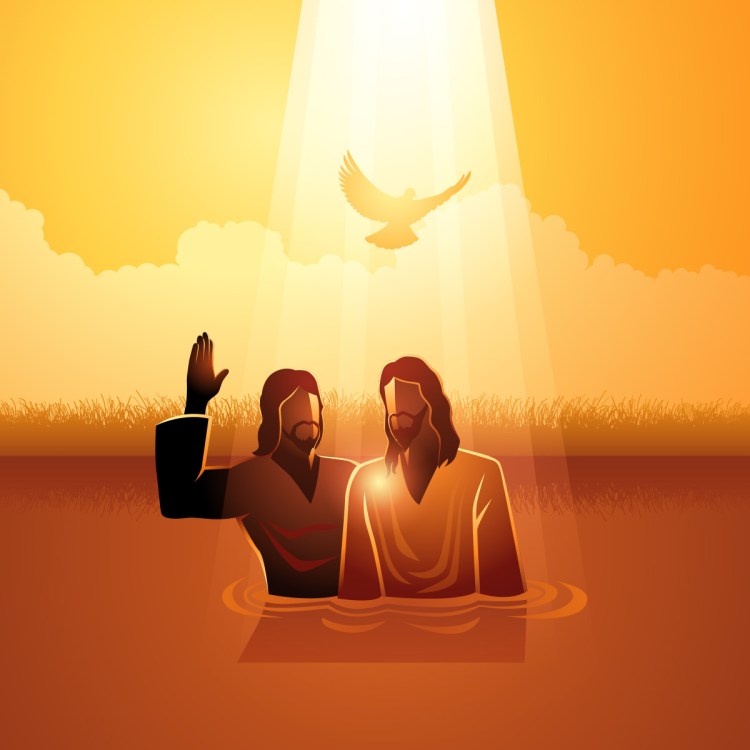
But at times, the Scriptures also set out to show the historical authenticity of the events they’re describing. In this morning’s Gospel, St Luke sets out to show the truth of John the Baptist’s ministry by setting it in a non-religious historical context (John is also someone whose existence has been confirmed by non-biblical sources by the way).

In the fifteenth year of the reign of Tiberius Caesar, Pontius Pilate being governor of Judea, and Herod being tetrarch of Galilee, and his brother Philip tetrarch of the region of Ituraea and Trachonitis, and Lysanias tetrarch of Abilene, during the high priesthood of Annas and Caiaphas, the word of God came to John the son of Zechariah in the wilderness.

That would put the beginning of John’s ministry around 28AD according to our calendar and we know from other sources that all of these political figures held the positions Luke says they did at that time. And Luke tries to do something similar when it comes to Jesus’ birth:

In those days a decree went out from Caesar Augustus that all the world should be registered. This was the first registration before Quirinius was governor of Syria.

It’s clear that Luke doesn’t know the exact year of Jesus’ birth because Augustus reigned from 31BC – 14AD and Quirinius was governor of Syria between 6AD and 7AD when there was a census that led to a revolt over taxes. But it’s also clear that Luke is trying to establish beyond any doubt that these things did take place, that they were real, historical events, and these people were real, historical figures.

Today, archaeological and historical research have caught up with Luke and there’s no longer any doubt that Jesus was a real historical figure, one that all people can believe in. But believing in Jesus as a real historical figure and believing in God are two different things and it’s quite possible to believe in Jesus and at the same time doubt, or even deny, the existence of God.

It simply depends on who you believe Jesus is.

If you believe Jesus was simply a man, then you don’t have to believe in God to believe in Jesus. But that’s not an option for a Christian. We believe that Jesus was more than simply a man. We believe that Jesus was both man and God, fully human and fully divine. So a Christian who says that they don’t believe in God but do believe in Jesus, is denying their own faith. A Christian who says that they doubt the existence of God but believes in Jesus is, at best, confused about their faith because how can you doubt the existence of God whilst at the same time believe in the existence of the second person of the Trinity? It’s tantamount to saying that you don’t believe in the Father but do believe in the Son. Whose Son is he then? Questioning God’s existence because God doesn’t seem to answer prayer but then praying to God’s Son; what is that saying, exactly? That the Father doesn’t answer prayers, but the Son does? But if we call on Jesus, the Son of God, because God doesn’t listen, or perhaps isn’t even there, who do we think we’re praying to? Aren’t we still praying to God? And if we think Jesus, the Son of God, then lifts us up and helps us to go on, who do we think has answered our prayers other than God? So for a Christian, any Christian, doubting or denying the existence of God whilst at the same time affirming their belief in Jesus is a very confusing, and confused, thing to do that leads us into trouble.

As Christians we’re called to profess our faith and proclaim the Gospel. But how can we profess our faith if we’re confused about it ourselves? How can we profess our faith if the things we say deny our faith? And how can we proclaim the Gospel if we doubt the existence of God? We might be able to do the good works Jesus urged us to, but the Gospel is more than doing good works. Isn’t the heart of the Gospel, the ‘Good News’ we’re called to proclaim, salvation and eternal life to all who do God’s will and believe in the one he sent, Jesus, his Son? And isn’t the vindication of all that Jesus said and did, his Resurrection from the dead and Ascension into heaven? Isn’t that what he said would draw all people to him? Who do we think raised Jesus if it wasn’t God the Father?

It may well be possible for some people to doubt or deny the existence of God but still believe in Jesus, but not for us. As Christians, belief in God and belief in Jesus go hand in hand and we simply can’t have one without the other. We may well wonder why the world has to be the way it is, so harsh, cruel and unjust. We may very well wonder too at times why God doesn’t step in and do something about it. But as Christians, we know too that when he did, people seemed to like things the way they were rather than the better way he showed them because wasn’t the one he sent, Jesus, his own Son, treated in the most, harsh, cruel and unjust way?

Through his words to the Christians in Philippi, which we read today, St Paul says that he prays with joy for the way they had helped to spread the Good News. Let’s pray that we can be like them too. Let’s pray that, whatever goes on in the world never causes us to separate our belief in God from our belief in Jesus because if we do allow that to happen, we stop proclaiming the Good News and then, we’ll no longer be able to be the messengers of hope and of a better way for the world, that we’re called to be.

Amen.


The Propers for Advent 2 can be found here.

Sermon for Advent 1: Sunday 28th November, 2021

I’m sure many of you will have heard the joke about what’s the best and worst thing about being a priest. If you haven’t, it goes like this:

What’s the best thing about being a parish priest? The answer? Dealing with the people. What’s the worst thing about being a parish priest? The answer? Dealing with the people!

That is a joke, but it is one with more than a hint of truth behind it. One of the great joys and privileges of being a parish priest is dealing with people, sharing in the good times of their lives, helping them through the bad times and, hopefully, helping them to grow in faith. But, as we all know, people can be very difficult to deal with at times and so whilst dealing with people can be a great pleasure, it can also be very challenging too. Having said that, for me personally, one of the best things about being a parish priest is dealing with one group of people who are, at one and the same time, both a great pleasure and extremely challenging to deal with. Those people are school children.

As vicar of this benefice, I have the pleasure of going into St Gabriel’s Primary School on a weekly basis to lead a school assembly and to welcome the children into church from time to time either for visits or for end of term worship. Part of the joy of that for me is in the children’s enthusiasm for what we do; the obvious excitement they show as their hands shoot up when I ask a question and they think they know the answer, and the sheer joy on their faces when they get the answer right. One challenge of dealing with the children though is in making sure that you understand what they’re trying to say when they answer questions.

Anyone who’s ever had or dealt with children will know that they don’t always express themselves in the way that adults do. So, when they answer a question, they often do know the answer, at least have some understanding of what the answer to a question is, but they can often give the answer in an unusual way and what they mean isn’t always immediately clear. It’s also never a good idea to tell a child that they’re wrong, especially in front of their classmates, let alone the whole school, and so you have to think very carefully about what a child has said before you respond. And you have to do that quite quickly too. Typically, I have about 10-15 minutes to lead a whole school assembly at St Gabriel’s and so you can’t afford to take too long on one question or your you wouldn’t get very far before your time was up. But I think the real challenge of dealing with school children isn’t in their answers to my questions, it’s in the questions they ask and expect me to answer.

Children can ask the most unexpected questions. Perhaps to an adult they might seem to be completely random questions that have nothing whatsoever to do with what we’re actually talking about. But to child, they might have. In any case, if a child asks a question when you’re leading an assembly or RE lesson, it’s because they want to know something and so I think you have to give them an answer, and again, you have to give them an answer quite quickly. So you have to think on your feet.

This happened just a couple of weeks ago when I had a Year 4 class in St Gabriel’s on a church visit. The idea of the visit was for me to show the class round church and explain what things in the church were and what we use them for. We’d not got very far into the visit when one of the children put his hand up to ask a question. So I, thinking it would be a question about something he’d either seen in church or I’d spoken about, asked what his question was. But his question didn’t seem to have anything to do with what we’d been looking at or talking about, it was this:

“Fr Stephen, what would you do if Jesus came into church now?”

So I said, “What, right now? Came and stood here with us right now?”

“Yes” he said.

“Well” I said, “I think the first thing I’d think is that I’d hope I’d been a good Christian, a good enough Christian to be Jesus’ friend. So I think perhaps one of the first things I’d do is ask him that. And I’d hope that he’d say ‘Yes’.

In the context of the school visit, I’m not sure why that young lad asked that question, but he must have had his reasons. And the answer I gave him seemed to satisfy him. But in the wider context of our lives as disciples of Christ, it’s a very pertinent question, a question that perhaps we all need to be asked, or at least ask ourselves on a regular basis. Just what would we do if Jesus came and stood with us right now? And if it’s a question for us to ask or be asked generally, it’s an especially pertinent question at this time of year as we begin the season of Advent and prepare to celebrate the coming into the world of our Lord Jesus Christ at Christmas.

The season of Advent is all about preparing for the coming into the world of the Messiah, isn’t it? Throughout Advent we read and hear the prophets who foretold the coming of the Messiah. This morning, for example, we read Jeremiah’s prophecy that the days are coming when the Lord will fulfil his promise to Israel and Judah that he

‘…will cause a righteous Branch to spring up for David, and he shall execute justice and righteousness in the land.’

We know from elsewhere in the prophets that this refers to the promise to send a Messiah, a Saviour of David’s family line, who will save God’s people.

But as well as this kind of prophecy, of foretelling what God will do in the future, the prophets were also commissioned by God to call his people back to righteousness, to call them away from lives of sin and back to the covenant he’s made with them so that they would be ready to meet the Messiah when he came. We see this especially on the third Sunday of Advent when we hear the preaching of John the Baptist but it’s also something we see in this morning’s Psalm.

The Psalms are often thought of as a hymn book but they’re part of the Scriptures too and, in some ways, they can be seen as the Scriptures in miniature because the Psalms contain all the themes we find elsewhere in Scripture, including prophecy. This morning’s Psalm is in that prophetic tradition because it’s a call, a prayer, to God that he might show us his ways, teach us his paths and lead us in his truth. It’s also a prayer for God to forgive our sins, and these are all things the Messiah would do when he came.

So, as we look forward to celebrating the birth of the Messiah, the coming into the world of our Lord Jesus Christ, we look back to those who told of his coming and called the people of Israel to prepare for his coming. But we also look forward during Advent to that unknown time in the future when Christ will return in glory, and just as the people of Israel were called to be ready for his first coming, so we’re called to be ready for his second coming. That’s summed up in our reading from 1 Thessalonians today when St Paul prays,

‘…may the Lord make you increase and abound in love for one another and for all, as we do for you, so that he may establish your hearts blameless in holiness before our God and Father, at the coming of our Lord Jesus with all his saints.’   

And in our Gospel reading today, we have Jesus’ own exhortation to live as God’s people so that we’ll be ready to him when he comes again:

“…watch yourselves lest your hearts be weighed down with dissipation and drunkenness and cares of this life, and that day come upon you suddenly like a trap. For it will come upon all who dwell on the face of the whole earth. But stay awake at all times, praying that you may have strength to escape all these things that are going to take place, and to stand before the Son of Man.” 

As we think about these things, and more in the same vein that we’ll read during Advent, we could, and perhaps should, ask ourselves the question that I was asked during that school visit to St Gabriel’s a couple of weeks ago: What would I do if Jesus came here, now? Perhaps we’d all hope, as I said I would, that we’ve been good enough Christians to be his friends. I’m sure we’d all hope, as I said I would, that his answer would ‘Yes’. But, if we’re really honest with ourselves, how many of us could be entirely confident that’s what his answer would be?

So, as we look back and forward during Advent, let’s not forget to look inward too, at ourselves, and if we see things that aren’t in keeping with the way we should live as God’s people and disciples of Christ, let’s do something about it. Let’s put those things right, and ourselves right; right before God before the coming of our Lord Jesus Christ. Because if we wait until he comes, it might be too late.

Amen.  


The Propers for Advent 1 can be viewed here.

Sermon for Christ the King – 21st November 2021

In the news this week there was a brief story about the Queen granting a Royal Warrant to her favourite tipple, Dubonnet. In the aftermath of that, sales of the drink skyrocketed. The supermarket chain, Waitrose, for example, said that sales had almost doubled, and the drink quickly sold out. Even Amazon, it seems, are struggling to keep up with the surge in demand for Dubonnet that’s followed the granting of the Royal Warrant. I must admit, all this brought a smile to my face because Dubonnet was also a favourite of our late friend, Fr Neville Ashton. But it was something he only started drinking after he heard that it was the favourite drink of the Queen and her mother, the late Queen Mother. But why should people do this kind of thing? Why should people want to do what the Queen does?

We live in what we might call an age of celebrity don’t we? And we only have to look at the programmes on the television to see that. Celebrity MasterChef; I’m a Celebrity…Get Me Out of Here and Strictly Come Dancing to name just a few. No doubt some of you will remember the original Come Dancing, a show in which ordinary members of the public took part in a dancing competition. That the programme’s been re-invented as Strictly Come Dancing, a dance competition for celebrities shows, I think, the interest, though perhaps obsession would be a better word, that our society seems to have for celebrities.

In a way, it’s quite easy to understand why people are so interested in celebrities. Celebrities are rich and famous, they’re seen as icons of fashion, and they enjoy extravagant lifestyles, and people who don’t enjoy those things, quite naturally, want them. So people see or hear what celebrities do and they try to copy them and do the same.

But the Queen isn’t really what we’d usually call a celebrity is she? She might be rich and famous, she might have palaces to live in but still, she’s not a celebrity in the usual sense of that word. The Queen hasn’t become rich and famous as an entertainer or sports star and we’re highly unlikely to see her on one of the celebrity TV shows that fill our screens. The Queen’s lifestyle may be very different to ours but it’s not one that we can aspire to because she’s the reigning monarch of this country. Anyone else who wanted to be that would no doubt find themselves in some serious trouble. People who’ve wanted to be that have often found themselves in the Tower of London where they’ve not enjoyed a very good lifestyle at all, and usually a very short lifespan too! So why do people want to do what the Queen does, even if it’s only in a small way, such as drinking what the Queen drinks?

I think the reason people do that is because they both respect and admire the Queen. I think people respect and admire the Queen because, despite being involved in politics on a daily basis, she stays out of politics because she makes no personal political statements and doesn’t get involved in political arguments. I think people admire the Queen because she never tries to use the great constitutional power she has, to push her own agenda. And I think above all, people admire the Queen because of her great sense of duty, of putting what she’s called to do, her duty as the Queen, before her own self-interest. And, if we think about these things, do we not see these same qualities in the one we acclaim today, not just as our King, but as the King, the King of all people and all time? Do we not see these qualities in Jesus Christ? 

To be honest, it’s difficult to say that Jesus never made political statements, but it would have been impossible for him not to have made political statements given the society he lived in. We have to understand that Jewish society at the time was a theocracy; it was a society run by priests and run according to God’s Law. Jesus said that he had come to fulfil the Law and his teaching was all about keeping the Law, especially the spirit of the Law rather than the letter of the Law. But, as God’s Law and state law were so closely intertwined, a religious statement about God’s Law was, inevitably, also a political statement about the way the land was governed. Perhaps a good example of that is his argument with the scribes and Pharisees about ‘corban’, offerings to God, in which Jesus accused the scribes and Pharisees of,

“…making void the word of God by your tradition that you have handed down. And many such things you do.”

But despite the inevitable political implications of what he said, Jesus’ teaching was always primarily about keeping God’s Law, about people doing what God required of them, not about politics as such.

And he was never partisan. Jesus didn’t go in for what we’d call ‘party politics’, it was simply about keeping the Law and living as God wants and intended us to live. And Jesus’ never made personal statements either because, as he said,

“…I have come down from heaven, not to do my own will but the will of him who sent me.”

There’s no doubt that Jesus could have used the great power he possessed for personal reasons or gain. The story of his temptation in the wilderness, right at the start of his ministry, is all about this very issue and temptation. But Jesus never did succumb to that temptation, he put himself entirely at God’s service. He did his duty, what he was sent to do, regardless of the cost to himself. As St Paul puts it in his Letter to the Philippians;

‘…though he was in the form of God, did not count equality with God a thing to be grasped, but made himself nothing, taking the form of a servant, being born in the likeness of men. And being found in human form, he humbled himself by becoming obedient to the point of death, even death on a cross.’

If we look at Jesus and his life in purely human terms, if we take him and his life at face value, there’s really not much to see that would inspire us to follow him or to do what he did. He was, and is, famous, but his fame didn’t bring him any earthly reward; it didn’t make him rich. And his life isn’t one that many, if any, people would aspire to. He was an itinerant preacher who had no home and owned nothing other than the clothes he wore. He was hounded from place to place by the authorities who eventually caught up with him because one of his closest friends betrayed him. And he was put to death in the cruellest way imaginable, and on a false charge of claiming to be the king of the Jews. Who would want to follow such a man or aspire to follow such a life?

And yet we do. And we follow him because of the way he lived and died because it’s through the way he lived and died that he rose again from the dead. It’s because of the way Jesus lived and died that St Paul could say,

‘Therefore God has highly exalted him and bestowed on him the name that is above every name, so that at the name of Jesus every knee should bow, in heaven and on earth and under the earth, and every tongue confess that Jesus Christ is Lord, to the glory of God the Father.’

It’s because of the way Jesus lived and died and rose again that we can hear the truth in Jesus’ words. It’s because of these things that we can see that his way of life, the way of humility and obedience to God’s will, is the true and only way to live. And so because of these things we can acclaim Jesus as our King and offer him our loyalty, our obedience, and even our lives.

In their refusal to make personal political statements or play party politics, in their abstinence in using power for their own ends, and in their devotion to duty above self-interest, I think there are similarities between Jesus’ life and ministry and our Queen’s reign. But there is also at least one great difference. The Queen, like all people, will die and her reign will come to an end. But Jesus, having died and been raised again from the dead and enthroned as our heavenly King, will never die again and so his reign will never end. And the great incentive for us to follow Christ’s example now is that, when our earthly lives come to an end, the promise of eternal life rests on our willingness to do as he both commanded us to do and he himself did on earth. When that time comes, there will be no other king to turn to, only Christ, the King. His way will be the only way, so I think we’d be wise to get used to following his way now.

Amen.


The Propers for Christ the King can be viewed here.