Entrance Antiphon Lord, be my rock of safety, the stronghold that saves me. For the honour of your name, lead me and guide me.
The Collect Almighty God, you have created the heavens and the earth, and made us in your own image: teach us to discern your hand in all your works, and your likeness in all your children; through Jesus Christ your Son our Lord, who with you and the Holy Spirit reigns supreme over all things, now and for ever. Amen.
The Readings Missal (St Mark’s) Ecclesiasticus 15:15-20 Psalm 119:1-2, 4-5, 17-18, 33-3 1 Corinthians 2:6-10 Matthew 5:17-37
When I was a young lad, one of the things I always wanted was a chemistry set. Unfortunately for me, I was never allowed to have one mainly, I think, because my parents were worried about what I might do with it, what foul smelling concoctions I might make with it and fill the house with, as my dad said on more than one occasion. So I had to content myself with doing chemistry at school. I did enjoy doing chemistry but, like lots of things we learn, I’ve never used or done any chemistry since I left school and so now about all I can remember about it are a few chemical formulas. Things like H2O, the formula for water, CO2, carbon dioxide, H2SO4, sulphuric acid, and NaCl, sodium chloride.
That last substance, sodium chloride, is a very interesting one. As I’m sure many of you will know, it’s a compound of two elements which, in themselves are particularly nasty and dangerous. Sodium, a metal that burns and causes an explosion when it comes into contact with water. And chlorine, a poisonous gas that was used as a chemical weapon in the First World War. But if these two rather nasty elements are combined in the right way, they form something that’s not only very useful but that’s actually essential to life because, as I’m sure many of you will also know, sodium chloride is better known as salt.
In this morning’s Gospel, Jesus tells his disciples that they’re the “salt of the earth”, and that’s a really good metaphor for the Church. Just like salt, the Church is a compound, a mixture of different elements, people in this case, with different properties, different gifts and abilities, who come together to give the world something that’s essential to life. In the case of the Church, the different elements come together to bring the Gospel to the world. The way the truth and the life that Jesus taught, that helps us in this life and is essential if we want to inherit eternal life. So, as I say, salt is a very good metaphor for the Church and the deeper we look it, the better it becomes.
Salt is made up of two elements which, in themselves can be dangerous. They have properties that are useful to us, but they have properties that can make them very harmful to us. And in the same way, the people who make up the Church have gifts and talents that are very useful to the Church and to the lives of others, but they also have faults that are not so helpful, either to the Church or to other people. We’re all like that aren’t we, a mixture of good properties and bad properties? But just as sodium and chlorine, when they’re combined in the right way and in the right measure can create something good and essential to life, so if we in the Church can come together in the right way, if we can combine our gifts and our faults in the right way, we can become something that’s good and essential to the world and to life.
Just think of Jesus’ disciples, those people whom he chose to make up the early Church. Peter, for example. If ever there was a disciple who was a mixture of the good and not so good, Peter must be the one. He was impetuous, he spoke without thinking, and acted in the same way. He thought he knew better than Jesus at times. He said he’d die for Jesus and was ready to take up arms to stop Jesus being arrested but then, when he’d had time to think about things and realised the danger he might be in, he said he didn’t even know who Jesus was. But he was chosen to lead the Church.
Or how about the brothers, James and John? Boanerges, Jesus called them, ‘Sons of Thunder.’ And it’s not surprising, when the people of a Samaritan village didn’t welcome Jesus, James and John wanted to call down fire from heaven to destroy them. And they were ambitious too; they wanted to sit at Jesus’ right and left hand in glory. But they were both totally committed to Christ.
Or Nathanael, honest as the day is long but a sceptic. When Philip told him they’d found the Messiah, Jesus of Nazareth, Nathanael’s response was ‘Nazareth! Can anything good come from Nazareth?’
Or Paul, perhaps the greatest of all the Apostles, certainly the one who did more than any other to help the Church grow from it’s Jewish origins into the worldwide Church it became. But, on the evidence of his letters and early descriptions we have of him, argumentative and hot-tempered.
These were the people Jesus himself chose to build up the Church and take the Gospel into the world. They weren’t perfect by any stretch of the imagination, they all had their good points, but they all had their faults too. We call them saints, holy people, but not because they were perfect examples of what it means to be Christians. We call them saints because they were dedicated to God and to Christ despite their faults. And because they were dedicated, even though they fell out and argued at times, and the Scriptures tell us they did that, they were able to come together and be the salt of the earth Jesus called them to be. They were able to use their good properties, their gifts and talents, and overcome their bad properties, their faults, so that they could give the world what it needed, the light of the Gospel.
And it’s the same for us today. We’re called to be the salt of the earth in the time and place that we’ve been given to live in. And we have the same problem to deal with, that we have to come together and overcome our faults so that we can use our gifts and abilities to give the world what it still so badly needs today, the way, the truth and the life that Christ came to teach us and that will lead us to eternal life.
It’s not easy though, and one of the stories I like to tell to show how hard it can be is about an argument that took place at a PCC meeting in a parish I once lived in. The Sunday before the meeting we’d had a baptism in church during the morning Mass and we’d had a problem with the baptism party. After the baptism, a few children were running around, making quite a lot of noise while the adults simply sat there talking and ignoring what the children were up to.
At the meeting, one of the churchwardens proposed that we, as a PCC, should make it a policy of the parish that, if children were being unruly during services, their parents should be asked to keep them under control and, if they didn’t, they should be told that they’d have to leave church. I objected to that, as a policy, on the grounds of the damage that would do to the Church. We were trying to encourage people, especially young people and children to come to church but if we started telling people to keep their kids quiet or leave, we’d never see them again, and they’d very likely tell their family, friends and neighbours what a miserable lot we are and tell them not to come to our church either. The warden didn’t take very kindly to me disagreeing with him and he said,
“Well, all I can say is that the Church is better off without some people and if that’s how you feel, perhaps you’re one of them!”
I really didn’t know what to say to that and I just looked at the warden, shook my head, and started laughing, which pleased the warden even less. And then everyone joined in. Everyone shouting at the same time, one or two in support of the warden’s policy but most, it must be said, in support of what I’d said, and everyone against the warden’s comments about the Church being better off without me. And after a few minutes of that, the warden said,
“It sounds to me as though it’s me you don’t want in church!”
But no one was saying that. People did want him because he was very passionate and committed to the church. What they were saying was that, in this case, they thought he was wrong; he hadn’t thought through the consequences of what he was suggesting and his comments to me were both wrong and totally uncalled for. But his response to that was to stand up and say,
“Well if people aren’t going to listen to me, as a churchwarden, and they’re not going to do what I say, I don’t see the point in being a warden, so I resign!”
And with that he walked out of the meeting. He did subsequently calm down and carry on as churchwarden, and he was much more prudent when he spoke after that, both in terms of what he thought the parish should do and in the way he responded to people who disagreed with him.
But there’s so much in that incident that’s reminiscent of what we see in Jesus’ disciples. Speaking without thinking, being bad-tempered and argumentative, raining down fire and brimstone on those who disagree with us, wanting to be in charge, and demanding that everyone else recognises that we’re in charge.
These are the bad properties that people have, and these are some of the faults that we bring to the mix when we’re part of the Church. But we have to work together to overcome all these bad properties so that we can use the good properties we have, the gifts and talents that we all have, and the passion and commitment we have, for the good of the Church, to build it up so that we can be the salt of the earth that Jesus calls us to be. It isn’t easy because one of the bad properties we all have to some degree is that
we all like to have our own way. But in the Church there’s only one way, and it’s not our own, it’s Christ’s way.
The Church is going through difficult times at the moment, we all know that, but I have no doubt whatsoever that these times are being made worse because so many people in the Church want their own way, regardless of whether their way is Christ’s way or not. And they’re prepared to argue and fall out with those who disagree with them. They’re prepared to call down fire and brimstone to destroy, in a sense, those who disagree with them, to silence them, even if that means kicking them out of the Church. As we look at the Church, I think it looks more like a dangerous and toxic jumble of elemental sodium and chlorine, rather than a balanced compound of sodium chloride. In its arguments about who’s right and who’s wrong, who’s in charge and who should either just shut up and do as their told or leave, the Church is in danger of losing it’s taste, it’s saltiness. And what will it be good for if that happens?
But we can at least play our part in making sure that the Church here, in our parishes, in that part of the world where we are, is the salt of the earth. We can do our best to overcome our faults so the we can combine our gifts and talents for the good of the Church in this place. We can, as Jesus put it,
“Have salt in ourselves, and be at peace with one another”
so that we can be the salt of that that part of the earth that God has given us to enlighten with Gospel of Jesus Christ.
Amen.
Propers for the 5th Sunday in Ordinary Time (3 before Lent) 5th February 2023
Entrance Antiphon
Come, let us worship the Lord. Let us bow down in the presence of our maker, for he is the Lord our God.
The Collect
Almighty God, who alone can bring order to the unruly wills and passions of sinful humanity: give your people grace so to love what you command, and to desire what you promise, that, among the many changes of this world, our hearts may surely there be fixed where true joys are to be found; through Jesus Christ your Son our Lord, who is alive and reigns with you, in the unity of the Holy Spirit, one God, now and for ever. Amen.
The feast day of the Church we’re here to celebrate today has had quite a few different names over the years. The original name of the feast was the Purification of the Blessed Virgin Mary, and it got that name because coming as it does, 40 days after Christmas Day, that is, 40 days after the birth of her son, it’s the day when, according to a law we find in Leviticus 12, Mary would have had to present herself to a priest and make an offering for her ‘purification’ after child-birth.
The BCP, on the other hand, in keeping with the Gospel account of Mary and Joseph taking Jesus to the temple to be consecrated to the Lord, called this day the Presentation of Christ in the Temple, and that’s the name the C of E still uses for this day in its Common Worship books and services. And for the same reason, the RC Church now calls this day the Presentation of the Lord.
But we usually call this day by another name don’t we? We call it Candlemas. So where does that come from?
Really that comes from the Song of Simeon which forms part of today’s Gospel reading, in particular, the part of Simeon’s song where he calls Jesus
“…a light to enlighten the pagans…”
as the translation we heard tonight puts it. Because of that, this was a day when candles were used to symbolise Christ as the light of the world and, in the days when candles were the main source of light in a church, it was also a day when the candles that were used in church during the year, were blessed. In effect, it was the day of the Mass of the Candles, or Candlemas. But whatever we call it, it is an important day in the Church’s year, and light has a lot to do with why it’s so important.
For many people, Candlemas marks the end of the season of Christmas. But even if we mark the end of Christmas after 12 days rather than 40, today still marks an end in the Church’s year. For the C of E, today is the end of the season of Epiphany which, as we know, is a season of revelation, a time in the Church’s year when we hear about various revelations of Jesus and who he is. And even in the RC Church when we’re now in Ordinary Time rather than the season of Epiphany, we still use these readings that reveal the identity of Jesus and so it’s still a season when we’re very much concerned with revelation. And so it’s very fitting that we mark the end of this season of revelation, whatever we might call it, with one more revelation about Jesus and who Jesus is. And today we hear that revelation today in the Song of Simeon.
The Song of Simeon, which we often call the Nunc Dimitis, goes like this;
“Lord, now you are letting your servant depart in peace,
according to your word; for my eyes have seen your salvation that you have prepared in the presence of all peoples, a light for revelation to the Gentiles, and for glory to your people Israel.”
But apart from the obvious meaning of the words, the Song of Simeon tells us that Jesus is the one through whom the promise God made to Abraham will be fulfilled. And that is the great revelation about Jesus we find in this Gospel reading.
We find the promise God made to Abraham in Genesis 12;
Now the Lord said to Abram, “Go from your country and your kindred and your father’s house to the land that I will show you. And I will make of you a great nation, and I will bless you and make your name great, so that you will be a blessing. I will bless those who bless you, and him who dishonours you I will curse, and in you all the families of the earth shall be blessed.”
We find the promise to Abram, and Abraham as he became, renewed later in Genesis. At first it’s an unconditional promise but later, when God does renew it, we read that it’s a promise, and a covenant, a deal, based on faith because in Genesis 15 we read of Abram,
And he believed the Lord, and he counted it to him as righteousness.
But we know that the promise to bless all nations through Abraham didn’t happen. It didn’t happen because his descendants, the people of Israel, kept the blessing to themselves by separating themselves from other people and nations. It was only in Christ that God’s blessing on the nations became a reality when faith in him allowed the Gentiles to be God’s people in the same way that the Jews were. And this is something St Paul writes about, especially in his Letters to the Romans and the Galatians.
St Paul isn’t always the easiest of people to understand, especially when he’s trying to talk about the relationship between faith in Christ and the Jewish law, as he does in these letters. But in essence, what St Paul says is that Abraham’s faith was a resurrection faith. It was a resurrection faith because he believed God’s promise that he would be the father of many nations even though he was 100 years old and his wife, Sarah, was thought to be unable to have children. So for St Paul, the Gospel, the good news that God can bring life from death, was proclaimed to Abraham even before Christ’s birth, and that was the basis of Abraham’s faith; he believed in the Resurrection before it happened. So Abraham’s faith is the same faith as those who believe in Christ because of his Resurrection. And so, just like Abraham, they’re considered righteous, right with God, because of their faith, and because of that, the blessing that God promised to Abraham is passed on to all those who have faith in Christ, Jew and Gentile alike.
So in the Song of Simeon, we see a revelation of Jesus as the one who will finally fulfil God’s promise to Abraham. Jesus is the one who’ll make Abraham a blessing to all people because he’s the one who’ll bring salvation to all people. Jesus is the one who’ll be a light of revelation to the Gentiles because he’s the one who’ll show the Gentiles how to be God’s people and allow them to be God’s people by bringing them to faith. And in doing that, Jesus will bring glory to Israel and God’s people by revealing to the world the truth of Abraham’s faith, which is the faith of Israel. What Simeon is saying is that this baby, is the one that not only he’s been waiting for, but that Israel has been waiting for, and the world has been waiting for.
In Galatians 3, St Paul argued that the offspring of Abraham, those who’d take the promised blessing to all people, didn’t refer to many offspring, it wasn’t offspring in a plural sense, but to one offspring. For St Paul, that one was Christ. And likewise, what Simeon said when he saw and spoke about the baby Jesus is that this is the one, and in that we can see a foreshadowing of what St John wrote in the prologue to his Gospel;
The true light, which enlightens everyone, was coming into the world. He was in the world, and the world was made through him, yet the world did not know him. He came to his own, and his own people did not receive him. But to all who did receive him, who believed in his name, he gave the right to become children of God, who were born, not of blood nor of the will of the flesh nor of the will of man, but of God.
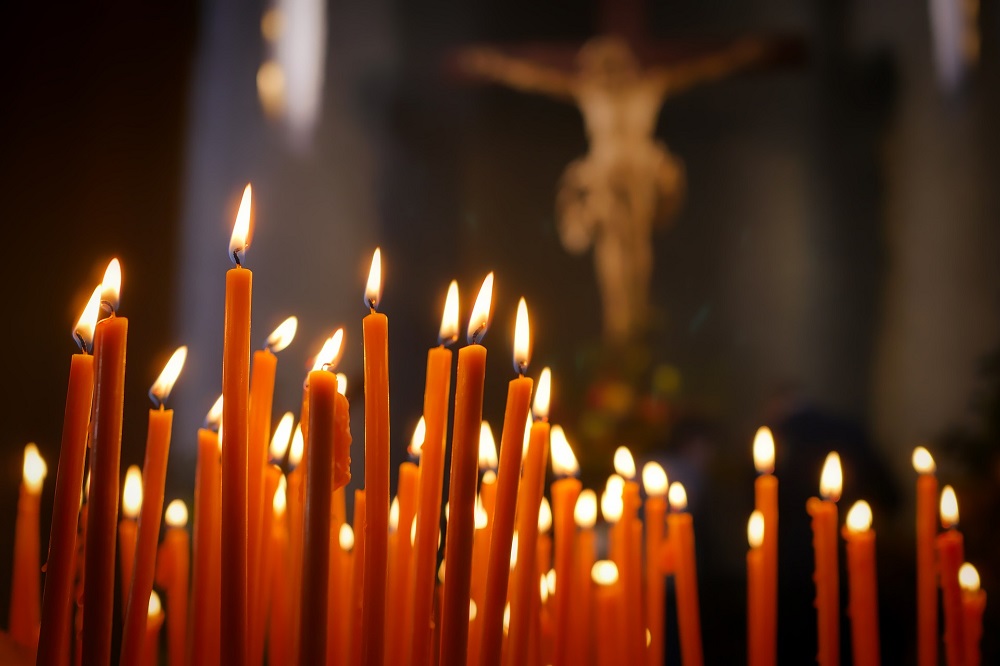
The candles we lit and held tonight earlier tonight were only small, but once we understand what they symbolise, we can recognise them as something much greater. They might only be small, and they might not give out much light as candles, but they symbolise the greatest and brightest light that’s ever shone, the one true light that gives light and life to the world, the light of Christ.
Amen.
The Propers for The Presentation of the Lord (Candlemas) can be viewed here.


 Parish Church of St Mark Chadderton