The feast day of the Church we’re here to celebrate today has had quite a few different names over the years. The original name of the feast was the Purification of the Blessed Virgin Mary, and it got that name because coming as it does, 40 days after Christmas Day, that is, 40 days after the birth of her son, it’s the day when, according to a law we find in Leviticus 12, Mary would have had to present herself to a priest and make an offering for her ‘purification’ after child-birth.
The BCP, on the other hand, in keeping with the Gospel account of Mary and Joseph taking Jesus to the temple to be consecrated to the Lord, called this day the Presentation of Christ in the Temple, and that’s the name the C of E still uses for this day in its Common Worship books and services. And for the same reason, the RC Church now calls this day the Presentation of the Lord.
But we usually call this day by another name don’t we? We call it Candlemas. So where does that come from?
Really that comes from the Song of Simeon which forms part of today’s Gospel reading, in particular, the part of Simeon’s song where he calls Jesus
“…a light to enlighten the pagans…”
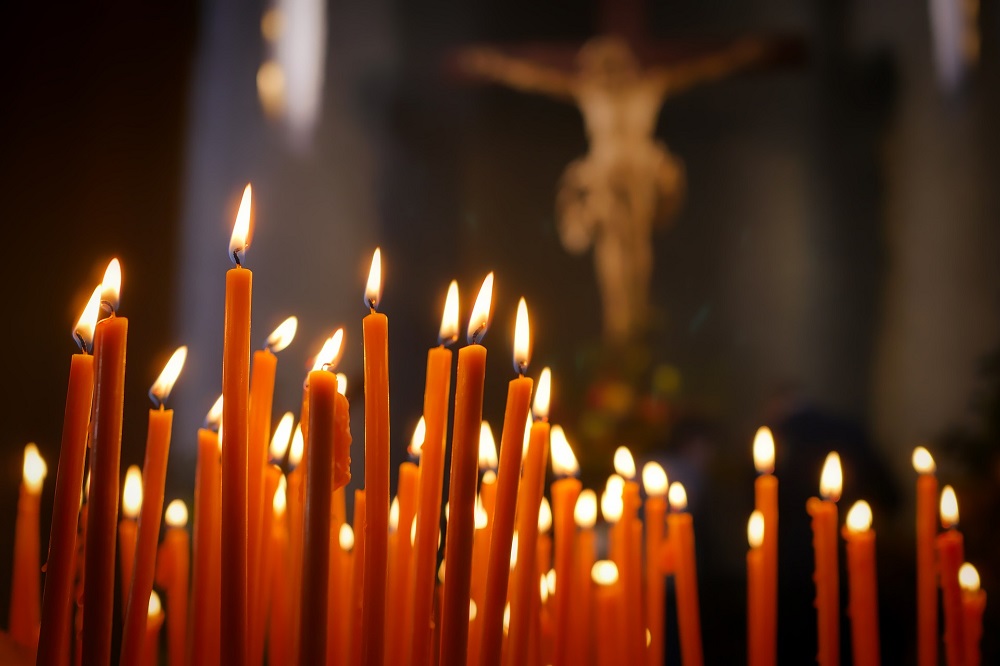
as the translation we heard tonight puts it. Because of that, this was a day when candles were used to symbolise Christ as the light of the world and, in the days when candles were the main source of light in a church, it was also a day when the candles that were used in church during the year, were blessed. In effect, it was the day of the Mass of the Candles, or Candlemas. But whatever we call it, it is an important day in the Church’s year, and light has a lot to do with why it’s so important.
For many people, Candlemas marks the end of the season of Christmas. But even if we mark the end of Christmas after 12 days rather than 40, today still marks an end in the Church’s year. For the C of E, today is the end of the season of Epiphany which, as we know, is a season of revelation, a time in the Church’s year when we hear about various revelations of Jesus and who he is. And even in the RC Church when we’re now in Ordinary Time rather than the season of Epiphany, we still use these readings that reveal the identity of Jesus and so it’s still a season when we’re very much concerned with revelation. And so it’s very fitting that we mark the end of this season of revelation, whatever we might call it, with one more revelation about Jesus and who Jesus is. And today we hear that revelation today in the Song of Simeon.
The Song of Simeon, which we often call the Nunc Dimitis, goes like this;
“Lord, now you are letting your servant depart in peace,
according to your word;
for my eyes have seen your salvation
that you have prepared in the presence of all peoples,
a light for revelation to the Gentiles,
and for glory to your people Israel.”
But apart from the obvious meaning of the words, the Song of Simeon tells us that Jesus is the one through whom the promise God made to Abraham will be fulfilled. And that is the great revelation about Jesus we find in this Gospel reading.
We find the promise God made to Abraham in Genesis 12;
Now the Lord said to Abram, “Go from your country and your kindred and your father’s house to the land that I will show you. And I will make of you a great nation, and I will bless you and make your name great, so that you will be a blessing. I will bless those who bless you, and him who dishonours you I will curse, and in you all the families of the earth shall be blessed.”
We find the promise to Abram, and Abraham as he became, renewed later in Genesis. At first it’s an unconditional promise but later, when God does renew it, we read that it’s a promise, and a covenant, a deal, based on faith because in Genesis 15 we read of Abram,
And he believed the Lord, and he counted it to him as righteousness.
But we know that the promise to bless all nations through Abraham didn’t happen. It didn’t happen because his descendants, the people of Israel, kept the blessing to themselves by separating themselves from other people and nations. It was only in Christ that God’s blessing on the nations became a reality when faith in him allowed the Gentiles to be God’s people in the same way that the Jews were. And this is something St Paul writes about, especially in his Letters to the Romans and the Galatians.
St Paul isn’t always the easiest of people to understand, especially when he’s trying to talk about the relationship between faith in Christ and the Jewish law, as he does in these letters. But in essence, what St Paul says is that Abraham’s faith was a resurrection faith. It was a resurrection faith because he believed God’s promise that he would be the father of many nations even though he was 100 years old and his wife, Sarah, was thought to be unable to have children. So for St Paul, the Gospel, the good news that God can bring life from death, was proclaimed to Abraham even before Christ’s birth, and that was the basis of Abraham’s faith; he believed in the Resurrection before it happened. So Abraham’s faith is the same faith as those who believe in Christ because of his Resurrection. And so, just like Abraham, they’re considered righteous, right with God, because of their faith, and because of that, the blessing that God promised to Abraham is passed on to all those who have faith in Christ, Jew and Gentile alike.
So in the Song of Simeon, we see a revelation of Jesus as the one who will finally fulfil God’s promise to Abraham. Jesus is the one who’ll make Abraham a blessing to all people because he’s the one who’ll bring salvation to all people. Jesus is the one who’ll be a light of revelation to the Gentiles because he’s the one who’ll show the Gentiles how to be God’s people and allow them to be God’s people by bringing them to faith. And in doing that, Jesus will bring glory to Israel and God’s people by revealing to the world the truth of Abraham’s faith, which is the faith of Israel. What Simeon is saying is that this baby, is the one that not only he’s been waiting for, but that Israel has been waiting for, and the world has been waiting for.
In Galatians 3, St Paul argued that the offspring of Abraham, those who’d take the promised blessing to all people, didn’t refer to many offspring, it wasn’t offspring in a plural sense, but to one offspring. For St Paul, that one was Christ. And likewise, what Simeon said when he saw and spoke about the baby Jesus is that this is the one, and in that we can see a foreshadowing of what St John wrote in the prologue to his Gospel;
The true light, which enlightens everyone, was coming into the world. He was in the world, and the world was made through him, yet the world did not know him. He came to his own, and his own people did not receive him. But to all who did receive him, who believed in his name, he gave the right to become children of God, who were born, not of blood nor of the will of the flesh nor of the will of man, but of God.
The candles we lit and held tonight earlier tonight were only small, but once we understand what they symbolise, we can recognise them as something much greater. They might only be small, and they might not give out much light as candles, but they symbolise the greatest and brightest light that’s ever shone, the one true light that gives light and life to the world, the light of Christ.
Amen.
The Propers for The Presentation of the Lord (Candlemas) can be viewed here.

