Entrance Antiphon We should glory in the Cross of our Lord Jesus Christ, for he is our salvation, our life and our resurrection: through him we are saved and made free.
The Collect God our Father, you have invited us to share in the supper which your Son gave to his Church, to proclaim his death until he comes: may he nourish us by his presence, and unite us in his love; who is alive and reigns with you, in the unity of the Holy Spirit, one God, now and for ever. Amen.
The Readings Missal (St Mark’s) Exodus 12:1-8, 11-14 Psalm 116:12-13, 15-18 1 Corinthians 11:23-26 John 13:1-15
One of the things I’ve noticed over the years is the great number of people who want authority without responsibility. I’ve come across so many people who want to be in charge and call the shots, and who are then quite happy to accept the credit and praise for things that go well, but who don’t want to carry the can when things go wrong. Rather, when things do go wrong, things which they’re responsible for, they look for a scapegoat, someone else to blame for what they’ve done wrong or caused to go wrong. I’ve seen it in life generally, I’ve seen it in the workplace, and I’ve seen it in the Church, and I’m sure you’ve all seen it too. And when we see this happening, what we’re seeing are people being one of those things that God hates; false witnesses who breathe out lies.
Normally when we talk about people bearing false witness, we’re probably talking about perjury, people lying under oath, perhaps in a court case. But to bear false witness doesn’t only mean that. A false witness is simply a liar and a deceiver, someone who either tells lies or distorts the truth in some way, someone who is deliberately deceptive in order to get other people to think and act in a certain way. And false witnesses are very much at the heart of the heart of the Passion story that we read today.
We really don’t know why Judas betrayed Jesus. We don’t know what passed between him and the chief priests so we can’t say whether there was any false witness, any lies or distortions spoken in their conversation, but what we can say is that the priests, and others, were quite happy to use false witnesses in their plot against Jesus, as we read this morning;
Now the chief priests and the whole Council were seeking false testimony against Jesus that they might put him to death, but they found none, though many false witnesses came forward. At last two came forward and said, “This man said, ‘I am able to destroy the temple of God, and to rebuild it in three days.’”
Even this last testimony, although it was based on something Jesus had said, was distorted and taken out of context. Jesus had said that if the temple was destroyed he would raise it again in three days, but he never said he would or could destroy the temple because he was speaking about his own body and Resurrection, not the temple buildings. But why would people bear false witness against Jesus? To curry favour with the authorities? Perhaps they’d been offered bribes or other inducements, as Judas had to betray Jesus?
But the chief priests also bore false witness against Jesus. Jesus was put to death as the King of the Jews, but when did Jesus ever claim to be that? The only kingdom Jesus spoke about was the kingdom of heaven, and he’d quite clearly shown himself to be no threat to Rome because hadn’t he said, “Give to Caesar what’s due to Caesar, and give to God what’s due to God.”? So he was no threat to the imperial earthly power of Rome. But what did the chief priests say to Pilate? According to St Luke, this:
“We found this man misleading our nation and forbidding us to give tribute to Caesar, and saying that he himself is the Messiah, a king.”
As we read the Gospels, and what Jesus had actually said, we can see these statements as nothing more than lies and distortions, as false witness that was made with the deliberate intention of inducing Pilate to sentence Jesus to death.
As we read the Passion stories in the Gospels, it’s noticeable that only the Romans call Jesus the King of the Jews. The Jews themselves never openly call him that, and indeed, they try to distance themselves from it later when they ask Pilate to change the charge against Jesus to one of claiming to be the King of the Jews. But Pilate himself implies that they put the idea that Jesus was the King of the Jews in his head. We find this in an exchange between Jesus and Pilate in St John’s Gospel:
So Pilate entered his headquarters again and called Jesus and said to him, “Are you the King of the Jews?” Jesus answered, “Do you say this of your own accord, or did others say it to you about me?” Pilate answered, “Am I a Jew? Your own nation and the chief priests have delivered you over to me…”
What we also see in the Passion stories is a succession of people in authority who try to evade their responsibilities. Whilst it is true that Rome had forbidden the Jews from carrying out executions, the charge against Jesus was a religious one, and it was their responsibility, not Pilate’s, to deal with it. But they were frightened of how the people might react if they acted against Jesus, so they bore false witness against him in order to make the charge against Jesus a political one so that they could pass the buck to Pilate. Judging political charges was Pilate’s responsibility, but he didn’t want it either. So, he tried to pass the buck to Herod, by claiming that, as a Galilean, Jesus came under his jurisdiction. We don’t know what Herod said or thought about the charges against Jesus, but it’s clear he didn’t want the responsibility of dealing with the case either, so he passed Jesus, and the buck, back to Pilate. And in the end, even though we’re told that Pilate knew there was no case against Jesus, he simply, and quite literally, washed his hands of the whole affair and tells the people who clamoured for Jesus’ death to “see to it yourselves.” The find the symbolism of this in the Book of Deuteronomy where, in the event of a death, a killing, where no responsibility can be found, any guilt is taken away by the sacrifice of a heifer over which those who made the sacrifice wash their hands and, with the blessing of the priests, declare that their hands did not shed blood, nor their eyes see it shed.
And so, as a result of false witnesses and people refusing to accept the responsibility that went with their position and authority, and refusing to accept responsibility for their own actions, Jesus became the scapegoat for the sins of his own people and of the whole world.
What happened to Jesus offends our sense of justice doesn’t it? In fact to see anyone falsely accused and be made a scapegoat for the faults and wrongdoing of others is unjust, and it should offend us. But are we really any better than those who bore false witness against Jesus? Are we any better than those witnesses, than the chief priests and the Council, than Herod, or Pilate? Because don’t we distort the truth for our own ends at times? To use the modern parlance, don’t we all put our own spin on things?
Isn’t it true that, at times, we try to evade our responsibilities and evade taking responsibility for our own actions? When something’s gone wrong or something wrong’s been done and we know that it’s our fault, don’t we twist the truth, or even tell blatant lies, to get ourselves out of trouble, or to make people think that we really weren’t to blame for what’s happened? But if something’s gone wrong and we say, ‘It wasn’t me.’ aren’t we inevitably posing the question, ‘Who was it then?’ and so, also inevitably, shifting the blame on to someone else? If we do something wrong or something goes wrong because of our decisions and actions, and we say, ‘It wasn’t my fault.’ aren’t we automatically implying that it was someone else’s fault, and inevitably, making a scapegoat out of them? Isn’t that also what we’re doing when we plead extenuating circumstances, the ‘Ah, well yes, but….’ response to a problem we’ve caused or a wrong we’ve committed. Because what is a plea of extenuating circumstances other than an admission of guilt but one that’s qualified by an insistence that this would never had happened if someone else had done what they should have done? ‘Yes, I did that, but it’s not really my fault, it’s theirs.’ And haven’t we all, at times, done what those in authority have wanted us to do rather than doing what we know is the right thing to do? Haven’t we all, at times, told someone in authority what they wanted to hear rather than telling them the truth? And haven’t we done these things because it’s been to our own advantage in some way to do them, even though doing them has been to the disadvantage or even harm of someone else?
If we think about the times we’ve been false witnesses who breathe out lies, and we have all done that, it’s not too hard to put ourselves in the shoes of those who bore false witness against Jesus; of those who did and said what the chief priests wanted them to, to put ourselves in the shoes of the chief priests themselves, in the shoes of Herod, and of Pilate. And Jesus said that what we do to others we do to him, so it’s not hard to see that when we have done these things and stood in the shoes of these people, we’ve betrayed Jesus, that we’ve made a scapegoat of him and crucified him, and then tried to wash our hands of it and deny any responsibility for what we’ve done.
As we enter Holy Week, our minds turn to focus on Jesus’ Passion. As we do that and we read and hear about the events of the last few days of Jesus’ earthly life and ministry, let’s try to put ourselves in the shoes of those people we read and hear about by thinking about the times we’ve acted just as they did. And let’s do that, with a sense of penitence, a sense of sorrow for the times that we have acted just like them. But let’s also do it with a sense of great thanks to Jesus because, when we come to realise that, at times, we’ve betrayed him, and denied him, and deserted him, and borne false witness about him, we’ll also be able to really understand something else too. We’ll understand, really understand, that, as Jesus was crucified and he prayed,
“Father, forgive them, for they know not what they do.”
he wasn’t just praying for those whose actions had led him to Golgotha and nailed him to the Cross on that day almost 2000 years ago, he was praying for us to. He was praying for you and for me.
Amen.
Propers for Palm Sunday – 2nd April 2023
Palm Liturgy
Entrance Antiphon Hosanna to the Son of David, the King of Israel. Blessed is he who comes in the name of the Lord. Hosanna in the highest.
Entrance Antiphon Six days before the solemn Passover, the Lord came to Jerusalem, and the children, waving palm branches, ran out to welcome him. They loudly praised the Lord; Hosanna in the highest. Blessed are you who have come to us so rich in love and mercy.
The Collect Almighty and everlasting God, who in your tender love towards the human race, sent your Son our Saviour Jesus Christ to take upon him our flesh, and to suffer death upon the cross: grant that we may follow the example of his patience and humility, and also be made partakers of his resurrection; through Jesus Christ your Son our Lord, who is alive and reigns with you, in the unity of the Holy Spirit, one God, now and for ever. Amen.
The Readings Missal (St Mark’s) Isaiah 50:4-7 Psalm 22:8-9, 17-20, 23-24 Philippians 2:6-11 Matthew 26:14-27-66
If I were to ask people whether they deliberately commit acts of evil or deliberately pursue evil ways, I’m sure that hardly anyone, if anyone at all, would say ‘Yes’ and admit or even accept that they do. And I’m sure of that because I’m also sure that most people truly believe that they don’t do evil things. They might accept that, at times, they do things they shouldn’t do but they don’t believe that’s the same thing as doing or being evil. So the vast majority of people, I think, genuinely believe that they don’t have what the Book of Proverbs calls ‘feet that run to evil’. But are people, are we, right in believing that?
First of all, let’s think about what evil actually is. Put very simply, evil is the opposite of good and perhaps most importantly when we consider what the Scriptures mean by evil, it’s the opposite of righteous, the opposite of doing and being what God wills us to do and be. In both the Old and New Testaments, evil can be a quality, something bad in itself such as illness or trouble and misfortune of some kind. But evil can also have a personal, moral dimension and when the Scriptures speak about evil in this sense what they’re speaking about is unfaithfulness. In the Old Testament that’s disobedience to God and the covenant and in the New Testament it’s disobedience to God, to the teaching of Jesus and, by extension, disobedience to the Gospel as proclaimed by the Apostles.
When we think of evil in these terms, as evil as the opposite of good and righteous, it’s not too hard to see that running to evil is the same as running away from good and from righteousness. It’s not hard to see that those feet that run to evil are the same feet that run away from God and from Jesus. And when we think of evil in this way can we really be so sure that our feet don’t run to evil?
Perhaps we could think about it in more practical terms too. During our school days, how many of us here ever heard someone say, “There’s going to be a fight after school!”? And when the school day finished, how many of us went, or perhaps even ran, to watch the fight? But did any of us ever go to where this fight was going to take place with the intention of stopping, or at least trying to stop the fight? Or did we go just to see two people beat the living daylights out each other? Wasn’t it always the latter? And so what were we doing then except, quite literally perhaps, running to evil?
We could excuse ourselves in cases like that because, after all, we were young and we didn’t know any better (though I think we almost certainly did, even then), and we wouldn’t do anything like that now.
Well, we might not run to watch two people having a punch-up now, we might even try and stop them from fighting now, but does that mean we don’t still run after evil, even though we are older and at least think we’re wiser?
In my sermons over the Sundays of Lent this year, as I’ve preached about the things that Proverbs tells us are hateful to God, haughty eyes, lying tongues, hands that shed innocent blood and hearts that devise wicked plans, I’ve noticed quite a few people, in both congregations, nodding in agreement when I’ve spoken about the ways in which we all show that have these things and do these things that are hateful to God. We know we shouldn’t do them because we know they’re not what God wants us to do. We know we shouldn’t do them because Jesus told us we shouldn’t do them. But we do them anyway, and we do them quite deliberately at times. And when we do these things, we’re being deliberately disobedient to God and to Jesus and we’re being unfaithful to the covenant we have with God that was sealed in Jesus’ blood. So when we do these things we are doing and being evil.
When it comes to feet that run to evil though, I think for the vast majority of people, it’s less a case of deliberately pursing ways that we know are evil and more a problem of running away from what’s good and righteous. I’m sure that very few people, and none of us I hope, would see something that we know is evil, that we know is wrong and shows unfaithfulness and disobedience to God and Jesus, and think or say, ‘Let’s go and do that’ anyway. I think what’s much more of a problem for us is seeing something that we know is good, but deciding not to do it. But why do we do that, why do we run away from what’s good and righteous, even though we know these are the things that God wants us to do, and Jesus told us to do?
I think the main reason we do this, is because we tend to do what’s easiest for us and what’s most expedient for us. Going back to the case of the after-school fight, for example, even if we had gone with the intention of stopping the fight, once we got to where it was taking place and saw the crowds all baying for blood, it would have been a very brave thing to do to try and stop the fight. We might have been beaten up ourselves, either by the people who were fighting, because it was nothing to do with us, or by members of the crowd who wanted to see a fight happen, for spoiling their fun. So the most expedient thing was to do nothing, even though that was running away from the right thing to do and the good and righteous thing to do.
But we can do this in so many ways. We see something we know needs to be stopped, because it’s wrong, but we do nothing because we know that doing something might expose us to some hardship, or even danger. How often, for example, have we heard or seen people in church acting or speaking in an un-Christian way but done or said nothing because we don’t want to upset the person, or people, concerned and don’t want to risk falling out with them? We see something that we know needs to be done but we know that doing it would be hard for us, so we do nothing. One way that Christians do this time and time again, is when they’re asked to do something in church, or for the Church. From time to time I, like all clergy, have to ask people if they’d think about serving on the PCC, or acting as a Parish Officer, to ask if they’d mind reading lessons or leading the intercessions on Sunday morning, or perhaps if they’d mind helping out with Sunday School. The list could go on and on but, on the whole, the answers are the same; I don’t have time; I’ve never done that before; I’m not very good at that; I don’t really like doing things like that. But can’t we always find time to do something if we really want to can’t we? We’ve never done anything before the first time we did it. Did that stop us learning to swim, to ride a bike, drive a car? None of us would ever have been good at anything unless we’d actually done it, so how did we become good at anything at all unless we did it. And as far as not liking things, do any of us really for one moment think that Jesus enjoyed being nailed to a Cross for us? But he did it because it was the good and righteous thing to do. Can’t we step just slightly out of our comfort zone for him?
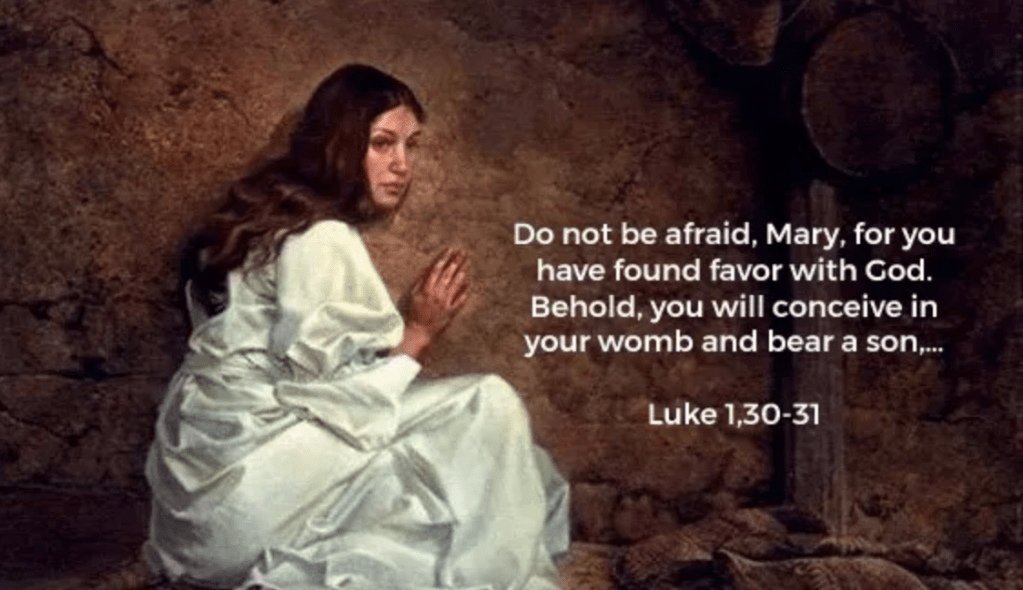
Today is the Fifth Sunday of Lent but, because of the date, we’re keeping today as the Feast of the Annunciation of the Lord, our celebration of the Archangel Gabriel’s visiting Mary to announce that God had chosen her to be the mother of his Son. And, as we think about what Mary was called to do, and the way she responded, she can not only be an example to us of someone who did what was good and righteous, in spite of the difficulties and dangers that involved, but she can be an inspiration to us as we think about just how difficult and dangerous a thing God had asked her to do, and that she did respond in the way she did.
God’s call to Mary was to co-operate in the greatest ever good, the sending to earth of his Son to save us from our sins and to raise us to eternal life. But there’s no doubt whatsoever that the easiest thing for Mary to have done, the most expedient thing for her to have done, was to have run away from this good. The thought of doing what God was asking of her scared her to death, and it’s not surprising that it did. Just think about what doing that good and righteous thing meant for Mary.
As a young, unmarried woman, it would have been bad enough to become pregnant but as a betrothed woman, expecting a child that wasn’t her intended husband’s would have marked her out as an adulteress, for which she could have been stoned to death. And we know that Mary was seen as an adulteress and that it was a stigma that almost certainly stayed with her. Over 30 years later, during a dispute with the religious authorities, Jesus spoke of God as his Father, while accusing them of being children of the devil, because they wouldn’t believe in the one whom God had sent. And in this dispute about fathers, they replied to Jesus,
“We were not born of fornication…”
Some early non-Scriptural writings tell us that the legitimacy of Jesus’ birth was questioned by the Jewish authorities so the implication here may well be, ‘We were not born of fornication, but you were’. So Mary’s reputation was probably tarnished for life because she did the good and righteous thing that God asked of her. And this leads us to a possible answer to another question that’s sometimes asked about Mary.
We never hear of Joseph after the story of Jesus being found in the temple when he was 12 years old, and the Church’s tradition is that he died before Jesus’ ministry began. But we don’t hear about another husband either, so why didn’t Mary remarry, as she would have been expected to after the death of her first husband? Could the answer be because no one would have her because of her reputation as a ‘fallen woman’ shall we say?
There’s no doubt that Mary endured a lot of evil for her willingness to do the good and righteous thing. No doubt the easiest and most expedient thing for her to have done would have been to put some distance between herself and her son. To stay at home when Jesus set off to begin his ministry and to try and just get on with her life in the best way she could. But that would have been running away from good, so she followed Jesus, identifying with him even though that must have been a constant reminder to the gossips and back-biters that he was her son, and her husband wasn’t his real father. No doubt she had to put up with dirty looks, finger pointing and whispers that passed around about her. And I’m sure that, when Jesus was crucified, there would have been no shortage of those saying something like,
‘Well, I’m not surprised it came to this, he came from a bad family you know. She was expecting before she was married, while she was betrothed, and the husband wasn’t the father.’
I’m sure that Mary would have endured all these things, and perhaps more besides as a result of deciding to do the good and righteous thing that God had asked of her. But she chose to do it anyway, and what’s more, she chose to carry on doing the good and righteous thing as the years went by when perhaps she could have stepped away and had an easier time and an easier life. And that’s why Mary is not only an example to us, but an inspiration to us.
She’s an example to us because she did what God asked of her, regardless of the difficulties and potential dangers involved. She’s an inspiration to us because doing what God asked of her was so very difficult and dangerous but nevertheless, she not only agreed to do it, but she stuck at it and saw it through to the very end. Mary made the time to do the good and righteous thing; she did the good and righteous thing even though she’d never done it before, no one had so had no one to turn to for help and advice, she had to get it right because she was the only one who’d ever been asked to do this thing. It took her completely out of her comfort zone and the happy, quiet married life she was no doubt expecting to live with Joseph in Nazareth. But she didn’t make excuses or try to run away, she just got on with it because it was the good and righteous thing that God asked her to do.
It’s very often the case with us that, unlike Mary, we prefer to take the easy way out. We don’t do the good we know we should do if we know, or perhaps even if we think, it’ll involve us in some hardship or other. We run away from what’s good and righteous because that’s the easiest and most expedient thing for us to do. But when we do that we’re turning away from obedience to God and Jesus and away from faithfulness to the covenant we have with them and so we are, inevitably, running to evil. So the next time we’re faced with a decision about what to do, about whether to do what we know we should do as Christians or to do what’s easiest and most expedient for us, even if that means disregarding the teaching and example of Jesus, before we decide, let’s just take a few moments to think about the choice Mary had to make, what she endured for the sake of doing the right thing in God’s eyes, and try to make what we decide and do, at least a little more like what she chose to do and did.
Amen.
The Propers for The Annunciation of the Lord (Lent 5) 26th March 2023
Entrance Antiphon As Christ came into the world, he said: Behold! I have come to do your will, O God.
The Collect WE beseech you, O Lord, pour you grace into our hearts; that, as we have known the incarnation of your Son Jesus Christ by the message of an angel, so by his cross and passion we may be brought to the glory of his resurrection; through the same Jesus Christ our Lord. Amen.
The Readings Missal (St Mark’s) Isaiah 7:10-14, 8:10 Psalm 40:7-11 Hebrews 10:4-10 Luke 1:26-38

 Parish Church of St Mark Chadderton