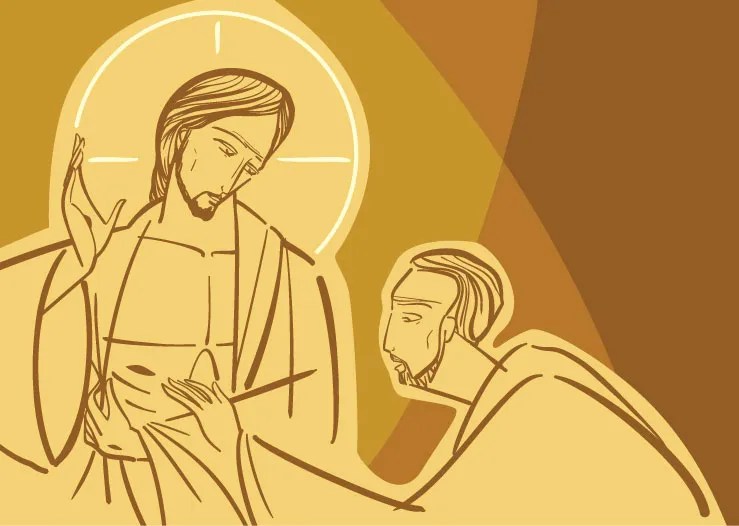
Sermon for 2nd Sunday of Easter, 7th April 2024

If ever there was a saint for today’s world, surely it must be St Thomas. Doubting Thomas, the man who wouldn’t believe until he’d seen it with his own eyes. Because I think today’s world is full of people just like Thomas, people who have no faith in anything they can’t see and verify for themselves. This is one of the reasons the Church is having such a hard time these days isn’t it, because we don’t deal in things that can be seen and touched, we don’t preach something that people can verify for themselves do we? We deal in faith and, as the Letter to the Hebrews  says,

‘…faith is the assurance of things hoped for, the conviction of things not seen.’

So we have a hard time today in a world where there is so little faith, so little time for things that can’t be seen or touched and verified by individual experience. But is that really the case?

One of the things people say today is that they look at the world through science rather than religion because science is about facts than can be proven not about faith that can’t. But have you ever noticed how many people who espouse that view actually express it in terms of faith? They say something like ‘I don’t believe in God; I believe in science.’ But what is belief other than faith? Belief is the acceptance that something is true without proof positive that it is so. Belief is simply another word for faith. So saying ‘I believe in science’ is just as much a statement of faith as is saying ‘I believe in God’ or that we believe in any other tenet of the Christian faith.

And for the vast majority of people science is a matter of belief. If I were to ask people here today whether a baryon is made up of two or three quarks, how many people would know the answer? How many would even know what I was talking about? A baryon is a particle and science tells us that it’s made up of three of three quarks but how many people understand what that actually means or would have the slightest idea how to go about proving it for themselves? But they believe it’s so because scientists tell us it’s so. So, for the vast majority of people, when they say that they believe in science, what they’re really doing is expressing a faith, their faith in the tenets of science and in what scientists tell them.

And even when it comes to scientific ‘facts’, that everyone thinks they do understand, how many people actually do understand? If I were to ask what the Theory of Evolution says, I’d expect to get answers that have something to do with the survival of the fittest. But is that really what the Theory of Evolution says? What if I were to put to you that according to evolutionary theory it’s not necessarily the fittest that survive and that genetic drift may cause the fittest to die out and the less fit to survive? Would anyone know what I was talking about? Unless you’d studied biology or evolution for yourselves, probably not. And yet this is part of the evolutionary theory that people think that they understand so well. So, on the whole, when people say that they believe in science rather than in God or anything else that we might call religious faith, what they’re really doing is expressing a faith, their faith in science and scientists because, on the whole they don’t understand and can’t prove for themselves what it is they say that they believe in.

The point I’m making is that, in spite of what people may think and say, there is faith in today’s world. There’s just as much faith in the world today as there ever has been. The problem for the Church is that it’s not necessarily, and in our own part of the world increasingly less likely to be, Christian faith. So why should this be?

Quite frankly, in my opinion, it’s the Church’s own fault that this is the case and it’s the fault of the people, the individuals, who both lead and make up the Church. It’s our fault because we’ve allowed this to happen and, on the whole, we aren’t prepared to do anything, or at least anywhere near enough, about reversing the situation. To put that in a nutshell, it’s our fault because we don’t do anywhere near enough of the very thing Christ commissioned us to do; we don’t proclaim the Gospel as we should.

Why do so many people today say that they believe in science? I don’t think there’s any doubt that in large part that’s because scientists are always telling us that they have all the answers, and that faith is nothing more than the superstition of ill-educated and unthinking people. And they say it so often and so loudly that people believe them, no doubt in part because people don’t like to be thought of as ill-educated and unthinking. So they say that they agree with science and scientists even though, on the whole they don’t understand what scientists are saying, or the science they say they agree with. And people don’t even think that what they’re actually doing when they say that they believe in science is simply swapping one faith for another.

And what does the Church do in the face of this? All too often, rather than meeting the challenge with an equally robust defence of the faith, it looks for holes in what science says and slots its faith into them. It’s sometimes known as preaching a God of the gaps. In other words, the Church looks for gaps in scientific knowledge and says that’s where God is, in the bits that science can’t explain. And because this is what the Church does, it doesn’t equip its people to deal with this challenge when they come across it in the course of their lives. How many people here have avoided talking about their faith, or allowed their faith to be ridiculed by those who ‘believe in science’ because you didn’t really know how to respond to the challenge of what they were saying? But when we have leaders who seem more interested in politics than faith, in political correctness than truth and in not offending those of other faiths and none than in defending our own faith, whose fault is this, really?

And now to be very controversial, I constantly hear people complaining about the growth of Islam. People complaining that this is supposed to be  Christian country and Muslims are taking it over. People asking what I think about such and such a place being made into a mosque? Ok. If you really want to know what I think. I think good luck to them. Why should we complain about the growth of Islam if we’re not prepared to do anything about the growth of the Church? Why should we complain about people of another faith taking over what’s supposed to be a Christian country if we’re not prepared to do anything to make it and keep it a Christian country? Why should we complain about places being turned into mosques if we can’t be bothered turning up to church in sufficient numbers to keep the churches we have open, let alone, in sufficient numbers to make building more churches necessary? As I said in my sermon last Sunday, people want and expect the Church to be here for them when they want and need the Church, but far too many can’t be bothered to lift a finger to make sure that the Church survives, let alone grows.

The growth of belief in science, and the growth of other faiths tell us that there is faith in today’s world, a great deal of faith, and if the Church isn’t benefitting from that we need to stop blaming others and look at ourselves and put our own house in order. I know at times we’re not helped by the Church leadership, but they don’t dictate what we do as individual Christians in our own lives. That’s up to us. So why do so many of us act as though we’re embarrassed by our faith or ashamed of our faith? And not just out in the world, but in church too. Sometimes, when I’m leading a service in church, I get the feeling that I’m either alone or the only one taking part in the liturgy because the responses that people make to prayers are so quiet that they’re inaudible. Sometimes I know that people aren’t responding at all because I can see them. Why? What do people think is going to happen to them if they speak? Do they think someone is going to make fun of them or criticise them if they open their mouths in prayer and praise? Why would anyone do that in church of all places? That’s what we’re here to do. We call what we do in church liturgy. Does anyone know what the word means? It comes from two Greek words that together mean public working. We call it liturgy because it’s supposed to be something that the people do in public, not what the priest does by themselves on behalf of the people.

There is faith in the world, but if we in the Church want to make sure that it becomes Christian faith then we in the Church need to need to start taking our faith more seriously, both in church and in the world. If we had 200 people coming to St Mark’s and St Gabriel’s every Sunday, we could perhaps afford to have some of them along for the ride. When we have a congregation of 30 – 40, if we’re lucky, on Sunday, we can’t afford that. And the Church can’t afford that either. We need to start speaking up for our faith and sharing our faith. We need to let people know that we believe our faith is something worth fighting for. If we want people to take us and our faith seriously, we need to show that we take our faith seriously. If we want people to make a commitment to our faith and the Church, we need to show our commitment to our faith and the Church. We can’t show them Christ’s hands and side for them to put their fingers and hands into to bring them to faith, but we can say of Jesus, ‘My Lord and my God’ and then show that we truly do believe that by what we do and say both in church and in the world.

Amen.


Propers for 2nd Sunday of Easter, 7th April 2024

Entrance Antiphon
Like new-born children you should thirst for milk,
on which your spirit can grow to strength,
alleluia!

The Collect
Almighty Father,
you have given your only Son to die for our sins and to rise again for our justification:
grant us so to put away the leaven of malice and wickedness,
that we may always serve you in pureness of living and truth;
through the merits of your Son Jesus Christ our Lord,
who is alive and reigns with you,
in the unity of the Holy Spirit,
one God, now and for ever.Amen.

The Readings
Missal (St Mark’s)        
Acts 4:32-35
Psalm 118:2-4, 15-18, 22-24
1 John 5:1-6
John 20:19-31

RCL (St Gabriel’s)          
Acts 4:32-35
Psalm 133
1 John 1:1-2:2
John 20:19-31

Sermon for Easter Day, 31st March 2024

Image designed by Freepik

Alleluia, Christ is risen! He is risen indeed, alleluia!

So goes the great Easter acclamation which we traditionally use to begin and end our services today, on Easter Day, and throughout the Easter season. Alleluia, is a word that means ‘Praise the Lord’ and it’s a very fitting word to use today because whilst we come to praise the Lord whenever we come to church, we come to praise him with special fervour today because this is the day when Christ is risen. This is the day when we know that Christ is indeed the way the truth and the life. This is the day when we know that our faith in Christ is vindicated. And this is the day when we know that the short span of human life is not all we have to look forward to, that we don’t have to fear the end of that short human life, because this is the day when we know that we can have life that never ends.

So today, above all days is the day when we should praise the Lord for what he’s done for us. But, I have to say, that I do question the extent to which many people can say ‘Alleluia’ today with true sincerity of heart. And I say that based on the very, very disappointing way people have kept Holy Week, and especially the Triduum, this year.

As you know, being in a united benefice, we alternate services on a yearly basis. So, this year, we celebrated Maudy Thursday and the Easter Vigil on Holy Saturday at St Gabriel’s and Good Friday at St Mark’s. The last time we celebrated these days in these churches was in 2022, and the congregations this year have been roughly half of what they were then, just two years ago. The best congregations this year have amounted to about one quarter of the regular adult congregation on Sundays. Before I go any further and before people take the huff because they may have had a good reason for not being in church on these days this year, I do know that some people do have genuine reasons for not being at some services. But three quarters of the people? For all the services? The question that I’d like to ask is, how can we truly praise the Lord because Christ is risen and for all that means for us, if we can’t show our thanks to the Lord by coming to church to remember what it cost the Lord to do this most wonderful thing for us?

On Maundy Thursday, I spoke in my sermon about what it means to commit ourselves to following Christ’s example of loving service. One of the most important ways of showing our loving service of others is by telling them about just what the Lord has done for us.

Part of our discipleship is to proclaim the Gospel. This is part of our baptismal covenant with God, it’s why we give a lighted candle to the newly baptised and confirmed. As we say in the Service of Baptism,

You have received the light of Christ; walk in this light all the days of your life. Shine as a light in the world to the glory of God the Father.

This is something we commit ourselves afresh to do on Holy Saturday or on Easter morning in the Renewal of our Baptismal Promises. But how can we do that if we opt to stay at home rather than coming to church on some of the most important days in the Church’s year? How can we encourage others to come to church if we don’t do it ourselves? How can we urge others to make a commitment to the Church and the Christian faith if ours is so weak and so easily laid aside?

I also spoke on Maundy Thursday about the choices that Christ made on the night of his betrayal and arrest. He chose to go to Gethsemane, knowing that his enemies would know where he was. He chose to stay in Gethsemane knowing that, if he did he would be arrested, beaten, mocked and humiliated, and condemned to the most terrible, cruel and agonising death. He chose to do all this, yes in obedience to his Father’s will, but he chose to do it for us, for you and me and every other human being who ever has lived and ever will live. He didn’t need to do it. Christ is the Son of God, he was in the beginning with God, he is God, and God is complete and sufficient within himself. God doesn’t need us, we need him. Jesus, Christ, chose to do this for us. So why can so few of us come to church to give thanks for what he’s done for us? How can we, with sincerity of heart say today, ‘Alleluia, Christ is risen!’ when in response to Christ’s choice to suffer so much for us, we choose to stay at home rather than coming to church to show our gratitude?

We seem to live today in a very utilitarian society, and by that I don’t mean one that’s aimed at producing the greatest good for the greatest number of people, but one that’s based on how useful things are to the individual. So many people today seem to look and treat things purely on the basis of how useful they are to them, and it must be said that many view and treat other people in the same selfish, utilitarian way.

People expect things to be there for them when they need them, but then couldn’t care less about them once that thing, or person, has served its immediate purpose. And this is a great problem for the Church because so many people see and use the Church in the same way. People expect the Church to be there for them when they need it but couldn’t care less about the Church once they’ve got what they want from it. In people outside the Church it’s shown when they want their children baptising, or they want a church wedding or church funeral, or in the requests for prayers we get when someone’s ill or in some kind of trouble. On the whole the Church is asked to do these things for people whose only interest in the Church is having the Church there when they need the Church to do these things for them. I remember very well, for example the uproar in the local community when the church I offered myself for ordination from was closed. But it closed because the combined congregation of their two Sunday services was less than twenty. So where were all these people who were up in arms about the church’s closure, whilst it was still open? But Church people can show this same utilitarian attitude towards the Church too, in a different way.

One of the things I was asked to do when I first came here was the Laying on of Hands for healing, and I’ve done that through the monthly Healing Liturgy we have. But very few of the people who asked for this ministry have ever actually used it. On some occasions, only one person has come to church for the Healing Liturgy. On one occasion, no one came. And yet, if I suggest not having this service again, people get quite upset and say it’s not fair on those people who do come. But when the congregation is one or even none, where are the people who do come? I’m equally sure that, if in the wake of the poor attendance at Holy Week services this year I said I wasn’t going to do them next year, perhaps in favour of joining with another church, there’d be uproar, and no doubt from some of the people who haven’t been to the services this year.

Many people, including it must be said, however sadly, some Church people, use the Church as a utility, simply as something to be used. And, as with any utility, we use it when we want or need it, and then put it aside until we want or need it again. Isn’t it a good job that God doesn’t treat us like that!

In The Reproaches, which are read during the Veneration of the Cross on Good Friday, the Lord speaks of the things he’s done for his people, and of the ungrateful way they’ve repaid him, and asks,

“What more could I have done for you that I have not done?”

And at Evening Prayer on Good Friday we heard an ancient homily on Christ’s descent into Hell, which again speaks of what the Lord has done for us;

‘For you, I your God became your son; for you, I the Master took on your form; that of slave; for you, I who am above the heavens came on earth and under the earth; for you, man, I became as a man without help, free among the dead; for you, who left a garden, I was handed over to Jews from a garden and crucified in a garden.

‘Look at the spittle on my face, which I received because of you, in order to restore you to that first divine inbreathing at creation. See the blows on my cheeks, which I accepted in order to refashion your distorted form to my own image.

‘See the scourging of my back, which I accepted in order to disperse the load of your sins which was laid upon your back. See my hands nailed to the tree for a good purpose, for you, who stretched out your hand to the tree for an evil one.

I slept on the cross and a sword pierced my side, for you, who slept in paradise and brought forth Eve from your side. My side healed the pain of your side; my sleep will release you from your sleep in Hades; my sword has checked the sword which was turned against you.

‘But arise, let us go hence. The enemy brought you out of the land of paradise; I will reinstate you, no longer in paradise, but on the throne of heaven. I denied you the tree of life, which was a figure, but now I myself am united to you, I who am life. I posted the cherubim to guard you as they would slaves; now I make the cherubim worship you as they would God.

“The cherubim throne has been prepared, the bearers are ready and waiting, the bridal chamber is in order, the food is provided, the everlasting houses and rooms are in readiness; the treasures of good things have been opened; the kingdom of heaven has been prepared before the ages.”

This is what lies behind our ‘Alleluia’ today. This is what the Lord has done for us, and this is what it cost him. And we should never, ever forget that God didn’t have to do this for us, and Christ didn’t have to do this for us because they don’t need us, we are not a utility to them. They freely chose to do this for us for no reason other than because they love us and out of that love and in that love, doing this was for our good.

Today, we acclaim, ‘Alleluia, Christ is risen’ and rightly so, for so he is. But let’s never forget God’s love for us and the sacrifice Christ made for our sake that lies behind that acclamation and allows us to make it. And let’s show the sincerity of our ‘Alleluia’ by making sure that in praise and thanks for all they’ve done for us, we never show a utilitarian attitude towards God, his Christ or his Church.

Amen.


Propers for Easter Day, 31st March 2024

Entrance Antiphon
I have risen:
I am with you once more;
you placed you hand on me to keep me safe.
How great is the depth of your wisdom, alleluia!

The Collect
Lord of all life and power,
who through the mighty resurrection of your Son,
overcame the old order of sin and death to make all things new in him:
grant that we, being dead to sin and alive to you in Jesus Christ,
may reign with him in glory;
to whom with you and the Holy Spirit
be praise and honour, glory and might,
now and in all eternity.
Amen.

The Readings
Missal (St Mark’s)
Act 10:34, 37-43
Psalm 118:1-2, 16-17, 22-23
Colossians 3:1-4
John 20:1-9

RCL (St Gabriel’s)          
Acts 10:34-43
Psalm 118:1-2, 14-24
1 Corinthians 15:1-11
John 20:1-18

Sermon for Palm Sunday Year B, 24th March 2024

Just over five weeks ago we began our journey through Lent and now, on Palm Sunday, we come to the final stretch of the journey as we enter the season of Passiontide and the start of Holy Week. As the name Passiontide suggests, this is the time of the Church’s year when our thoughts turn towards the climax of our journey through Lent, and indeed the climax of Jesus’ earthly life and ministry, the time that he himself often called his ‘hour’, the time of his Passion and Cross.

On the First Sunday of Lent, as always, we read in church the story of Jesus’ Temptation in the Wilderness. This year, being the year when we concentrate on the Gospel according to St Mark, we didn’t actually read what those temptations were but, as I said in my sermon that day, I’m sure we all know well enough what they were; the temptation for Jesus to satisfy his hunger by turning stones into bread, the temptation for Jesus to prove his identity by forcing God into a miraculous act on his behalf, saving Jesus from harm after he’d thrown himself from the top of the temple, and renouncing God by serving the devil in return for earthly power and glory. And we know that in each case, Jesus resisted the temptation and answered the tempter by quoting from scripture.

This morning, as always on Palm Sunday, we read the Passion Gospel, this year St Mark’s account of Jesus’ Passion and Cross. The Passion narratives in the Gospels can be read in different ways. Of course, they’re the story of the last hours of Jesus’ earthly life but each of the Gospels tell the story in a slightly different way. The differences are sometimes said to be the result of the stories being eyewitness accounts and those witnesses having seen, heard and remembering different things. That’s quite acceptable because we know from personal experience that people can and do remember the same event in slightly different ways. People see and hear different things and some parts of an event will have a deeper impact on one person than it will on another and will be more memorable to one person than to another. So people do remember things differently from one another. It’s also said that the Passion narratives are told in slightly different ways because the evangelists who wrote them wanted to highlight different parts of the story because these were of most immediate concern to the people they were writing for – they answered the questions uppermost in the minds of those people at the time. Another way of looking at the Passion narratives though is to read them as attempts to prove Jesus’ identity as the Messiah through the events of his Passion and Cross, and they do that by appeals to scripture.

All the Passion narratives are full of quotes from scripture and allusions to scripture, and in that sense we can look at them as complimentary to the stories of Jesus’ Temptation in the Wilderness. We can see these as narratives as the bookends of Lent, and we can see the Passion narratives as a reworking of the Temptation stories. In those Temptation stories Jesus resisted temptation and answered the tempter through the words of scripture and in the Passion narratives we see Jesus as someone who not only lived “by every word that that comes from the mouth of God” but who died by those words too.

In answer to the first temptation, Jesus quoted from the Book of Deuteronomy and said,

“‘Man shall not live by bread alone, but by every word that comes from the mouth of God.’”

And in the Passion narratives we see Jesus as someone who does live and die by God’s word. We see it in his Agony in the Garden where, in spite of his own feelings he says to the Father,

“Abba, Father, all things are possible for you. Remove this cup from me. Yet not what I will, but what you will.”

And so, as he said he would, Jesus goes the way it is written of him, according to God’s Word. And as we read the Passion narratives in each of the Gospels we’re told repeatedly that what happens, and what Jesus himself says and does is all in order that the scriptures, or what was written, may be fulfilled. Even his cry,

“’My God, my God, why have you forsaken me?’”

is taken from scripture; they’re the opening words of Psalm 22.

In Jesus’ second temptation, the tempter uses scripture, Psalm 91, to try and manipulate Jesus; he uses God’s word to tempt Jesus into disobeying God’s word. But Jesus’ answer to this was to use God’s word, again from Deuteronomy, to counter the temptation;

“‘You shall not put the Lord your God to the test.’”

And again in the Passion narratives we see Jesus refusing to put God to the test. When Jesus was arrested in Gethsemane and one of the disciples drew a sword and cut off an ear of the High Priest’s servant, Jesus said,

“Put your sword back into its place. For all who take the sword will perish by the sword.Do you think that I cannot appeal to my Father, and he will at once send me more than twelve legions of angels?But how then should the Scriptures be fulfilled, that it must be so?” 

And on the Cross when one of the criminals called on Jesus as “the Christ” and urged him to save himself and him and the other criminal too, Jesus said and did nothing. So too, when the onlookers and chief priests and scribes said similar things, and also called on Jesus to save himself, he said and did nothing. Even when they said,

“He trusts in God; let God deliver him now, if he desires him. For he said, ‘I am the Son of God.’”

Jesus would not call on God to save him from the Cross; he wouldn’t put God to the test.

In his third and final temptation, Jesus resisted the lure of earthly power and glory with another reference to Deuteronomy, the commandment to serve God alone by saying,

“‘You shall worship the Lord your God and him only shall you serve.’” 

In this third temptation, Jesus had been tempted with ‘all the kingdoms of the world and their glory’. As the Messiah, knew that he would be a king and that his kingdom would have no end, that’s prophesied in scripture. But Jesus wasn’t interested in an earthly kingdom. He knew he was a king, he said so to Pilate but said that his kingdom is “not of this world.” He accepted the so-called repentant thief’s request to “remember me when you come into your kingdom.” So Jesus was a king and knew he was a king, and yet it wasn’t through any great act of earthly power that he showed himself to be a king, but through the way he lived and died according to God’s word. And we find that in the Passion narratives at the very moment of his death on the Cross when we read,

‘And when the centurion, who stood facing him, saw that in this way he breathed his last, he said, “Truly this man was the Son of God!”’

The Son of God, the Messiah, the King of the Jews and because of his living and dying in accordance with the word of God, soon to be the Christ, our King, our Lord and our God and Saviour of the world.

Our journey through Lent is supposed to bring us a little closer to Christ. It’s supposed to help us be able to live our lives a little more like the way Jesus lived his life. So as we think about these bookends of the Lenten journey, let’s try to make our lives accord a little more with God’s word so that we can resist the tempter, in whatever way he shows himself to us, so that, at the end of our lives, we can join Jesus, our King, in paradise.

Amen. 


Propers for Palm Sunday, 24th March 2024

Antiphon
Hosanna to the Son of David, the King of Israel.
Blessed is he who comes in the name of the Lord.
Hosanna in the highest.

Introduction
Dear brothers and sisters in Christ, during Lent we have been preparing by works of love and self-sacrifice for the celebration of our Lord’s death and resurrection. Today we come together to begin this solemn celebration in union with the Church throughout the world. Christ enters his own city to complete his work as our Saviour, to suffer, to die, and to rise again. Let us go with him in faith and love, so that, united with him in his sufferings, we may share his risen life.

Blessing of the Palms
God our Saviour,
whose Son Jesus Christ entered Jerusalem as Messiah to suffer and to die;
let these palms be for us signs of his victory,
and grant that we who bear them in his name may ever hail him as our King,
and follow him in the way that leads to eternal life;
who is alive and reigns with you,
in the unity of the Holy Spirit,
one God, now and for ever.
Amen.

The Palm Gospel
Missal (St Mark’s)         Mark 11:1-10

RCL (St Gabriel’s)          Mark 11:1-11

The Collect
Almighty and everlasting God,
who in your tender love towards the human race,
sent your Son our Saviour Jesus Christ to take upon him our flesh,
and to suffer death upon the cross:
grant that we may follow the example of his patience and humility,
and also be made partakers of his resurrection;
through Jesus Christ your Son our Lord,
who is alive and reigns with you,
in the unity of the Holy Spirit,
one God, now and for ever.
Amen.

The Readings
Missal (St Mark’s)        
Isaiah 50:4-7
Psalm 22:8-9, 17-20, 23-24
Philippians 2:6-11
Mark 14:1 – 15:47

RCL (St Gabriel’s)          
Isaiah 50:4-9
Psalm 31:9-16
Philippians 2:5-11
Mark 14:1 – 15:47