If I were to ask you to name a poem by William Blake, how many of you would be able to do that? Probably not too many, I would have thought and yet most people do know at least one of his poems because Blake wrote the poem that we now know as the hymn And did those feet in ancient time, which we usually know by the name Jerusalem. But Blake wrote many other works too and one his later works was The Everlasting Gospel.
The Everlasting Gospel is an interpretation, or perhaps reinterpretation would be a better word, of Jesus Christ and his teachings. As a poem it isn’t always easy to read and as an interpretation of Jesus and his teachings it can be even more difficult to read. And yet in places The Everlasting Gospel is quite profound in its truth and wisdom, perhaps especially in what it says about the way Christians behave. Take this for example:
The vision of Christ that thou dost see
Is my vision’s greatest enemy.
Thine has a great hook nose like thine;
Mine has a snub nose like to mine.
Thine is the Friend of all Mankind;
Mine speaks in parables to the blind.
Thine loves the same world that mine hates;
Thy heaven doors are my hell gates.
Both read the Bible day and night,
But thou read’st black where I read white.
How true that is. We all call ourselves Christians, followers of Christ, and yet we so often disagree about what that means and how to actually do it. On the whole, we all read the same Bible, and yet we disagree on how to interpret what we read. Some ignore those parts of the Bible they don’t like, or even leave them out completely and produce their own particular version of the Bible (and in my experience, those who do this are the very same people who shout the loudest about being ‘Bible based’ and use that term as the basis of their condemnation, and even hatred (and no, that’s not too strong a word at times) of those who disagree with them). And in the process of all this we argue and fall out, and we tear the Church apart. We do all these things and still call ourselves ‘Christians’. But where in Jesus Christ’s teaching and example do we find justification for any of this?
I don’t know about you, but when I read the Gospel, I hear Jesus saying that we should love our neighbour as ourselves. I hear him saying that his disciples should love one another, just as he loves us. And when it comes to those whose interpretation of things and way of doing things and denomination of the Church differs from mine, rather than criticising or condemning them for those things, I call to mind the passage from Mark’s Gospel when the disciple John, says to Jesus,
“Teacher, we saw someone casting out demons in your name and we tried to stop him, because he was not following us.” But Jesus said, “Do not stop him, for no one who does a mighty work in my name will be able soon afterward to speak evil of me. For the one who is not against us is for us.”
And yet how often do people in the Church act in just the way John described; set ourselves up against and try to stop those who do things in Christ’s name simply because they don’t follow ‘us’, because they don’t belong to our little group and don’t do things our way? What are all our petty, stupid arguments about denomination and tradition and churchmanship other than this very thing which Jesus Christ, the one whom we all claim to follow, says we should not do?
And we all do it. And by all I mean the Church. We all do it. We all call ourselves Christians, followers of Christ and yet we do the very things he told us not to do. We’re the very kind of people he told us not to be. We all do it and we all think we’re right and everyone else is wrong and in our self-righteous pride, treat one another appallingly, in the most un-Christian way because of it. I must admit that, of all the things I could complain about in and about the Church, it is this that I find by far the most tiresome and, I must also admit, that I find I have increasingly less patience with as the years go by. To put it very bluntly, if we’re going to call ourselves Christians, we ought to start acting like Christians, that is, in the way that Jesus said we should act.
But of course this is the great problem isn’t it? We, and again by we I mean the Church, we all think that we are acting in a Christian way. But in fact we’re often not doing that because, to put it in William Blake’s terms, we act according to our version of Christ and think everybody else’s version is our enemy. We hate what they love and visa versa. We think our way is the way to heaven and theirs is the way to hell, and they think the same of us. And we all read the Bible subjectively, never objectively, because we all read it through the prism of our own opinions and prejudices.
And when we do this, what are we doing other than acting in the same way the tenants in this morning’s Gospel acted. The Church is the Lord’s vineyard, and we have been left in charge of it. But instead of looking after it in the way the Lord intended and called us to, we’ve decided to treat it as our own possession, something that belongs to us and so we can treat in the way we want to treat it, regardless of whether that way is the way the Lord intended. And when we ignore the teaching of Christ so that we can be in charge of the Church, which is exactly what we are doing when we carry on in the way I’ve described this morning, to all intents and purposes we’re throwing the Son out of his Father’s vineyard and killing him so that we can have it for our own. But, if we are the Bible based Church so many claim to be, if we do take Jesus’ words seriously as we all claim to do, we must know how wrong this is. We must know the danger doing this puts us is because as we read at the end of this morning’s Gospel,
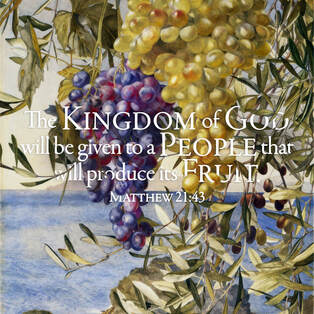
“When therefore the owner of the vineyard comes, what will he do to those tenants?” They said to him, “He will put those wretches to a miserable death and let out the vineyard to other tenants who will give him the fruits in their seasons.” Jesus said to them, “Have you never read in the Scriptures: ‘The stone that the builders rejected has become the cornerstone; this was the Lord’s doing, and it is marvellous in our eyes’? Therefore I tell you, the kingdom of God will be taken away from you and given to a people producing its fruits.”
All I’ve said this morning applies to the Church as a whole, to parish churches and to individual members of the Church. And in the past few weeks it’s been shown that they to apply to this benefice. But the very essence of the Church and of the Church of England itself is that there is a place for everyone and everyone is welcome. And parish churches are not private clubs for people who agree with us and are prepared to do things only our way.
The Church faces many problems, it always has done, but to me, the Church’s biggest problem is how to put an end to the intolerant, un-Christian way individual members of the Church and the different denominations of the Church can, and often do, behave towards one another. Most of it doesn’t matter, it’s petty and stupid, and trivial and irrelevant in the grand scheme of things. What matters is our own salvation and how we can proclaim the message of salvation to the world.
And we can’t and won’t do the cause of either much good if we can’t love one another as Christ commanded us to do. Being a Christian has nothing to do with what we like or don’t like, with how we think things should be or not be, with what we’re used to or not used to. It has everything to do with following the teaching and example of Jesus Christ. All of it, not just the bits we like or agree with.
The late Swiss theologian Hans Kung put it, quite brilliantly, I think, in his 1968 book The Church. Kung was speaking about Church unity, specifically between the Anglican and Roman Catholic Churches, but what he said applies to all Churches and just as much to individual congregations and Christians as it does to that wider issue. He wrote,
‘Church unity is not a matter of one Church returning to another or joining another; it’s not a matter of the subjugation of one Church by another, but of the submission of all Christians to Christ. The road to Church unity is one which takes us on a common journey in which we must all move towards Christ. And the closer we come to him, we’ll find that we will necessarily, move closer to each other.’
We might call ourselves Anglicans, or Catholics, or Methodists, or Baptists, or Lutherans, or Calvinists or by another of the many titles we have to use because of the division our pride and selfishness have caused in the Church but collectively, we all call ourselves Christians, followers of Jesus Christ. So for our own good, for the good of the Church both locally, nationally and worldwide, and for the good of the world too, perhaps it about time we all started acting like it.
Amen.
Propers for the 27th Sunday in Ordinary Time, 4th October 2026
Entrance Antiphon
Within your will, O Lord, all things are established,
and there is none that can resist your will.
For you have made all things, the heaven and the earth,
and all that is held within the circle of heaven;
you are the Lord of all.
The Collect
Almighty ever-living God,
who in the abundance of your kindness
surpass the merits and the desires of those who entreat you,
pour out your mercy upon us
to pardon what conscience dreads
and to give what prayer does not dare to ask.
Through our Lord Jesus Christ, your Son,
who lives and reigns with you in the unity of the Holy Spirit,
God, for ever and ever.
Amen.
The Readings
Isaiah 5:1-7
Psalm 80:9, 12-16, 19-20
Philippians 4:6-9
Matthew 21:33-43
Prayer after Communion
Grant us, almighty God,
that we may be refreshed and nourished
by the Sacrament which we have received,
so as to be transformed into what we consume.
Through Christ our Lord.
Amen.

