Anyone who’s ever been to a Christian funeral will have heard the Prayer of Committal which is said as the coffin is lowered into the grave, or the curtains are closed at a crematorium and which begins with the words,
Our Lord Jesus Christ said, “Come to me all who labour and are heavy laden, and I shall give you rest.”
Those words are taken from St Matthew’s Gospel, and we’ve just heard them in our Gospel reading this morning. Coming where they do in the funeral service, they’re words which express the loving care Jesus has for us, a loving care which extends beyond this life and into eternity. Those words, and the Prayer of Committal itself, express our belief that, once the troubles of this life are over, we will find eternal rest and peace with Jesus in heaven. It’s a lovely prayer intended to express a wonderful, comforting hope and belief. And yet, when we come across these words in the Gospel itself, I think they do cause us something of a problem because they really don’t seem to follow on very well from what Jesus has said only a short time before.
These words are found at the end of Chapter 11 of St Matthew’s Gospel and yet in Chapter 10, Jesus had warned the Apostles that he was sending them out as “sheep in the midst of wolves”, that they will be delivered “over to courts”, “flogged in synagogues” and “dragged before governors and kings”. That they will be “delivered over to death” by members or their own families, and that they will be persecuted. And he went on to say that he had “not come to bring peace, but a sword”. And then in Chapter 11, just before we find this morning’s reading, Jesus speaks about how and why he and his message are being rejected:
“…John came neither eating nor drinking, and they say, ‘He has a demon.’ The Son of Man came eating and drinking, and they say, ‘Look at him! A glutton and a drunkard, a friend of tax collectors and sinners!’ Yet wisdom is justified by her deeds.”
And yet, as we’ve just heard, Jesus then goes on to say that he will give those who come to him rest, and not only that, but in what appears to be stark contrast to what he’s said earlier, that his “yoke is easy” and his “burden is light”. So what are we to make of this and how do we read it?
At the risk of sounding as though I’ve borrowed one of Fr Alex’ sermons, we have to read this morning’s Gospel in context.
Coming where it does, this morning’s Gospel sits in the middle of a larger section of St Matthew’s Gospel that records warnings of how difficult things will be for those who follow him which are themselves set in the midst of the rejection of Jesus by the scribes and Pharisees. Earlier in the Gospel Jesus had been accused of breaking the Law, of blasphemy and of casting out demons “by the prince of demons”. And as we read on we find Jesus again being criticised for breaking the Sabbath laws, for which the Pharisees began to plot against him to “destroy him”, and again for casting out demons “by Beelzebul, the prince of demons” which Jesus equates with the only unforgiveable sin, sin against the Holy Spirit, a wilful rejection of God and attributing the work of the Spirit to the Evil One.
When we read this morning’s Gospel in this context, it doesn’t only help us to understand why Jesus speaks about his followers finding rest and his burden being light, in the midst of all this trouble, but we can find so much more in what he says that perhaps isn’t so obvious on a simple reading.
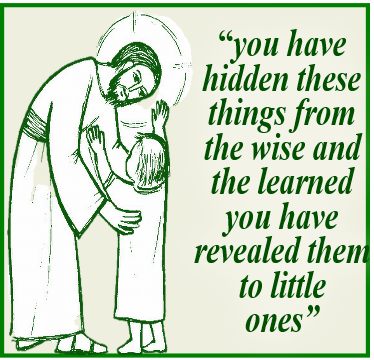
Jesus begins with praising the Father for giving simple people, whom Jesus refers to as “little children”, the wisdom and the faith to accept him and his message when the “wise and understanding”, the scribes and Pharisees not only can’t see God in Jesus but steadfastly refuse to see God at work in Jesus. And this is because their wisdom is human wisdom, not the Wisdom that comes from God.
Wisdom, the Wisdom that the Scriptures refer to is the knowledge of God. We usually equate Wisdom with the Holy Spirit because it is the Spirit that gives Wisdom to human beings. But Jesus is saying something else here. He says,
“All things have been handed over to me by my Father, and no one knows the Son except the Father, and no one knows the Father except the Son and anyone to whom the Son chooses to reveal him.
So what Jesus is saying here is that he has the Wisdom that Scripture speaks about because he knows God in a way that no other does. Yes, the Spirit is Wisdom and gives Wisdom always, but now, at this time and in this place, Wisdom is walking amongst you and speaking to you directly. Not in dreams and visions or through prophets as in the past, but in and through me, because I am the Word and Wisdom of God. And that leads into Jesus’ call to discipleship.
We can see the Scriptures as a whole, and perhaps the whole of human history as the story of our search for God. Not just a search for belief in God, a search for faith, but a search for understanding, and perhaps above all a search to know God. The great Church Father St Augustine of Hippo expressed this very well when he said of God,
You have stirred in us the desire to praise you, for you have made us for yourself and our heart is restless until it comes to rest in you.
And this is the rest Jesus speaks of when he says,
Come to me, all who labour and are heavy laden, and I will give you rest.”
It’s not a rest from the problems associated with being a disciple of Christ in the world, it’s a rest that comes when the soul stops searching for God because it has found God and knows God.
And it is this kind of knowledge of God that comes from Wisdom that Jesus is referring to because what he says next is very much in the wisdom tradition.
“Take my yoke upon you, and learn from me, for I am gentle and lowly in heart, and you will find rest for your souls.”
Which parallels very closely something we read in Wisdom literature, in the Book of Sirach which says,
Acquire wisdom for yourselves without money.
Put your neck under her yoke and let your souls receive instruction;
it is to be found close by.
See with your own eyes that I have laboured but little and found for myself much serenity.
But Jesus hints at something else here too. He speaks of his own gentleness and lowliness of heart, and this is no doubt intended to contrast with the self-righteousness and pride of the scribes and Pharisees, something that’s made even more evident by what he says next;
“For my yoke is easy, and my burden is light.”
The implication of course, being that their yoke is anything but easy, something that we find in numerous places in the Gospel narratives of Jesus’ disputes with them.
We find in these narratives that the scribes and Pharisees themselves profane the Sabbath and yet consider themselves guiltless when they do. We find that they put human traditions above the Law and consider themselves justified in doing so. And yet they insist on others dotting every ‘I’ and crossing every ‘t’ of the hundreds of rules and regulations in the Law. Indeed, in Chapter 23 of St Matthew’s Gospel, Jesus says of the scribes and Pharisees,
“They tie up heavy burdens, hard to bear, and lay them on people’s shoulders, but they themselves are not willing to move them with their finger.”
And he then goes on to describe the many, many ways they do this. And this is something that Jesus does not do.
When we read this morning’s Gospel in this context, we do find so much more than is apparent on a simple reading. And there’s a lot for us to take on board from this too. It reminds us that we don’t need to have great academic knowledge and understanding to gain the Wisdom that comes from God and to know God and his ways. It reminds us that the rest Jesus promises to his followers has nothing to do with having a nice easy life. It’s about knowing the kind of rest, the peace at heart, that comes when our souls are at rest because we know God and are sure that we’re walking in his ways. And it reminds us that, whatever other people say, however they say we should live and what we should or shouldn’t do if we want to be Christians, what really matters is what Jesus says because he is the Word and Wisdom of God and he is that one who calls us, and whom we follow.
Amen.
Propers for the 14th Sunday in Ordinary Time, 5th July 2026
Entrance Antiphon
Your merciful love, O God,
we have received in the midst of your temple.
Your praise, O God, like your name,
reaches the ends of the earth;
your right hand is filled with saving justice.
The Collect
O God, who in the abasement of your Son have raised up a fallen world,
fill your faithful with holy joy,
for on those you have rescued from slavery to sin,
you bestow eternal gladness.
Through our Lord Jesus Christ, your Son,
who lives and reigns with you in the unity of the Holy Spirit,
God, for ever and ever.
Amen.
The Readings
Isaiah 9:9-10
Psalm 145:1-2, 8-11, 13-14
Romans 8:9, 11-13
Matthew 11:25-30
Prayer after Communion
Grant, we pray, O Lord,
that, having been replenished by such great gifts,
we may gain the prize of salvation,
and never cease to praise you.
Through Christ our Lord.
Amen.

