When I was serving my first curacy, I was asked to lead a course in the parish on basic Christianity. One of the insights I gained from doing that is just how much misunderstanding people can have about the faith they profess. That was shown in many ways by the things people on the course said and obviously, believed. For example, when we were discussing the Incarnation and the Annunciation that preceded it, one person expressed the view that the reason Jesus was so much better than us is that Mary was so different from us. Well, apart from being wrong, that view is implicitly heretical. Scripture tells us;
Therefore he (Jesus) had to be made like his brothers and sisters in every respect, so that he might become a merciful and faithful high priest in the service of God, to make propitiation for the sins of the people. For because he himself has suffered when tempted, he is able to help those who are being tempted.
But Jesus gets his humanity from Mary and if Mary was not like us, if her humanity was so different to ours, how could Jesus be completely like us in every respect?
But I think this really highlights a more general problem in the Church. I think people often tend to elevate the great figures of our faith and the Church, the saints, to something much more than they were in reality. We can make icons of the saints; we can treat them as though they were more like statues of marble or bronze rather than flesh and blood human beings. We can treat them almost as demigods even. We can see the saints as perfect examples of faithfulness and holiness and Christian living, so much better and different than we are ourselves. But there’s a great problem and danger with doing this. We say the saints are examples to us of faithfulness and holiness of life, of what it means to be Christians. But if the saints were so much better than us because they were so different from us, how can they be examples to us? If the saints were so much better than us because they were different form us in some fundamental way, their example is one we can’t ever hope to live up to. In fact, if the saints were so different from us, we can’t even aspire to the kind of lives that they led. It would be like wishing we could fly like a bird. Well, our human ingenuity means that we can fly but we can’t flap our arms and fly like a bird because we’re not birds, they are different from us.
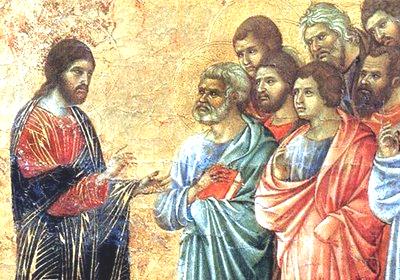
In this morning’s Gospel we heard the story of Jesus sending out the twelve Apostles. We know that they did go and do what Jesus had instructed them to do and that they had some great successes. But as we read through the Gospels we find that the Apostles were far from perfect. Sometimes they failed because their faith or prayer wasn’t up to the job in hand. We know they argued and, in spite of what Jesus had tried to teach them, they jockeyed for position. But then they were so slow to understand and believe at times that Jesus became exasperated with them. And while we say that one of them betrayed him, in fact all except one betrayed him because in the last few hours of his earthly life, when the going got tough, they got going alright, in the opposite direction: they ran away, all except one. So when we look at the Apostles, these great saints and figures of our faith and the Church, they were far from perfect: they struggled with prayer and faith; they struggled to understand; they struggled to follow Jesus’ teaching and, when following Jesus became difficult, their faith melted away. So far from being great icons of perfection, people who were so different from us, weren’t they really just like us? And we can find many examples throughout the Church’s history to show that, far from being any different from us, the saints were just like us.
Not too long ago, the Church celebrated the Feast day of St Augustine of Canterbury. This is a Feast in England because, as I’m sure you’ll know, St Augustine was the first Archbishop of Canterbury, and he’s sometimes known as the ‘Apostle to the English’. Actually there are some historical problems with that last title because the English, as a people, didn’t exist until over 300 years after St Augustine had died. In his day what would become England was populated by a mixture of the original people of the land, the Britons, who were already Christians, in the West and North-West, and a mixture of pagan peoples, Angles, Saxons and Jutes in the rest of the land. But that’s another story.
The story we’re interested in starts when Pope Gregory I saw some blond-haired, blue-eyed boys in Rome and asked who they were.
“Angles.” he was told.
To which Gregory replied,
“Not Angles but angels.”
And he promptly decided to send someone to convert these angelic looking pagans to the Christian faith, and chose Augustine, a Benedictine monk, to lead the mission.
Augustine, however, didn’t seem too keen on the idea. He set off but turned back and asked the Pope for permission to abandon the whole exercise and return to Rome, which Gregory refused to grant. In the end it took Augustine and his companions 2 years to reach the shores of Britain which was pretty slow going even then. And when the party got here, he went nowhere near the territory of the Angles, instead he went to the Jutish kingdom of Kent. And he almost certainly went there because, while the king of Kent, Æthelbert, was a pagan, his queen, Bertha, was a Christian who openly practised her faith and already had a bishop with her whom she’d brought over from her homeland in what’s now France. So Augustine was hardly stepping into the lion’s den when he arrived here. And he never really did. He never evangelised the Angles and only dipped his toe into the Saxon territory of London after reinforcements were sent from Rome 4 years after his initial arrival. He left the mission to the angelic looking Angles to others, some of whom it must be said seemed to be about as enthusiastic about the enterprise as Augustine himself had been when he first set out from Rome. Augustine might not have been a Southerner in the sense that we mean but he certainly didn’t appear to want to venture even as far as Watford, let alone North of the place!
We celebrate the life and example of St Augustine; we dedicate churches to him; we regard him as a great saint and so as an example to us, in Augustine’s case, as a missionary and evangelist. But he’s an example to us because he was a was no different from us, his story tells us that. Like Augustine, how often do we drag our feet when what we’re called to do for the Church is difficult, and when we’d really rather not do it at all? How often do we look for the easy way out? Yes, we’ll do what’s being asked of us, but we’ll look for the easiest way to do it, even if that means leaving the harder part of what we should be doing to someone else. In other words, how often do we baulk at stepping out of our comfort zone for the sake of the Lord, our faith and the Church?
The Church recognises many, many saints, but whichever saint’s story we look at, we find that they were not the paragons of Christian life that we sometimes imagine them to be. They all struggled with the same doubts and fears that we struggle with. They all got things wrong at times, just as we get things wrong at times. But this is why the saints are such great examples to us, because they were just like us and if there is any difference at all between the saints and us is that they didn’t allow their weaknesses and faults and failings, and failures, to beat them.
They kept going in spite of these things. They weren’t perfect, and nobody knew that more than they did, but their imperfections spurred them to greater effort.
And that is what we should aim for too. Not to think that we’re always right, or have got everything right, but to be aware of our faults and failings so that we understand just how far we still have to travel on the road towards Christ’s example. And not to let our faults and failings, no matter how many they are and how often we fail cause us to give up. To remember that true holiness is not about perfection but about tireless, unswerving, dedication to the Lord and his ways. To look at the saints, not as people so different from us that their example is unachievable by us, but to look at the saints as though we’re looking in a mirror and ask, if you could do this, why can’t I do it too?
Amen.
Propers for the 11th Sunday in Ordinary Time, 14th June 2026
Entrance Antiphon
O Lord, hear my voice, for I have called to you; be my help.
Do not abandon or forsake me, O God, my Saviour!
The Collect
O God, strength of those who hope in you,
graciously hear our pleas,
and, since without you mortal frailty can do nothing,
grant us always the help of your grace,
that in following your commands
we may please you by our resolve and our deeds.
Through our Lord Jesus Christ, your Son,
who lives and reigns with you in the unity of the Holy Spirit,
God, for ever and ever.
Amen.
The Readings
Exodus 19:2:6
Psalm 100:1-3, 5
Romans 5:6-11
Matthew 9:36-10:8
Prayer after Communion
As this reception of your Holy Communion, O Lord,
foreshadows the union of the faithful in you,
so may it bring about unity in your Church.
Through Christ our Lord.
Amen.

