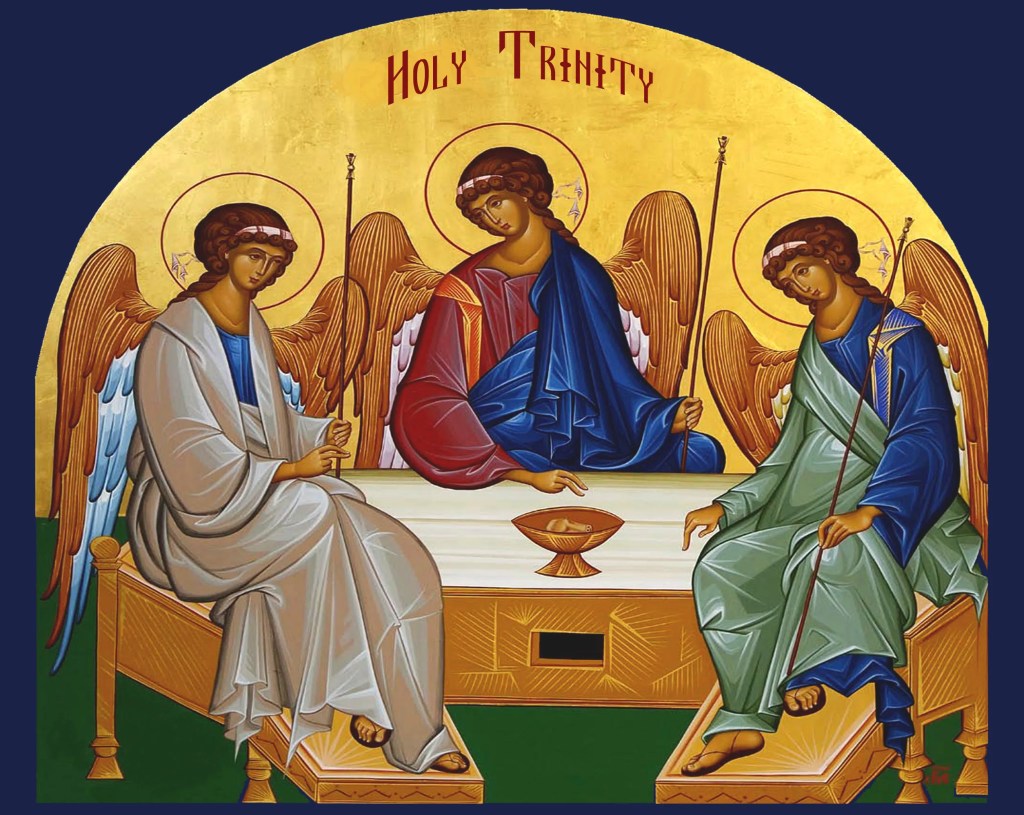
Well here we are once again on that day in the Church’s year so beloved of preachers the world over, Trinity Sunday. A day when, by tradition, if a parish priest can get someone else to preach, they do (and I hope Fr Alex appreciates the fact that I haven’t followed that tradition by asking him to preach today!). But all joking aside, Trinity Sunday is day that many don’t like to preach on because it’s a day when the preacher has to try to do the impossible by explaining the inexplicable.
Of course we all know what we mean when we say God is a Trinity of Father, Son and Holy Spirit but how can we explain how one God can be three distinct persons, and yet still be only one God? And to further complicate matters, that each of the three distinct persons is sufficient unto themselves, that is, that each of the three is God in all God’s fullness, and yet they are not three distinct Gods, but still only one God?
It’s so difficult for us to really get a handle on the Trinity because it’s a concept outside our everyday experience, we don’t come across anything like this in our everyday lives. The way we try to describe the Trinity is confusing because we don’t have the words to describe something so contrary to our everyday experience and understanding. People have tried to explain the Trinity in everyday terms and perhaps one of the most well-known ways has been to say the Trinity is like water which can be solid (ice), liquid and gas (steam) and yet still be the same water. But water can’t be all those things at the same time and there’s no what we would refer to as a personal, loving relationship between those three states of water. In fact, that better describes Modalism, the idea, the heresy, that God is one who reveals himself in different ways, different modes, rather than existing as three persons simultaneously.
So how can we describe the Trinity in ways that are understandable in everyday terms? Can we do that even? It’s not easy and so it would be a brave or foolish person who would try. Well, I’ve raced 500cc motor bikes that don’t have any brakes, so I guess I’m not lacking in either of those qualities so here goes!
When we try to use analogies to speak about the Trinity, one thing that’s often lacking, as it is in the water analogy, is that dynamic personal, relational aspect that exists within God as Trinity.
But when we speak about the Trinity directly we add that relational aspect by saying that the Holy Spirit is the bond of love that unites the Father and the Son. Or we speak of the Father as the lover, the Son as the beloved and the Spirit as the active love that’s shared between them and unites all three. And we often say that God is love don’t we. So understanding personal loving relationships is essential to trying to get our heads around the Trinity and any analogy we use for the Trinity must also contain that aspect of personal loving relationship. And I think we can find such an analogy in something we all know about and understand, and that many of us have experienced personally, the sacrament of Holy Matrimony – marriage.
Just listen to these words form the Preface to the Church of England Marriage Service:
‘The Bible teaches us that marriage is a gift of God in creation and a means of his grace, a holy mystery in which man and woman become one flesh. It is God’s purpose that, as husband and wife give themselves to each other in love throughout their lives, they shall be united in that love as Christ is united with his Church.’
So just as we speak of the Trinity as lover and beloved being united through the bond of love, so these words speak very clearly of two distinct persons becoming one by being united in love.
This isn’t a perfect analogy by any means. The love shared between the Father and the Son in the Spirit is perfect, unconditional and eternal whereas we know our love for one another often isn’t like that. We argue and fall out at times, we do things to our beloved that we really wouldn’t like to be done to us; we do these things, as we say in the general confession, through negligence, weakness and our own deliberate fault. We do these things because we are flawed and sinful. And of course our love is not eternal but ‘till death us do part’. But in those times when our love for one another is as it should be, those who have experienced this kind of loving relationship, whether in marriage, or outside marriage, will have experienced being a distinct person in their own right while at the same time being united to another distinct person, being one with that other person through the love that you’ve shared. And in experiencing that, you will have experienced something, even if only a hint, of God as Trinity.
Amen.
Propers for Trinity Sunday, 31st May 2026
Entrance Antiphon
Blest be God the Father,
and the Only Begotten Son of God,
and also the Holy Spirit,
for he has shown us his merciful love.
The Collect
God our Father, who by sending into the world
the Word of truth and the Spirit of sanctification
made known to the human race your wondrous mystery,
grant us, we pray, that in professing the true faith,
we may acknowledge the Trinity of eternal glory
and adore your Unity, powerful in majesty.
Through our Lord Jesus Christ, your Son,
who lives and reigns with you in the unity of the Holy Spirit,
one God, for ever and ever.
Amen.
The Readings
Exodus 34:4-6, 8-9
Psalm (Canticle) Daniel: 3:52-56
1 Corinthians 13:11-14
John 3:16-18
Prayer after Communion
May receiving this Sacrament, O Lord our God,
bring us health of body and soul,
as we confess your eternal holy Trinity and undivided Unity.
Through Christ our Lord.
Amen.

