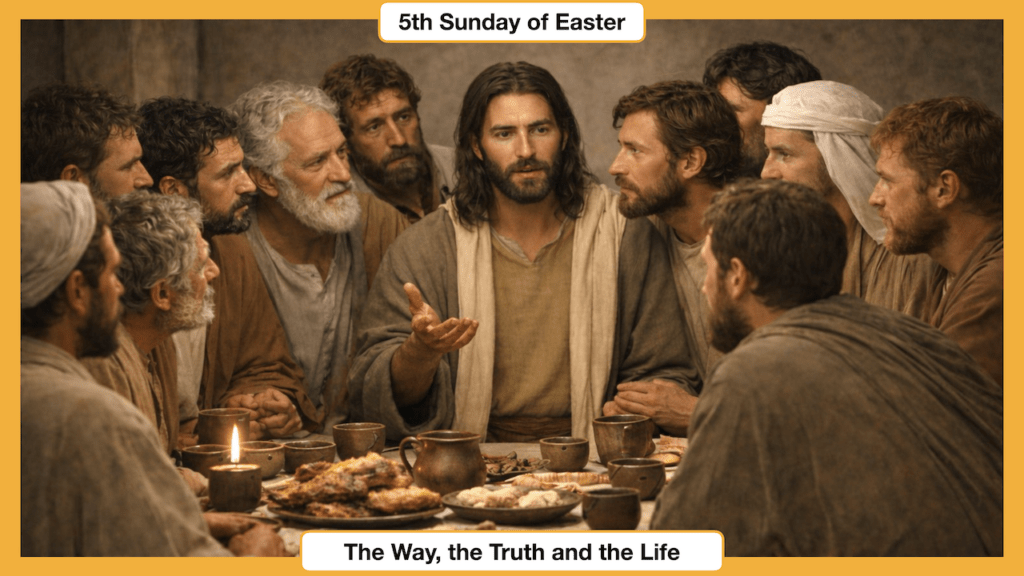
In these days when ordained clergy are so few and far between, you may be asked, or perhaps have been asked, whether your church has a priest. And in answer you may have said “Yes” but qualified your answer by saying that you have to share him with another parish. And that would almost certainly be the kind of answer that person was looking for. But another way you could deal with that question is to ask the one asking it to qualify the question. Are they talking about ordained clergy, or about the general priesthood of all believers? Because if they mean the former, Yes, one that you have to share but, if they mean the latter, your church, this church, has as many priests as it has people. And those priests are you.
This is an understanding of the Church that we find in quite a few places in the New Testament, and one of them is in this morning’s Epistle when St Peter tells his readers,
‘…you yourselves like living stones are being built up as a spiritual house, to be a holy priesthood, to offer spiritual sacrifices acceptable to God through Jesus Christ.’
We can get further insight into just what this means if we read it together with something St Paul writes in his Letter to the Romans:
‘I appeal to you therefore … to present your bodies as a living sacrifice, holy and acceptable to God, which is your spiritual worship.’
So to be the holy priesthood we’re called to be means to offer ourselves, body and spirit, to God, through Christ. It means to conform ourselves to Christ, because Jesus’ whole life was an offering of himself in God’s service. As Jesus himself says in this morning’s Gospel,
“Truly, truly, I say to you, whoever believes in me will also do the works that I do…”
But we mustn’t reduce this to something that’s merely functional. While priesthood in a sense, is about what we do, it’s much more about who and what we are. If, for example, we do the kind of good works that Christ did, but do them for our own glory, or because we think we’ll benefit from them in some way, far from serving God through Christ, we’re really using Christ to serve ourselves and that is not the way of Christ, and it is not priestly service.
But what is priestly service? What is a priest? All Christian priesthood, whether that’s the general priesthood of all believers or the particular priesthood of the ordained must be rooted in the priesthood and priestly service of Christ, and it must mirror the priesthood and priestly service of Christ. So if we want to know what Christian priesthood is like, what our priesthood must be like, we have to look at Christ’s priesthood.
Christ, like all priests were, and are, called to do, served God and his neighbour, and he did that in various priestly ways. He was a teacher. He was a man of prayer. He was a pastor. He led worship. And he offered sacrifices on behalf of the people. And these are all things that we are called to do as Christians are they not. We’re called to teach by proclaiming the Gospel. We’re called to pray. We’re called to be pastors by caring for the sick and needy. Our call to lead worship is nuanced because the Church reserves certain things to the ordained priesthood, but we can all lead our brothers and sisters in worship in some ways. We can read lessons, lead intercessions, lead singing, we know that this is something Jesus did. And we can offer sacrifices too. We can offer ourselves as those ‘living sacrifices ‘ St Paul speaks of. Christ’s sacrifice on the Cross, of course, was made once and for all so we can’t offer that sacrifice again, but we do plead Christ’s own sacrifice on the Cross at every Mass, every Eucharist, and in that way we’re enabled to take part in Christ’s sacrifice and share in it. So in all these ways we are a priesthood because we share in the priesthood of Christ. But I must add something here.
Some denominations of the Church have used the idea of the general priesthood of all believers to deny the need for an ordained priesthood. But the vast majority of the Church haven’t done that . The majority of the Church, including the Church of England, obviously, still call people from the general priesthood of all believers to be set apart as ordained priests.
The orders of ordained clergy we have now developed in the first century of the Church’s history, but the roots do go back to the very early Church. In the New Testament we find people being selected for leadership from among congregations and hands being laid on them to formally approve and sanctify their choice. So the case for calling people out to be ordained is a sound one. But what we mustn’t do is completely separate the ordained priesthood from the general priesthood of all believers.
And unfortunately, this has happened many times, and in more ways than one! On the one hand there’s sacerdotalism, a belief that the ordained are a distinct priestly class, over and above the laity. And I once heard that expressed in very simple terms when a priest once told me that,
“The business of the laity is to turn up, pay up, and shut up!”
But on the other hand, some lay people seem to have seen the existence of an ordained priesthood as absolving them from anything that we might call general priestly responsibility. And I’ve heard this expressed in simple terms too. Someone at a parish I once worshipped at was once asked if he’d be interested in coming to Bible study classes if the vicar ran them. His answer was,
“Whadda we wanna to study t’Bible for? That’s what t’vicar’s paid to do innit?”
Both of these ways of understanding priesthood are wrong. The ordained priesthood may be called from the general priesthood of all believers, but they are still part of that general priesthood and can’t exist without it. But the existence of an ordained priesthood in no way absolves the lay person from responsibility for fulfilling their own calling and service as part of the general priesthood of all believers.
In his book, The Christian Priest Today, the then Archbishop of Canterbury, Michael Ramsey, summed up the relationship between Jesus, priesthood and people in this way;
‘…the ordained priest evokes and serves the ministry of the people of God, and he sees so many of the laity eager to serve and to lead. While he is called to bring the expertise and the authority of his ordination into this scene, he knows that the expertise and authority are rooted in the humility of Christ.’
That was written over 50 years ago, but I think it is very much in line with what the Church is asking of us today. For the ordained priest to be an enabler, to evoke, to stir up, the people of God to lead and to serve. To fulfil their own vocation as part of the general priesthood of all believers. To be built up into the spiritual house and holy priesthood we are all called to be. And to do this not for their own glory, or for brownie points, but humbly in the name of Christ and to the glory of God. I must ask though, 54 years after Archbishop Ramsey wrote those words, how many are eager to lead and to serve today?
In an even earlier book, Ministerial Priesthood, written in 1897, but still considered a classic work on an Anglican understanding of priesthood, the author, R.C.Moberley, wrote that the office of ministerial priesthood, that is, ordained priesthood, is the consummation of the priestly office. By that he didn’t mean that the ordained priest is the ultimate of what a Christian priest should be, and I don’t know any priest who thinks that they are the ultimate expression of that, but that in the ordained priest, all that belongs to the whole Body of Christ, comes together and is focussed. The teaching, the prayer, the pastoral work, the leading of worship, and the offering of the Eucharistic sacrifice are all visible in the office of the ordained priest. But this is a representation of what belongs to the whole Body of Christ. Because in due measure these things belong to each individual member of the Body. And Moberley urges us not to be taken in by appearances; priesthood is not about what we do but about who and want we are, the spiritual reality that lies behind what we do and makes what we do real rather than simply empty ritual.
And that is something that applies not just to the ordained priest but to each and every member of the Church. To look at themselves and perhaps ask themselves, Why am I doing this? Why am I not doing that? What could I do, what can I do, to fulfil my calling as part of the general priesthood of all believers? To ask, in what ways to I need to be built up so that I can make the words I heard from Jesus in this morning’s Gospel personal, to me:
“Truly, truly, I say to you, whoever believes in me will also do the works that I do…”
Amen.
Propers for Easter 5, 3rd Sunday 2026
Entrance Antiphon
O sing a new song to the Lord,
for he has worked wonders;
in the sight of the nations
he has shown his deliverance, alleluia.
The Collect
Almighty ever-living God,
constantly accomplish the Paschal Mystery within us,
that those you were pleased to make new in Holy Baptism
may, under your protective care, bear much fruit
and come to the joys of life eternal.
Through our Lord Jesus Christ, your Son,
who lives and reigns with you in the unity of the Holy Spirit,
God, for ever and ever.
Amen.
The Readings
Acts 6:1-7
Psalm 33:1-2, 4-5, 18-19
1 Peter 2:4-9
John 14:1-12
Prayer after Communion
Graciously be present to your people, we pray, O Lord,
and lead those you have imbued with heavenly mysteries
to pass from former ways to newness of life.
Through Christ our Lord.
Amen.

