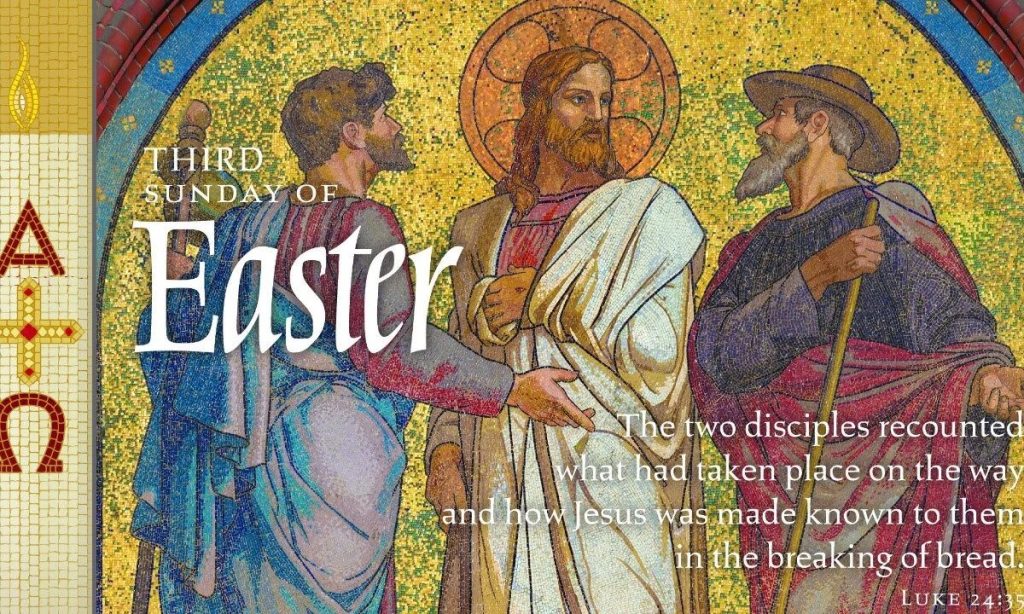
We’ve just heard what must be one of the best-known post-Resurrection Gospel stories in the whole of the Gospel, the story of the risen Jesus’ appearance to two disciples on the road to Emmaus. As well as being a very well-known part of the Gospel, this story is also a very important one. Usually, when people discuss this story, the focus is placed towards the end of the story and the two disciples recognising Jesus in the breaking of the bread. So this is very often read as a story about the Eucharist and about the need to recognise Jesus in the sacrament of Holy Communion. But while that is a very important part of the story, there are other elements of the story which are also of great importance to us both as individual Christians, as a local worshipping community, and as a Church.
First of all, lets recap the story and draw out a few of these important elements.
It’s the day of the Resurrection and two disciples are making their way from Jerusalem to Emmaus. They’d already heard that, in spite of what had happened just a few days earlier, Jesus was alive and they don’t know what to make of it. Suddenly, a stranger comes along and starts asking them what they’re talking about. They think there must be something wrong with this guy because he doesn’t know about what’s been going on in Jerusalem concerning Jesus. But, when they tell him, this stranger tells them that they’re fools; they might know what’s happened over the last few days, but they obviously don’t understand why it had happened. And so he starts to explain things to them. And they’re so engrossed in what he’s saying, and no doubt eager to hear more, that when they get to Emmaus, they ask him to stay and eat with them. And it’s only then, when this stranger breaks the bread that they recognise that he is actually, Jesus. Jesus disappears but they rush back to Jerusalem to share their story with others of their group.
It’s a wonderful story but it’s also a story with great meaning. In addition to the Eucharistic elements towards the end, this is a story about people coming to understanding and a deeper faith. We’re told of the two disciples that ‘Their eyes were opened’. As Jesus explains the Scriptures to them, they begin to understand the meaning of his death and Resurrection, to see why these things that had happened in Jerusalem had to take place, and how they fit into God’s plan of salvation. And they share their story and new found understanding with others, and by doing that, they begin to build up a community of faith.
But let’s put ourselves in the shoes of those two disciples on the road to Emmaus and consider how we might react in the same situation. If we were discussing some matter of faith and a stranger came along and asked us what we were talking about, would we be open to their question and tell them, or would we look at them with some suspicion, perhaps even ask what it had to do with them? If then, that person clearly didn’t seem to know something which we thought ought to be common knowledge, would we take the trouble to explain, or would we dismiss them as some kind of idiot who wasn’t worth talking to? If we did explain and that person then said we were fools, would we be prepared to listen to them explain why we were fools, or would we be offended get on our high horse and tell them to ‘take a hike’ or words to that effect? Would we think, or even ask, who this person thinks they are? Would we think, or even tell, this person that they’re not even one of us? Would we then think, or even tell, this person that we know what we’re talking about and think, or ask them, what do they know about it? And even if we were prepared to listen to what this know all had to say, how long would we be prepared to listen? Would we be prepared to invite them to join us for a meal and stay the night with us, or would we say something along the lines of,
“This is where we have to leave you, bye.”
And think,
“Thank goodness we’ve got rid of them.”
We might like to think that we’d react in the way those two disciples did, but if we’re honest, don’t we far more often react in exactly the way I’ve just described? We might think that those two disciples were speaking to Jesus, and we wouldn’t be. But they didn’t know that at the time, and anyway, aren’t we called to see Jesus in all people, so how do we know that the stranger who walks and talks with us isn’t Jesus, or someone sent to us by Jesus? And this is a particularly pertinent question when it comes to our dealings with other people in the Church.
I’ve been a communicant member of the Church since 1981. I’ve been in ordained ministry for over 20 years. And in all those years, and in all the parishes in which I’ve worshipped and served, one thing I’ve found people to be extraordinarily bad at, is sharing their faith, even with other Christians. And yet, this is essential to building up the Church.
So many people in the Church think in terms of ‘us’ and ‘them’ rather than in the ‘we’ that Christ himself calls us to do. We can never truly know what’s in a person’s mind, of course, so we can’t say exactly what people think, but judging by their words and actions, so many people in the Church seem to think that the ‘Church’ extends little, if any, further than the walls of the building they meet in to worship. Some people seem to want to restrict it even further by applying it only to those who do things in a certain way, their way. I’ve lost count of the number of times, for example, that I’ve heard people say,
“We don’t do that here!”
And whether the ‘that’ in question is right and proper according to the teachings of Christ and the tradition of the Church is irrelevant. The attitude seems to be one of, this isn’t our way so we’re not doing it.
But how much growth in faith and understanding do people miss out on because of this kind of attitude? How many opportunities to build up the Church, both locally and more widely, are missed because of this kind of attitude? How often do our eyes remained closed to Jesus walking with us in our brothers and sisters in Christ because of this kind of attitude? How often do our minds remain closed to what Jesus may be trying to say to us in and through others because we think we know better, because of this kind of attitude? And when this kind of attitude stops us from sharing our faith stories with others, rather than our story building up the Church, it breaks it down. Rather than building up the one Church that Christ called us to be, our parochialism breaks it down into our denomination against theirs, our church against theirs, our tradition against theirs, our group against theirs, our way against theirs. Our parochialism won’t let us see Jesus in the stranger who comes to us in faith, it won’t let us listen to the stranger who comes to us in faith. And rather than inviting the stranger who comes to us in faith to stay, we much prefer to show them the door because, in the final analysis, it’s our way or the highway.
The story of the meeting on the Emmaus Road tells us about the importance of recognising Jesus in the breaking of the bread, but it also tells us about the importance of recognising Jesus in the stranger. It tells us about the importance of listening to the one who comes to us in faith even if they’re not ‘one of us’. And it tells us about the importance of sharing what we know and what we’ve learned with others.
This is very much in line with something that the ex-Archbishop of Canterbury, Rowan Williams called ‘Living Catholicism’. Archbishop Rowan said that to be truly catholic, truly universal and able to speak to all people at all times, the Church must be a living Church. The Church mustn’t ignore its traditions but can’t become so set it its ways that it can’t grow and change. Living
Catholicism is about taking the best from all denominations and traditions to gain what Archbishop Rowan called an “enlarged access to truth” and using this to proclaim the Gospel to the world of the day.
And this is what we must do. The world of today is not the world of 40, 30, 20 or even 10 years ago. So what worked to bring people into church 40, 30, 20 or 10 years ago, isn’t necessarily going to work to bring them in today. So we have to change. We have to take the blinkers of parochialism off and look beyond our own tiny part of the Church. We might be very comfortable with ‘our way’ but if that way isn’t leading our church into growth then we have to look to other ways if we want our church to survive beyond our time. And if we can’t or won’t do that but adopt, as so many in the Church have and do, an ‘our way or no way’ attitude, then in the end, when we’re no longer here, it will be no way.
Amen.
Propers for the 3rd Sunday of Easter, 19th April 2026
Entrance Antiphon
Cry out with joy to God, all the earth;
O sing to the glory of his name.
O render him glorious praise, alleluia.
The Collect
May your people exult for ever, O God,
in renewed youthfulness of spirit,
so that, rejoicing now in the restored glory of our adoption,
we may look forward in confident hope to the rejoicing of the day of resurrection.
Through our Lord Jesus Christ, your Son,
who lives and reigns with you in the unity of the Holy Spirit,
God, for ever and ever.
Amen.
The Readings
Missal (St Mark’s)
Acts 2:14, 22-33
Psalm 16:1-2, 5, 7-11
1 Peter 1:17-21
Luke 24:13-35
Prayer after Communion
Look with kindness upon your people, O Lord,
and grant, we pray,
that those you were pleased to renew by eternal mysteries
may attain in their flesh
the incorruptible glory of the resurrection.
Through Christ our Lord.
Amen.

