It’s a very well-known saying, isn’t it, that when people come to the end of their lives, what they regret most of all isn’t the mistakes they made, nor even their failures, the things they tried to do but didn’t succeed at; no, what they regret most of all are the things that they simply didn’t do. And I think that must be true because isn’t it also true that, as we get older and look back on our lives, we’re more sorry about the things that we didn’t do, about the chances that we let pass us by, than we are about anything we did that went wrong or didn’t work out in the way we wanted it to? For example, my great ambition was to be a professional speedway rider but along with many others, I tried and didn’t make it. But that’s just the way it went, I’m not sorry that I tried. And when I speak to others who tell the same story, I don’t know anyone who feels any different; we all wish it would have worked out differently, but none of us are sorry for trying. As one person put it,
“We were all going to be the world champion weren’t we? Not many of us made it but we all had a lot of fun trying. “
It wasn’t all fun of course, it was very disappointing at the time not to mention physically painful at times (and I have the scars to prove that) but nevertheless, there’s no real regret involved because at least we tried.
I’m sure most people could say something similar about themselves because the only people who’ve never tried and failed at times, are people who’ve never tried in the first place. I think everyone must know this and yet so many people still don’t try. So many people never try to reach for something that’s beyond them, beyond their present capabilities that is. So many people seem far more content to stay where they are and simply dream about what they want, to content themselves with wishing things were different, than are prepared to try to turn those dreams and wishes into reality by actually trying to do something to make it happen. But why should that be?
I’ve said on many occasions that one of the things that holds the Church and parish churches back is that people are far too comfortable with the way things are, and they simply don’t want to move out of that comfort zone. People may very well realise that the way things are is not the way they should be, they might not even be the way they want them to be, they might wish things were different. And yet they still won’t do anything to change things because they themselves don’t want to change. It’s the can’t do, don’t know how to do, never done that here before, argument that I’ve spoken about so often. But people will say all these things whilst at the same time openly acknowledging that things aren’t right and wishing that things were different. So whilst they don’t want to change and shrink from change, they fully understand and accept that change is needed. The real problem is that people know things need to change but they want somebody else to do all the hard work that change involves, for them. They want somebody else to take the risks that doing something new and different involves. They want to stay in their comfort zone and let somebody else leave theirs and then, when all the hard work has been done, when all the disappointment and hard knocks of failure have been taken, let those people simply present them with a solution, on a plate. Why? We might say it’s simply a matter of laziness, but I think it’s far more about fear; fear of the unknown and fear also of losing control.
I’m sure that one of the most comfortable things about staying in our comfort zone is that we think doing what we know and are used to and comfortable with allows us to exercise control over our lives and over what we’re doing. Once we step outside that comfort zone, we’re venturing into the unknown and we can’t possibly be in control of what we don’t know about. And that frightens us. Just think, for example, how nervous we’ve all been on our first day at new job. We’re nervous, frightened, because we don’t know what’s going happen and we aren’t in control of what’s going to happen. Think how many people are frightened of going to the dentist. We know the dentist is going to do things that affect us, but we aren’t in control of what the dentist does. In fact some people are so afraid of the dentist that they exert the only measure of control they can and simply don’t go. That’s really what people in the Church who use the can’t do, don’t know how to do, never done that before, argument are doing; trying to exert control by refusing to be part of something they don’t understand because they’re afraid of it.
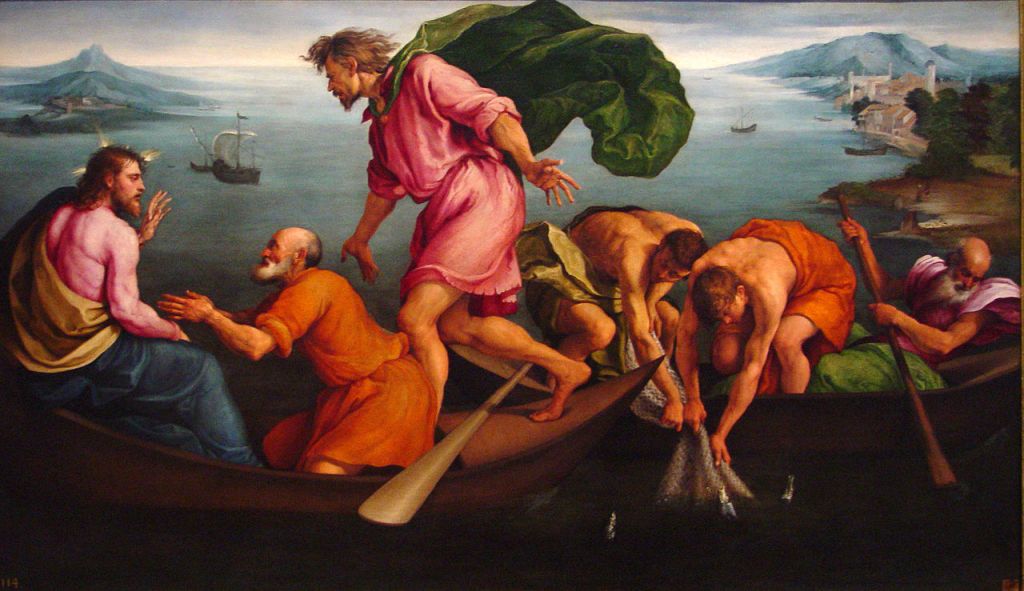
But the very reason we’re here, in church, this morning is because, 2000 years ago, a small group of people were prepared to face their fear of the unknown and do something different and new, something they probably thought they couldn’t do and didn’t know how to do because they’d never done it before. They were prepared to let go of the control they had over their own lives and hand it over to Christ and do what he told them to do. We know they didn’t always understand what he was asking them to do. We know he warned them about the difficulties and dangers they’d face in doing what he asked them to do. And we know that it was difficult and dangerous. But they were prepared to face that, and to stick at it in the face of those difficulties and dangers, and to keep going through the disappointments and physical hardships that came their way, because they knew it was what they had to do to make what they wanted a reality. And we see the start of it all in this morning’s Gospel.
I think this really is a wonderful story that we can learn so much from in terms of our own discipleship and of the need to overcome our fears and work for the Lord, even if that does mean doing new things or doing things differently than we have done, when we have to.
In this morning’s Gospel Jesus tells Peter,
“Put out into the deep and let down your nets for a catch.”
Peter was a fisherman, that’s how he made his living, so when it came to catching fish, he knew what he was doing. But he’d been fishing all night and had caught nothing and now suddenly, here’s this carpenter telling him what to do, how to catch fish. I think in similar circumstances, most people would be inclined to ask, ‘What do you know about it?’ and tell them to put out into deep water, at a running jump! But nevertheless, Peter, albeit with what I always imagine to be a tired ‘If you say so’ reply, born out of a, ‘Well we can’t do any worse than we are doing’ feeling, does as Jesus asks. The point here though is that whatever Peter’s feelings about what he was being asked to do, and the fact that the person doing the asking wasn’t himself a fisherman, he did it. Things weren’t working when he did things the way he’d always done them, the way he knew and understood, and so he was willing to try something else for Jesus’ sake.
And of course, doing things Jesus’ way worked, and it worked better than doing things the old, familiar way was working at that time. But that frightened Peter. He falls on his knees and says to Jesus,
“Depart from me, for I am a sinful man, O Lord.”
It’s very important here to note what Peter says. Just before this in the Gospel, Jesus had healed a man with an unclean demon. And the words that Jesus uses on that occasion to drive out the demon, are almost identical to the words Peter uses here to try to drive Jesus away. Jesus tells the demon to ‘Depart from him’. Peter tells Jesus to ‘Depart from me.’
In the earlier story, the demon says to Jesus,
“What have you to do with us, Jesus of Nazareth? Have you come to destroy us? I know who you are—the Holy One of God.”
Peter admits that he is a sinful man, and he recognises that there is a holiness about Jesus; he calls him ‘Lord’ and Luke tells us that Peter’s response was due to his astonishment at the size of the catch they’d just made. But the word we translate as ‘astonished’ is one that’s often used to show awe, wonder or amazement at a display of God’s power. So we get the sense here that Peter is overawed at what’s happened, he realises that the power of God is at work in Jesus and is terrified by it, not least because he thinks he’s unworthy to be part of whatever this thing is that’s happening. He thinks he’s not good enough and if he gets involved it will destroy him. So he says to Jesus, in effect, Go away and leave me alone. I’m not good enough to be involved in this. Leave me to what I know and understand. Or perhaps, I can’t do this; I don’t know how; I’ve never done or been involved in anything like this before and I don’t want to be now.
But we know that Peter did get involved. he did do this thing that he didn’t think he could. Of course he’d never done it before, and we know he made plenty of mistakes along the way. We know he went through hard times, times of crushing disappointment and physically hard times too. But he stuck it out. Which is just as well for us because if he and a handful of others hadn’t done that in those early days, and thousands of others in the intervening years hadn’t done that too, we wouldn’t be here in church this morning because there would be no Church to be part of and no churches to come to.
And now it’s our turn to put our fear to one side and do what’s needed to make sure that the next generation have a Church to belong to and churches to come to. It’s not easy but we can do it. I know for a fact we can. When we realised the extent of the roof work that needs to be done at St Mark’s people actually said, that they didn’t know how we were going to do it and that they’d never had to do anything like this before. Well, take a look at the Bell Tower this morning: it’s done. There’s more to do, a lot more, but what’s already been done proves that it can be done. And I know there are people at St Gabriel’s who are wondering how we’re going to afford a new central heating boiler. Well, we’re going to find a way and we’re going to do it. And it’s the same with anything we need to do for the Church and our parish churches. If it needs to be done, we just have to find a way to do it. If that means getting out of our comfort zone, so be it. If it means doing things we think we can’t do, we’ll just have to change our can’t do attitude to a can-do attitude. If it means doing things we don’t know how to do, we’ll just have to learn how to do them. And if it means doing things we’ve never done before, we’re just going to have to do them for the first time. We have to remember that we’re doing these things for the Church and for our parish church, and that means we’re doing them for Christ. And when we come to the end of our earthly lives, I’m sure that none of us wants to have to look back and regret the things we might have done and could have done, but didn’t do for him.
Amen.
Propers for the 5th Sunday of Ordinary Time 9th February 2025
Entrance Antiphon
O come, let us worship God and bow low before the God who made us,
for he is the Lord our God.
The Collect
Keep your family safe, O Lord, with unfailing care,
that, relying solely on the hope of heavenly grace,
they may be defended always by your protection.
Through our Lord Jesus Christ, your Son,
who lives and reigns with you in the unity of the Holy Spirit,
God, for ever and ever.
Amen.
The Readings
Isaiah 6:1-8
Psalm 138:1-5, 7-8
1 Corinthians 15:1-11
Luke 5:1-11
Prayer after Communion
O God, who have willed that we be partakers
in the one Bread and the one Chalice,
grant us, we pray, so to live
that, made one in Christ,
we may joyfully bear fruit
for the salvation of the world.
Through Christ our Lord.
Amen.
 Parish Church of St Mark Chadderton