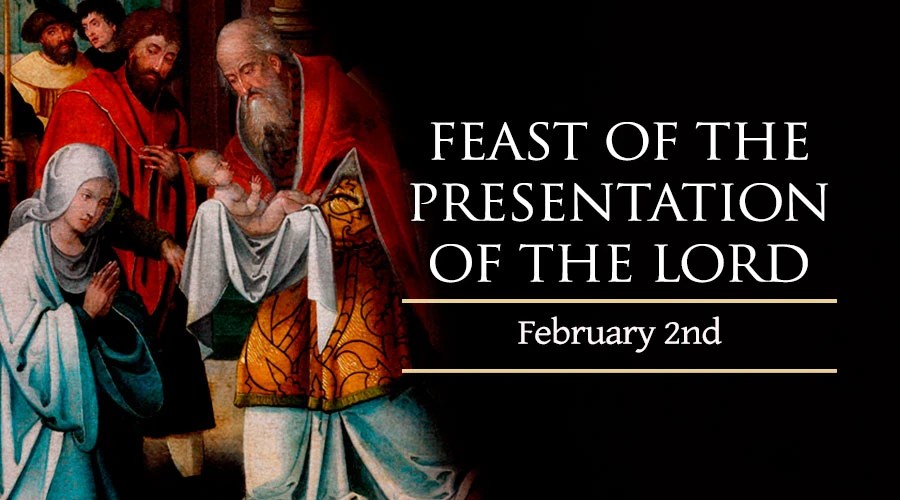
If I were to ask what this morning’s Gospel is really all about, what would you say? I’m sure some would say it’s about Jesus being taken to the temple to be presented to the Lord, forty days after his birth, so that Mary and Joseph could perform the Jewish rites of purification that the Law said were necessary after childbirth, and in particular after the birth of a first-born son. Some would no doubt add that it’s about the Holy Family meeting Simeon and Anna who recognised Jesus as the Messiah and who praised God and spoke about the child. Some might even say that it’s the last Christmas story, which it is because it’s the last story in the Gospels about Jesus as a baby. And if you were to say any or all of those things, you’d be right. But what is this story really about? What lies behind the story and at the heart of the story? What is Luke trying to say to us through the story?
In that respect, I’m sure that many people would say that what lies at the heart of this story is the prophecy of Simeon.
“Lord, now you are letting your servant depart in peace, according to your word; for my eyes have seen your salvation that you have prepared in the presence of all peoples, a light for revelation to the Gentiles, and for glory to your people Israel.”
This prophecy is central to the story in more ways than one. For one thing it comes right in the middle of the story so in terms of structure, Luke’s telling of the story leads up to Simeon’s prophecy about Jesus: that he is the Saviour, the Messiah: that he is the light of the world, the one who will reveal God’s truth to the whole world, to all people: the one who will both teach and show Israel and the world what it really means to be and live as God’s people. So, just like the story of the shepherds of Bethlehem and the story of the Wise Men, this is a story about revelation, about who this child really is. And then the story leads away from this and ends with the Holy Family going home to Nazareth.
But as important as Simeon’s prophecy is to the story, and as all parts of the story are in their own way, there’s another theme that runs through the whole story, from the time the Holy Family arrive at the temple, through the prophecy of Simeon and on to the time the Holy Family leave the temple to go home. And that theme is obedience to the Law, the Law of the Lord.
This is a short story really, only eighteen verses, but in those eighteen verses we’re told no less than 6 times that what happened in the temple that day was done in accordance with the Law.
So what Luke seems to be saying to us, perhaps above all, is that the Holy Family, the human family that God chose for his Son to be born into, to grow up in and to live as part of, is a family that was obedient to the Law. They were good, faithful people who lived their lives in obedience to God and did everything that God required of them. And that is the lesson for us and our own lives in this story.
Mary and Joseph took Jesus to the temple that day, as we’re told, to fulfil their obligations under the Law; for Mary to be purified after childbirth, for Jesus to be consecrated to the Lord and to offer a sacrifice to God for these things. And at the heart of this was thanksgiving, giving something back to God for what God had given them. We might find what they gave to God in thanksgiving for the birth of their first-born son quite odd because their way of showing their thanks to God was to sacrifice two birds. Some, I’m sure will find it abhorrent even to kill animals as a way of showing our thanks to God. But I’ve said many times that we can’t and mustn’t judge these things according to our own views: we have to try to look at them through the eyes of the people of that time, and at that time, animal sacrifice was a very acceptable way of showing thanks to God. What we need to do is to try and understand why animal sacrifice was an acceptable way of showing thanks to God for the birth of a first-born son.
For the people of those days, the idea of animal sacrifice as a way of giving thanks to God was about giving something to God commensurate with what God had given them. So, in thanksgiving for a life, a life was given back. We read about the particular sacrifice made by Mary and Joseph in the temple on this day in the books of Exodus and Leviticus and in Exodus it speaks about redeeming the life of a first born with a sacrifice. So the Law gives the sense of animal sacrifice as buying the life of a first-born from God and paying for that life with a payment in kind: a life for a life. We see this idea elsewhere in the Law too don’t we, in the ‘life for life, eye for eye, tooth for tooth’ approach to crime and punishment. Jesus absolved us from the obligation to follow that particular aspect of law, and his death on the Cross absolved us from any requirement to make animal sacrifices to God, but he didn’t absolve us from our obligation to give thanks to God in a way commensurate with what we owe to God. But do we give thanks to God in this way?
Jesus was only 40 days old when he was taken to the temple so the Holy Family must have travelled to Jerusalem from Bethlehem. That’s a journey of about 10km, 6 miles, and they would have walked there, so it would have taken them about 2 hours. But how many people who say that they’re Christians and so presumably believe that they owe everything to God, won’t go to church if they can’t drive there or be driven there, even if the church is only a few minutes’ walk away? How many people won’t go to a church service anywhere else but their own church because they say it’s too far to travel, even if they are offered transport? How many people in fact, simply stop going to church completely if their own parish church closes down and they have to travel a little further to worship and give thanks to God? We know all these things happen, but how is that in any way commensurate with what we owe God for all he’s done for us? He sent his own Son from heaven to walk this earth and suffer and die for us and yet so many people can’t be bothered going to church to show their thanks for that because it’s inconvenient.
As Christians we believe that God is with us always. We believe in Jesus’ promise to be with us until the end of time. We believe that God sent the Holy Spirit to us to be our guide and comforter. We believe that God is with us at every moment of our lives from the cradle to the grave and beyond, that he knows us and loves us eternally. And yet how many people who confess that belief seem to think that they’ve done enough to show their thanks to God in return, simply because they spend an hour in church on a Sunday morning? How many people refuse to do more because they’re ‘too busy’ or ‘don’t have time’? How many won’t do more because they have in the past and say that they’ve ‘done their bit’ and think it’s about time ‘someone else had a go’? How is that commensurate with what God has done and does do for us? Does God only love and care for us while we’re in church, or only on Sunday morning? Is God too busy holding all creation in the palm of his hand to be bothered with us as individual people? Did God send his Son to offer himself on the Cross once and for all and then say,
‘Well, that’s it, I’ve done my bit, it’s up to you now’
If we really do believe what we say about God and his care for us, how is the part-time commitment people so often show in response in any way proportionate to his eternal commitment to us?
One of the ways we’re asked to show our thanks to God is through our giving, through our financial support of the Church and our parish church. I have, in the past, spoken about what people need to give ‘on average’ to adequately support their parish church. But I have never and will never tell anyone what they, as an individual, should be giving. I don’t know people’s individual circumstances, they do. I don’t know how much they can really afford to give, only they know that. But what I will say is that each and every one of us should give serious thought to what we can afford to give.
You’ve probably all heard me use a prayer when the collection plate is brought forward at the Offertory on Sunday. It goes like this;
Yours, Lord, is the greatness, the power,
the glory, the splendour, and the majesty;
for everything in heaven and on earth is yours.
All things come from you,
and of your own do we give you.
That’s a prayer in which we state our belief that we owe everything we have to God, and that we offer back to God something of his own goodness towards us; it’s very much in the ‘life for life’ mould. And yet, whilst I don’t know what any individual gives to their parish church, I do that some people don’t take that commitment seriously enough to give what they give serious thought. I know that some people have stewardship envelopes but rarely if ever use them. I know that some people never increase what they put in their envelopes, and probably never have done since they first took them 20, 30, 40 or however many years ago. I know that some people simply put their hand in their pocket on a Sunday morning and throw in whatever loose change they happen to have. Perhaps those who do this think,
‘Oh, that’ll do.’
But if we’re talking about giving something back to God commensurate with all that God has given and does give to us, in thanksgiving to God, that simply will not do. How is a handful of loose change in any way a fitting ‘Thank you’ to the God who has given so much to us and to his Son whose Church we belong to and that he gave his all, even his very life for, and for us?
If we want to be the people of God we claim to be, then we have an obligation to give thanks to God for all he has given to us. And our thanksgiving should be commensurate with what we’ve received. So if all we can be bothered to give to God is a handful of loose change while we spend an hour in church on Sunday morning, so long as we don’t have to travel too far to do it, that is, what does that say about the depth of our thankfulness? What does it say about the value we place on all that God has done for us and has given us?
The Holy Family did all that was required of them by the Law of The Lord. We, in the Church, are called to be part of that family because Jesus himself said that those who do the will of God are his mother and brothers and sisters. So let’s be part of his family and like Mary and Joseph let’s do what’s required of us and give the thanks to God that’s befitting him for all he’s given to us.
Amen.
Propers for The Presentation of the Lord (Candlemas) 2nd February 2025
Entrance Antiphon
Your merciful love, O God, we have received in the midst of your temple.
Your praise, O God, like your name, reaches the ends of the earth;
your right hand is filled with saving justice.
The Collect
Almighty ever-living God,
we humbly implore your majesty that,
just as your Only Begotten Son
was presented on this day in the Temple
in the substance of our flesh,
so, by your grace,
we may be presented to you with minds made pure.
Through our Lord Jesus Christ, your Son,
who lives and reigns with you in the unity of the Holy Spirit,
one God, for ever and ever.
Amen.
The Readings
Malachi 3:1-4
Psalm 24:7-10
Hebrews 2:14-18
Luke 2:22-40
Prayer after Communion
By these holy gifts which we have received, O Lord,
bring your grace to perfection within us,
and, as you fulfilled Simeon’s expectation
That he would not see death
until he had been privileged to welcome the Christ,
so may we, going forth to meet the Lord,
obtain the gift of eternal life.
Through Christ our Lord.
Amen.

