Anyone who takes their faith seriously will know that to be a Christian, and especially to grow in faith and to be more Christ like, involves quite a lot of practice and self-reflection. I think that’s simply a matter of common sense. If we want to improve and be better at anything we do, the first thing we have to do is to do that thing regularly, in other words, we have to practice. And another essential part of improving at anything is to compare ourselves to those who are better than we are at what we’re doing. We do that both so that we can see how good we actually are at what we’re trying to do and so that we can learn from those who are better than we are at what we’re doing, how to be better at it.
So to be a Christian, the first thing we have to do is to try to be a Christian, in other words, we have to try our best to practice what we preach. But even when we do that, we also have to engage in some self-reflection from time to time. We have to take an honest look at how good we are at being a Christian and compare ourselves to those who are better at it than we are so that we know where we need to improve and how to improve. I’m sure we all know this because, as I’ve said, I think it’s simply a matter of common sense. The problem we can have though, is in putting these things into practice.
One difficulty we can have is in over emphasising our faults and failings, and under estimating, or even ignoring the good things we do and the things we do well. For example, an examination of conscience is a very useful tool that we can use as an aid to self-reflection. For those who haven’t used one, an examination of conscience is a step-by-step way of helping us to call to mind the wrong we’ve done and the good we haven’t done. But, if you think about it, if the examination helps us to do those things, it also helps us to do the opposite and recall the good we’ve done and the wrong we haven’t done.
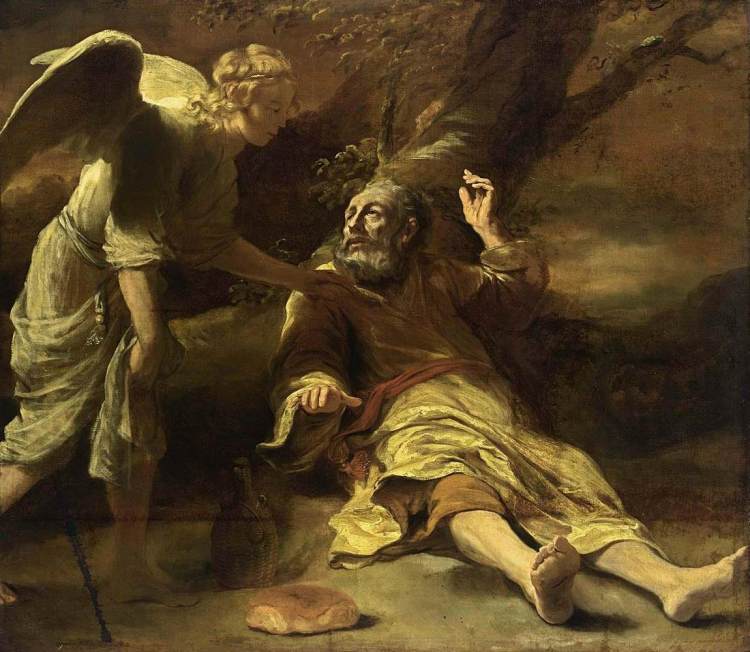
Unfortunately, most people seem to use the examination in a negative way and see it as simply a means of identifying how bad they are at practicing their faith. I know that because it’s exactly what I did the first time I used an examination of conscience. I was given an examination of conscience by a priest who asked me to use it and then meet with him again to go through it with him. This morning, we read about Elijah asking the Lord to take his life because he was no better than his ancestors. And I can identify with that because, after I’d used an examination of conscience for the first time, I thought I must be the worst person, and the biggest sinner in the world. Later though, when I went to see the priest and discuss it, he said that whilst what I’d done with the examination was good in that I’d used it to pick my faults and failings, I’d completely ignored the positive side of the examination because I hadn’t used it to identify the good things I was doing and the things I was doing well. And I know other people do the same thing because, now that I’m a priest myself, I’ve had the same conversation with those who’ve come to me after they’ve used an examination of conscience.
So an examination of conscience is a good aid to self-reflection. It can help us to grow in faith and be better Christians and for that reason it’s something I do recommend that all Christians use from time to time. But it has to be used in the right way. It has to be used to pick up our good points as well as our bad because if it’s not used in that way, it can lead people to think that they’re worse than they really are. So terrible and sinful perhaps that they’re tempted, as Elijah was, to simply give up.
Another problem we can have, and one that’s far more common, and far more dangerous in terms of hindering our ability to grow in faith is in emphasising the good we do and under estimating or ignoring our faults and failings. In fact, people who do this can often give the impression at least that they think they don’t have any faults and failings!
As we know, we do find people in the Church who think, and say, that no one does as much for the church as they do. But don’t we also find that these are the people who are the most likely to be involved in arguments in the Church? The people who are most likely to fall out with and call and criticise other members of the Church? And this usually stems from a belief by the people who say they do so much for the Church that what they do is more important than what anyone else does. And by implication, doesn’t this mean that they think they are more important to the Church and in the Church than others?
And yet in the Beatitudes, the very first thing Jesus tells us is that the kingdom of heaven belongs to the humble, the poor in spirit. So pride, and especially spiritual pride, is one of the worst sins of all. And in this morning’s reading from his Letter to the Ephesians, St Paul says that we should
‘Let all bitterness and wrath and anger and clamour and slander be put away from you, along with all malice.’
Or, depending on which translation we’re reading, that we should
‘Never have grudges against others, or lose your temper, or raise your voice to anybody, or call each other names, or allow any sort of spitefulness.’
And in his preface to these statements, St Paul identifies them as things which
‘… grieve the Holy Spirit of God.’
In other words, all these are things that are incompatible with the Christian faith. They shouldn’t be found in the lives of Christians and must be ‘put away,’ they must be renounced and discarded from our lives.
I think what really lies at the root of this problem though, is a lack of honest self-reflection. If we’re unwilling to do something like an examination of conscience, we don’t pick up on our faults and failings, our sins, and so we don’t see ourselves as we really are. As we really are as measured by the standard of Christ’s example, that is. If we can’t do that, we can lose sight of what being a Christian is all about. We can become so wrapped up in what we do, especially if we do it well, that what we do becomes the be all and end all of what Christianity and the Church is all about. What it’s all about to us, and also what we think it should be all about to everyone else too.
I well remember one occasion, for example, when the enrolling member of the Mother’s Union in one parish in which I served, quite literally, ranted and raved at me in church one morning, in the presence of a number of other people, when I turned up in church to take a funeral. The cause of her anger, was that I had arranged a funeral in church that morning and she wanted to set out some tables for an afternoon tea party the Mother’s Union were having at 4pm that afternoon. In her eyes, I had been totally inconsiderate in arranging the funeral that day and she told me, in no uncertain terms, that I should have consulted with her before I arranged anything in church that day. She would have told me that we couldn’t have a funeral in church that day and I could then have told the funeral director and the bereaved family that they would have to have the funeral on another day. But, she said, as I had arranged the funeral, I needed to get a move on with it and clear everybody out of the church as soon as possible so that she could get on with setting up for the tea party.
There’s nothing wrong with the Mother’s Union having an afternoon tea party, and that lady did a very good job as the enrolling member of the Mother’s Union in that parish, but I ask you, as Christians, which was more important, conducting a funeral, commending a departed soul into God’s keeping and bringing some comfort and reassurance to a bereaved family, or the Mother’s Union having the sole use of the church for a whole day to set up a tea party? Which do you think was the right thing to do, in the Lord’s eyes, conducting a funeral in a dignified and respectful manner and leaving the Mother’s Union a few minutes less than the 5 hours or so that they were going to have to set up for their tea party, or rushing through the funeral and rushing the bereaved family out of church so that the Mother’s Union could have a few minutes more than the 5 hours or so they were going to have to set up their tea party?
People can become so wrapped up in what they’re doing that what they’re doing becomes more important than anything else, and it can lead them to think that what they’re doing should be more important than anything else to everyone else too. But isn’t this a problem Jesus himself encountered? Didn’t he ask people to follow him but found that they were too concerned with other things to follow? And didn’t he tell the scribes and Pharisees that they were so concerned with the minutiae of the law, that they were neglecting it’s weightier matters? And isn’t that tantamount to saying that they were so wrapped up in their own particular concerns that they’d lost sight of what the law was really all about, and of what was really important about their faith?
In our Gospel this morning, Jesus tells the Jews, which in John’s Gospel means the religious authorities, to stop complaining to each other and to come to him to learn the teaching of God the Father. And that is what we are called to do too. The most important thing for us to do as Christians is to learn from Christ, from his teaching and example, and then to reflect on our own lives to see how well we measure up to his teaching and example. If we don’t measure up very well, we’re called to make our best effort to be and do better. Where we do measure up well, we can carry on with those things. But we can’t allow those things we do well to go to our heads and allow us to think that we’ve no faults and failings to address because we do, we all have. So we have to carry on doing what we do well without neglecting to do our best improve where we need to. And we have to remember too that the business of running the Church and all the peripheral activity that goes on around the Church in connection with that business, is not what being a Christian is all about, nor is it what the Church is all about. So no matter how much we do in that respect, we can’t allow ourselves to think doing a lot of that business absolves us from the need for that self-reflection that brings us closer to the teaching and example of Christ and to fulfilling what Jesus called the weightier matters, justice, mercy and faith, and above all, love of God and of our neighbour.
Amen.
The Propers for the 19th Sunday of Ordinary Time can be viewed here.

