One of the hardest things about the undoubtedly hard business of being a Christian, is that it’s a very counter intuitive thing to do and to be. If we think about the way human society usually works, we find that it operates on the basis of working for rewards. And from a very early age, we’re taught to think the world works like that. We’re conditioned by everyone around us to believe that the world works like that. How many of us, when we were children, were told, for example, that we had to eat our dinner if we wanted a pudding? How many of us were told that, if we weren’t good, Father Christmas wouldn’t come? And as we get older, so it goes on. At school and college we’re told to work hard to get good grades so that we can get into university or get a good job. And at work we’re told to work hard so that we can get a pay rise, or a promotion, or a better job. At the moment, in the Olympic Games, we’re seeing athletes from all over the world who’ve worked hard for many years in the hope of competing in the games and, hopefully, winning a medal in the games. In fact, in any area of life we can probably think of, we’re taught to believe that hard work brings rewards. And the rewards that hard work brings are measured in very tangible terms, whether they’re in material things that we can actually hold in our hands, or in the nice, comfortable standard of living that our hard work allows us to enjoy.
But being a Christian isn’t like that. Being a Christian involves a lot of hard work, a lifetime of hard work but, unless we abuse our position in the Church, for example, and in some way use our faith for selfish purposes, that hard work doesn’t come with the promise of any tangible reward, at least in the way rewards are usually measured. No matter how hard we work at being a Christian, it probably won’t get us any more money. It probably won’t get us a better job. We’re highly unlikely to win any medals for being a good, hard-working Christian. And it’s unlikely that working hard at being a Christian will get us a better standard of living as that’s usually measured, because to be a Christian we’re called to deny ourselves some of the pleasures of earthly life, and to share the earthly riches we do have with those who have less, rather than keeping and enjoying them simply for ourselves. Of course there is a reward on offer for working hard at being a Christian, a very great reward, the greatest of all rewards in fact, the promise of eternal life.
But that’s obviously not a reward we can have and enjoy in this life. And, as human beings, we’re taught to work for rewards we can enjoy in this life, and we’re conditioned by the world to expect tangible, earthly rewards for our hard work. So being a Christian and working hard to be a better Christian, is a very counter intuitive thing to do because it doesn’t fit in with the ‘work for reward’ way we expect things to work.
This isn’t a new problem for disciples of Christ though because it’s surely what we’re seeing in this morning’s Gospel. Our Gospel reading this morning follows on directly from the story of Jesus’ feeding of the 5,000 which we read last Sunday. We read then that a large crowd was following Jesus because they’d seen the ‘signs’ that he was giving by curing the sick. We know that Jesus often asked people to follow him, and these crowds certainly were doing that. But this morning’s Gospel tells us that cut no ice with Jesus. The crowds had gone looking for Jesus and had eventually taken to their boats and put out to sea to find him. So they’d gone to quite some trouble and hard work to follow Jesus. But, when they found him, Jesus’ response was to tell them, to all intents and purposes, that all that effort was for nothing, because they were following him for the wrong reasons. They weren’t following Jesus because what they’d seen had brought them to faith. They weren’t following Jesus because they wanted to learn anything from him. They weren’t following Jesus because they were looking for any kind of lasting, spiritual nourishment. No, they were following Jesus because they were looking for another free nosh-up. In other words, they were prepared to go to some trouble to follow Jesus, but they wanted something immediate, physical and tangible in return for their hard work.
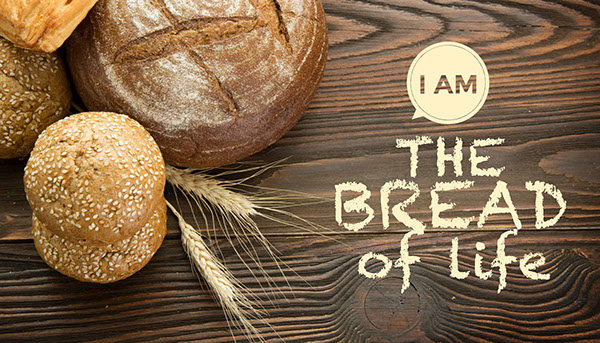
Jesus makes it quite clear, that those who really want to follow him, need to follow him for a different reason. They need to work for an eternal reward, not a perishable, earthly reward. And they need to follow him so that he can give them that eternal reward, the bread that God has sent from heaven to give life to the world. And that bread of life is Jesus himself.
In many ways, this Gospel story is very similar to the story of Jesus and the Samaritan woman at the well, which we also read in St John’s Gospel. There Jesus speaks of himself as ‘living water’ and says,
“… those who drink of the water that I will give them will never be thirsty. The water that I will give will become in them a spring of water gushing up to eternal life.”
In this morning’s Gospel when Jesus speaks about himself as the ‘bread of life’, he says,
“Whoever comes to me will never be hungry, and whoever believes in me will never be thirsty.”
These statements obviously can’t be taken as referring to physical hunger and thirst. No matter how closely we follow Jesus, no matter how hard we work at being a Christian, we still need to eat and drink because we still get hungry and thirsty in a physical sense. And they can’t be taken as referring to another type of hunger and thirst either, the hunger and thirst for an end to the world’s problems. The hunger and thirst that following Jesus satisfies is a deep, spiritual hunger and thirst. Following Jesus satisfies our spiritual hunger and thirst to know God. It satisfies our hunger and thirst to know that there is a purpose in life and to life. Following Jesus satisfies our hunger and thirst to know that this life is not all there is to life because it satisfies our hunger and thirst to know what happens to us, when this life ends.
Once we have faith in Jesus, there’s no need for us to hunger and thirst for the answers to these eternal, and spiritual things because we have the answers. What we need to do then, is to work for the promised reward, which as Jesus tells us, as he told the Samaritan woman at the well, and the crowds who followed him after they’d been fed with bread and fish on the mountain, is to be raised to eternal life. And if we have faith in Jesus, knowing what the promised reward is, then no matter how counter intuitive the hard work we have to do to achieve a reward we can’t see and touch might be, we ought to be prepared to put that hard work in, surely? Because there can be no greater reward.
If we’re not prepared to do that, if we prefer to put our efforts into achieving earthly rewards, then we’re simply going to be like the rich fool in the parable in St Luke’s Gospel. I’m sure we all know what happened to him. He worked hard to make and store up earthly riches for himself and then, at the very moment he felt satisfied, he finds out his life is going to end and so, in the end, all his hard work has been for nothing. When he died, his reward died with him because he hadn’t worked for anything of eternal value.
I’m sure none of us want to be rich fools. So let’s not simply look to short term rewards for our work by putting all our efforts into seeking earthly rewards. Let’s not simply work for the kind of food that perishes but, as Jesus urges us, let’s work for the food that lasts to eternal life by putting our best efforts into following him.
Amen.
The Propers for the 18th Sunday of Ordinary Time (Trinity 9) can be viewed here.
 Parish Church of St Mark Chadderton