Sing a new song to the Lord! Sing to the Lord, all the earth. Truth and beauty surround him, he lives in holiness and glory.
The Collect
Almighty God, whose Son revealed in signs and miracles the wonder of your saving presence: renew your people with your heavenly grace, and in all our weakness, sustain us by your mighty power; through Jesus Christ your Son our Lord, who is alive and reigns with you, in the unity of the Holy Spirit, one God, now and for ever. Amen.
Wedding Feast at Cana
Julius Schnorr von Carosfeld, 1819
I’m going to start my sermon this morning with a warning: please be advised that some may find the content offensive. To be specific, I’m going to start my sermon with a joke which some people may not find funny. But if this applies to you, please listen on because there is a very good point to it.
I came across the joke in a cartoon that someone showed me just a couple of days ago and which, just by chance as far as they were concerned, is about our Gospel reading this morning, the Wedding in Cana. The cartoon showed Jesus stood next to a man lying in the street, face down with his head resting in the inner elbow joint of one arm, whilst clinging to Jesus clothes with his other. Jesus says, “No, I’m not going to cure your hangover!” To which the prostrate figure on the ground replies, “But Lord, you’re the one who changed the water into wine!”
Some of you may find that funny, some of you may not, but if we put humour to one side, I think that joke, that cartoon, does tell us something about the strangeness of this Gospel story. St John tells us that this was the first ‘sign’ through which Jesus ‘manifested his glory’. He also says at the end of this story that ‘his disciples believed in him’ which leads us to believe that it was through this rather strange sign that they came to faith. But what is this sign, what’s it all about? It’s a miracle story, but it’s a strange sort of miracle, isn’t it? It’s not a healing such as many other miracles that Jesus performed. It’s not like the stilling of the storm when Jesus saved his disciples from danger. It’s not like Jesus’ miracles of raising people from the dead. It’s not even like the miraculous feeding of thousands of people, because on those occasions, those who were fed were following Jesus and had no food. At the wedding in Cana, the guests had already had plenty to drink, as the wedding steward said,
“Everyone serves the good wine first, and when people have drunk freely, then the poor wine. But you have kept the good wine until now.”
Some translations suggest that the guests were already drunk when Jesus turned the water into wine, so this sign, this miracle, doesn’t seem to be about helping anyone in need but rather about catering to people’s excesses, to provide the means for people who’d already had enough, and perhaps more than enough to drink, to drink even more. No doubt some of the guests would have been hung over and Jesus had provided the means for them to get in that condition, hence the joke cartoon that I mentioned at the start of my sermon.
So it’s a strange story from that point of view but also because it’s a story that contains what appears to be an argument between Jesus and his mother, Mary. When Mary tells Jesus that the wine has run out, he seems to answer her in a harsh and disrespectful way;
“Woman, what does this have to do with me and you? My hour has not yet come.”
To which Mary seems to respond by simply ignoring what Jesus has said.
So this Gospel story of Jesus’ first sign, the changing of water into wine at a wedding feast does seem to be a strange sort of miracle set in a strange story. It’s a story full of symbolism too, about old wine and new wine. But, at a human level, what was going on at that wedding in Cana?
To begin to understand that we have to go back to the beginning of the story where we’re told,
‘On the third day there was a wedding at Cana in Galilee, and the mother of Jesus was there. Jesus also was invited to the wedding with his disciples.’
We notice that Jesus’ mother, Mary, is mentioned before Jesus so it would seem that, of the two, Mary was considered to be the more important guest at the wedding. Some people have suggested that, as she knew the wine had run out, Mary may have perhaps had some kind of official role at the wedding, perhaps as a family member of either the bride or groom. That’s speculation, but as the story begins, we’re left in no doubt that Mary was a more important person at the wedding than her son.
Then, when Mary finds out that there’s no more wine left and tells Jesus, we have this strange discussion between them. Mary tells Jesus the wine’s run out. Jesus responds by calling his mother, ‘Woman’ and asking her what that’s got to do with him, or her. His hour, the time for him to reveal his true identity, hasn’t come yet. But Mary seems to completely ignore Jesus’ words and in response to them, she simply tells the servants at the feast to,
“Do whatever he tells you.”
Sometimes Mary’s response is taken to mean that, in ignoring his words, she forced Jesus’ hand by putting him in a situation in which he had to do something. He had to act and reveal, at least something of his glory. For that reason, Mary is sometimes credited as being the catalyst for Jesus’ ministry. But there is another way to look at this conversation between Mary and Jesus which turns that idea on its head.
In many of the miracle stories we read in the Gospels, when people come to Jesus for help, his immediate response is to take a step back. He seems to want to put some distance between himself and the one who’s asked him for help. And there’s a delay before Jesus acts. If we think about the story of the Raising of Lazarus, for example, Jesus is told that Lazarus is ill, and he’s asked to go quickly to Lazarus’ aid. But Jesus waits; he waits for 2 days; until Lazarus has died, before he even sets off for Lazarus’ home in Bethany. And in the story of Bartimaeus, the blind beggar who asked Jesus to restore his sight, Jesus’ initial response was to ask Bartimaeus,
“What do you want me to do for you?”
Which is very similar to his response to Mary at the wedding feast isn’t it? We could very easily rephrase Jesus’ words on that occasion, “What is that to me and you?” as “What do you want me to do for you?”
And Jesus response to his mother isn’t so harsh and abrupt as it seems. Calling her ‘Woman’ is simply a way of putting a distance between himself and her request. Mary was Jesus’ mother but in coming to him with a request to do something about wine having run out, was Mary coming to Jesus as her son, or as God’s? And if it was as God’s Son, there could be no favouritism shown to Mary; her request would have to be treated like anyone else’s request for Jesus to use his divine power. And as we know from the Gospels, Jesus never acted, never performed any miracles without a confession of faith from the one making the request.
If we put all these things together, we can interpret this miracle at the Wedding in Cana as story about faith, and discipleship. Jesus’ response to Mary,
“Woman, what does this have to do with me and you?
can be seen as Jesus putting a distance between himself and his mother until she has clarified their relationship in faith; her own faith in him. Mary may very well have been his mother but on this occasion, she was making a request of him to act as God’s Son, to use his divine power and so Mary had to make a confession of faith in Jesus as God’s Son. And she did. Far from ignoring Jesus’ response and forcing his hand, Mary’s instruction to the servants to do whatever Jesus told them to, was the answer to his question. It was Mary’s confession of faith that she not only believed Jesus could provide more wine but that he would. And her instruction to the servants was also a proclamation of her faith in Jesus to them, and an exhortation that they should have faith too and show it by doing whatever he told them to do.
We also find in this story an image of the right relationship between a disciple and their master. Later in John’s Gospel, Jesus tells his disciples that
“A servant is not greater than his master.”
The story of the Wedding in Cana begins with an identification of Mary as a more important guest than Jesus but, by the time Jesus tells the servants to fill the jars with water, those roles have been reversed. In her confession of faith and instruction to the servants, Mary submits to the authority of her son who, although he is her son is also God’s Son and her Lord and Saviour. Just like John the Baptist before her, Mary who had such a great part to play in the story of our Salvation prior to Jesus’ earthly ministry, has to become a lesser figure as Jesus’ ministry begins and he becomes greater.
And these are all things that we need to do in our lives as disciples of Christ today. We need to have faith that Jesus not only can but will act in our lives. But we need to remember that, during his earthly ministry, Jesus distanced himself from requests for help until those who asked for his help had confessed their faith. So we need to confess our faith today, to proclaim it openly and not hide it for fear of what the world may say. We need to encourage others to have faith too, to encourage them to do whatever Jesus told us to do and one of the best ways to do that is to make sure that we do whatever Jesus told us to do. And we need to get our relationship with Jesus right. We need to remember that we are the disciples, the servants, and he is the Master, and to show it by thinking less of ourselves than we do of him, to make sure that we do whatever he told us to do rather than doing what we want to do and yet still calling ourselves his disciples. In other words we need to submit to his authority and not vice versa.
If we can do these things, then Jesus can and will act in our lives today. He may act in ways we expect, perhaps by opening our minds and hearts to understand the Scriptures as we read them. But he may also act in ways we don’t expect, in ways we might find very strange. Changing water into wine at a wedding feast, giving people who’d already had enough wine, even more, does seem a strange way for Jesus to bring people to faith, but is it really? I was persuaded to return to the Church through my friendship with the parish curate, so we could say that the catalyst of my coming to faith was meeting him. And where did we meet? In a pub where we chatted together over a few pints of beer. So perhaps, bringing people to faith by changing water into wine isn’t so strange after all.
Amen.
The Propers for the 2nd Sunday of Ordinary Time (Epiphany 2) can be viewed here.
Not too long ago, reports emerged that the present Archbishop of Canterbury had expressed his doubts about the existence of God, and indeed, I spoke about this in a sermon when these reports emerged. But as disappointing as that may be coming from an archbishop, it’s probably not something that would have come as too much of a surprise to anyone who’s been a member of the Church for any length of time. Some of us I’m sure, for example, will remember the explosion of controversy, not to mention anger of many in the Church when, in the mid-1980s, the bishop elect of Durham, David Jenkins, said that he doubted the literal truth of the virgin birth and the physical reality of Jesus’ Resurrection. On that occasion a petition was raised and signed by over 10,000 people asking the Archbishop of York not to consecrate David Jenkins as bishop. The petition fell on deaf ears but when, 3 days after his consecration as bishop, York Minster was struck by lightning and was severely damaged by the ensuing fire, some saw this as a sign of divine wrath at Bishop Jenkins’ appointment.
It’s sad, but true that, for quite some time now, some people in the Church have been only too eager to express their own doubts about their faith and about the truth of the Scriptures in public. And, as we live in an increasingly secular society, and those in the public eye, such as bishops and archbishops, don’t seem to see anything wrong with expressing their doubts to the media, is it any wonder that these things are given the publicity that they are and that the Church is held in such low esteem these days? After all, why would anyone listen to a Church whose leaders say, quite publicly, that they doubt the truth of what the Church proclaims and teaches?
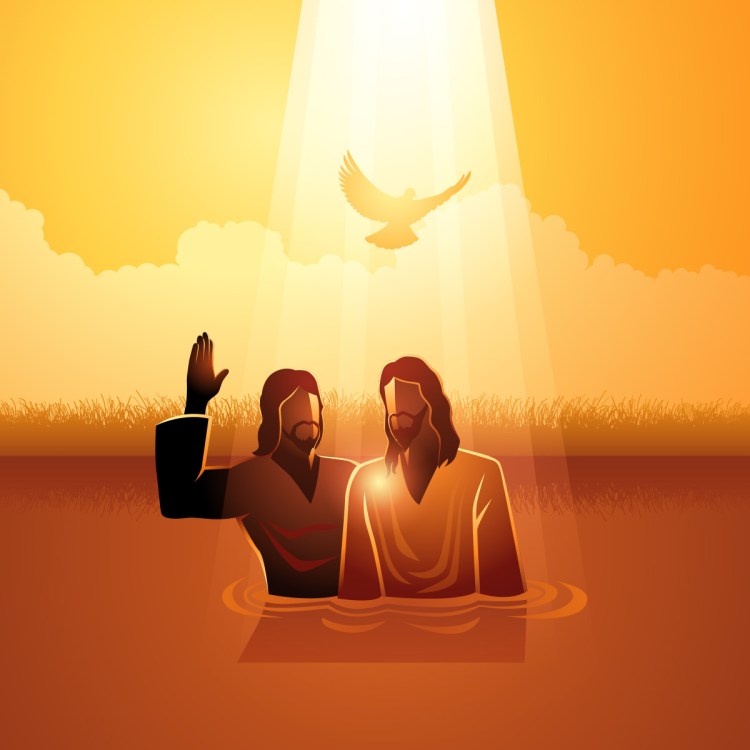
But whatever people believe about what the Church teaches and what the Scriptures say, one bible story which is never called into question is the one we heard in our Gospel reading this morning; the story of Jesus’ baptism by John the Baptist. One of the reasons for this is that we find it in all the Gospels. Matthew, Mark and Luke tell the story explicitly and whilst John doesn’t do that, he certainly alludes to it because in John’s Gospel, John the Baptist says of Jesus,
“I saw the Spirit descend from heaven like a dove, and it remained on him. I myself did not know him, but he who sent me to baptize with water said to me, ‘He on whom you see the Spirit descend and remain, this is he who baptizes with the Holy Spirit.’”
Another very good reason for our belief in the truth of this story is that it’s told at all, let alone by all the evangelists. The Gospels are very keen to point out that Jesus is superior to John the Baptist, indeed they record John having said this himself. So why would they tell a story about Jesus being baptised by John, submitting to John in a sense, unless it was not only true but also widely known to have happened and therefore, impossible to ignore?
But if we can’t doubt the truth of Jesus’ baptism by John, that still leaves the question of why Jesus went to John to be baptised? Why should the Son of God go to a man, even one as great as John, and submit to him in this way? Or, to put the question in John’s terminology, why should the greater submit to the lesser? Only Matthew, in his Gospel, gives us an answer to that. St Matthew tells us that,
‘Jesus came from Galilee to the Jordan to John, to be baptized by him. John would have prevented him, saying, “I need to be baptized by you, and do you come to me?” But Jesus answered him, “Let it be so now, for thus it is fitting for us to fulfil all righteousness.”’
For the Jews, and we must never forget that Jesus was a Jew, righteousness was about living in a right relationship with God. It’s what God called all his people to be through his covenant with them. So to fulfil all righteousness was to do everything that God required under the terms of the covenant between himself and the people of Israel. God had sent John to proclaim the coming of the Messiah, and to baptise the people in readiness for his coming. So being baptised by John was also something that God required of his people and as Jesus was one of God’s people, it was something God required of him too. And if we look at it in this way, we can see that Jesus baptism by John is a display of his humanity; that he was, as the author of the Letter to the Hebrews puts it ‘completely like his brothers and sisters’.
Jesus though, as well as being human, was and is, also divine. Jesus is the Son of God and so through him, God tells us what we need to do to fulfil all righteousness. We find out what this means through Jesus’ teaching and example, but we’re also told what it means in the Great Commission that Jesus gave to us, his disciples. St Matthew tells us that,
Jesus came and said to them, “All authority in heaven and on earth has been given to me. Go therefore and make disciples of all nations, baptizing them in the name of the Father and of the Son and of the Holy Spirit, teaching them to observe all that I have commanded you.”
The words of the Great Commission make it quite clear that, just as it was for Jesus, baptism is something that God requires of us today too. One of the problems we have with baptism in the Church today though, is that people don’t bring their children to the Church to be baptised in anywhere near the numbers they once did. Quite often too, baptisms take place outside the Mass, the Eucharist. Strictly speaking, that should only happen in the case of emergency baptism but these days, it happens more often than not. There are reasons for this, not least that people who bring their children to Church to be baptised are very often only interested in having a nice day – half an hour in Church, a few nice photos and then a party. The spiritual significance of baptism is hardly given a thought, if it’s given any thought at all. Because of that, people can be very disruptive if they’re asked to be in Church for the whole of a Sunday service because they’re simply not interested in anything other than the baptism. I’ve been present when that’s happened. I can remember more than one occasion when a baptism party has been so disruptive after the baptism that they’ve been asked to leave the Church either by the vicar or the churchwardens. On one occasion when that happened, the baptism party did leave and then started what turned out to be a mass brawl in the churchyard!
One unfortunate consequence of this though, is that most people who do come to church regularly, hardly ever take part in a baptism. And the regular members of a church are expected to take part in a baptism. They’re expected to take part through their own responses to the questions put to the congregation and they’re expected to take part by promising to uphold the newly baptised in their life in Christ, and to welcome them as new members of the Church. But as well as not being able to do that, not being present at baptisms denies people the opportunity to be reminded of their own commitment to fulfil all righteousness made in their own baptismal promises and the vows they made at their own confirmation.
I’m not asking anyone to answer these questions now, but I am asking you to think about them and answer them for yourselves. How long is it since you thought about your own baptismal promises and confirmation vows and what they mean? How long is it since you really thought about those baptismal promises to reject the devil and all rebellion against God, to renounce the deceit and corruption of evil and to repent of your sins? How long is it since you really thought about what it means to turn to Christ as your Saviour, to submit to him as your Lord and to come to Christ as the way, the truth and the life and to make his way, his truth and his life your own?
If you’re confirmed, how long is it since you thought about the vows you made at your confirmation, the vows to continue in the apostle’s teaching and fellowship, in the breaking of bread and in prayer, in other words, in your vow to come to Church regularly? How long is it since you thought about your vow to resist evil and, when you do sin, to repent and return to the Lord? How long since you thought about you vow to proclaim the Gospel by both word and deed? How long since you thought about your vows to love your neighbour as yourself, to acknowledge Christ’s authority over us, to pray for the world, to help the weak, and to seek peace and justice? How long is it since you recalled that, at both your baptism and confirmation, you were anointed to symbolise your reception of the Holy Spirit of God to guide and strengthen you in your attempt to fulfil all these promises, to fulfil all righteousness, as God requires us to do? How long since you remembered that you received a lighted candle to symbolise not only that you are called to walk in the light of Christ all the days of your life, but also to be a light in the world yourself, to the glory of God the Father?
I’m sure you all try to do these things, as we all do. But the promises and vows we made to do them are hard to keep and none of us ever keep them all as well as we could and should. So it’s never a bad thing to be reminded of them from time to time, just to keep us on our toes. It would be nice if we could be reminded of them by a regular stream of baptisms in church on a Sunday morning, during the Mass, the Eucharist, but unfortunately, that doesn’t happen these days, so we have to be reminded in other ways, or to find other ways to remind ourselves of the promises and vows we made to fulfil all righteousness.
I don’t think people should criticise themselves unnecessarily because there are plenty of people in the world who’ll do that for them without any help or encouragement. Unfortunately though, we have lots of people in the Church who, by being critical of their own faith, have given more than enough help and encouragement to those outside the Church to criticise both the Church and our faith. But if we can take some time to think about our baptismal promises and confirmation vows and try to keep them a little better than we might have done in the past or are doing now, if we can do all we can to fulfil all righteousness in our lives, at least we shouldn’t be giving any help or encouragement to those who are looking to criticise us, the Church, or our faith.
Amen.
The Propers for The Baptism of the Lord can be viewed here.