Sermon for the Holy Family, 28th December 2025

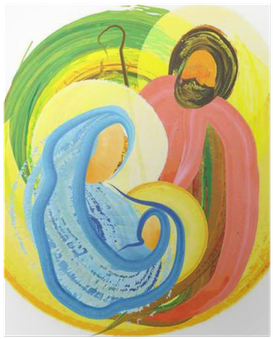
I must admit that I find the Church’s calendar rather odd at this time of year.  Our Gospel reading for today, the Feast of the Holy Family of Jesus, Mary and Joseph, is as we’ve just heard, is the story of the Holy Family’s flight into Egypt and it begins,  

‘When the Magi had departed….’  

and yet, in the Church’s calendar, the Magi haven’t even arrived yet. So it is, as I say, rather odd that we do things in this order. Nevertheless, this is the way the Church’s calendar is organised and so today we are celebrating the Feast of the Holy Family.  

Speaking of families may draw our minds to something we hear quite a bit about these days and that is family values. In particular in recent years, we seem to have heard a lot about the decline in family values in our society. As the Church holds up the Holy Family as an example of how family life should be, it stands to reason that we should be able to see in the example of the Holy Family something of what these much-vaunted and much-lamented family values are. So what do we see in the example of Jesus, Mary and Joseph that can help us to see just what family values we should aspire to in our own family life?   

The first thing we see is that, even before they were a family as such, Mary and Joseph were God fearing people. In the Gospel account of the Annunciation, and in the account of Joseph’s dream, we find that they were both people who were attentive to God and obedient to the will of God. What God asked of them wasn’t easy, in fact it was frightening, we know that because the angel told both of them not to be afraid. The easy thing to do for both of them would have been to say ‘No’, and perhaps in human terms that would have been the smart thing to do. But for God fearing people faith overrides other concerns and so for Mary and Jospeh, obeying God’s call was more important than any difficulties doing it might present. And so it should be for us too. For Christian people, listening for God’s call and obeying it when it comes should be a value at the very heart of our lives.  

We also see in the example of the Holy Family  that they were law-abiding people. We know that, later in life, Jesus said quite explicitly that he hadn’t come to abolish the law but to fulfil it.  

But we also need to remember that, when he was asked about the lawfulness of paying taxes to Caesar, his said that it was, but implied that God’s call on our lives is more important.  

“…render to Caesar the things that are Caesar’s, and to God the things that are God’s.”  

But this is something we find in the Holy Family more widely. Mary knew the potential legal consequences of obeying God’s call but obeyed anyway. Joseph knew what the law said he should do in the circumstances but even before God’s call for him to marry Mary anyway, he’d decided to be merciful and not make a public example of Mary, in other words, not to have Mary stoned to death. And we should also remember that, in that case, Jospeh would have been required to cast the first stone. And of course, Mary and Jospeh undertook the journey to Bethlehem in obedience to the secular law. And so it should be for us too. We should be law-abiding but, where possible, merciful and lenient in dealing with others, even when the law is on our side. And obedience to God should always be our first priority.  

The Gospels also tell us that Mary and Joseph were people who thought long and hard before they made a decision. Again in the story of Joseph’s dream we’re told that he was considering what to do when he received God’s call to take Mary as his wife. And we read a number of times that Mary stored things up, treasured them and pondered them in her heart.  So Mary and Joseph were not people to make quick decisions, they didn’t fly-off-the handle when the unexpected happened, or when things didn’t go the way they wanted them to. They thought things through and, in light of their faith, came to good, and what proved to be the right decisions. And that’s a value we all need in our lives generally, but perhaps especially in our family lives because how many families have been torn apart by arguments that have got out of hand? When someone has taken offence at what another family member has done or said, reacted badly in the heat of the moment and caused a hurt that has never been healed?  

We also know that the Holy Family stuck together in hard times. We see that in the story of Joseph’s dream, but we see it in a lot of the Gospel readings at this time of year. The journey to Bethlehem wouldn’t have been an easy one in the best of circumstances but it would have been especially difficult with Mary being an expectant mother.  

Finding no room at the inn apart, we don’t know what struggles the Holy Family went through during their time in Bethlehem but according to the Gospel account of the Magi, it’s likely that they stayed in Bethlehem for some considerable time after Jesus was born, up to two years perhaps. So they were away from their home in Nazareth for a considerable time. Perhaps they’d decided to make a new home for themselves in Bethlehem and, as I’m sure many of us will know, moving home and especially relocating to a new area can be very stressful. And then, as we heard this morning, the family had to flee for their lives, leave Bethlehem and undertake another, longer and even more difficult journey, this time to Egypt, to save the life of their young son. We know that there were Jewish communities in Egypt at that time so the Holy Family might have been able to join one of those, but even so, the fact that they eventually decided to return home suggests that they perhaps never really settled in Egypt. And neither were they able to return to the life they’d made in Bethlehem because they were still afraid to return there. And so they went back to Nazareth. So the Holy Family didn’t have an easy time of it, especially in those first few years. But nevertheless they stuck together. And how precious a value would that be in these days when families and family life seems to fall apart under the pressures of modern life which, for all they are, can’t be any worse than the pressures the Holy Family faced.  

And there was also, clearly, a deep love at work between the members of the Holy Family. We see this in so much of the story but perhaps where we see it most of all is in an unlikely place, in the story of the young Jesus teaching in the temple. I say this is an unlikely place because, to us, not knowing that your 12 year-old son wasn’t with you when we set off home from a journey would seem like unbelievable neglect. Finding him after 3 days and saying nothing more than,  

“What have you done this for? We’ve been worried sick about you.”  

might seems a quite mild response. No matter how happy and relieved we’d be to have found him, our initial response might be a clout round the ear hole, and something along the lines of,  

“You stupid little so and so. We’ve been looking everywhere for you. Don’t you care what you’ve put us through? Well that’s the last time we ever trust you to go off by yourself again. Get a move on you selfish little…..” 

And if we received a reply that amounted to, 

“What’s your problem? You ought to have known what I’d be doing.” 

Well, I’ll leave it to your imagination what our response to that might be! 

On the surface, none of this sounds very loving but it does actually reveal a great deal of love if we look a little deeper. The first thing we have to notice is that St Luke, in whose Gospel we read this story, is quite specific that Jesus was 12 years-old. In other words, in the eyes of his faith community, he was an adult. Luke also tells us that the Holy Family were travelling in a group, so it’s not hard to understand why Mary and Jospeh would have simply thought that Jesus, who was now an adult after all, was with the group even if not directly with them. Obviously, when they realised he wasn’t with the group they set off to look for him, but when they found him, their response to the way he answered them reveals a lot about the Holy Family. Mary and Joseph didn’t understand what Jesus meant (and actually his response is better translated as “be about my Father’s business” rather than “be in my Father’s house.”) but nevertheless, Jesus  

‘…went down with them and came to Nazareth and was submissive to them. And his mother treasured up all these things in her heart.’ 

And I think this reveals so much about the Holy Family. The love and respect between Jesus, Mary and Joseph. The love of parents who allow their child to grow. The love and respect of a son who submits to the authority of his parents even though he knows they don’t really understand him or what he does. And how much are those values of love and respect needed in so many families today? But also that patient, thoughtful nature, of Mary in this case, wondering and trying to understand what all this means rather than making snap, hasty judgements based on feelings in the heat of the moment. And overarching all this, for all of them, working out God’s will and purpose for them.  

Given the Gospel reading for the Feast of the Holy Family, it is a little odd that we celebrate it before the arrival of the Magi on the Feast of the Epiphany, but perhaps there’s a case for celebrating it even earlier, before Christmas. Christmas is a time of year when families do get together, and so many of them argue and fall out when they do. Perhaps a timely reminder of the values of the Holy Family might just make some of those arguments a little less likely.  

Amen. 


Propers for Holy Family Sunday, 28th December 2025

Entrance Antiphon 
The shepherds went in haste, 
and found Mary and Joseph and the Infant lying in a manger. 

The Collect 
O God, who were pleased to give us 
the shining example of the Holy Family, 
graciously grant that we may imitate them 
in practicing the virtues of family life and in the bonds of charity, 
and so, in the joy of your house, 
delight one day in eternal rewards. 
Through our Lord Jesus Christ, your Son, 
who lives and reigns with you in the unity of the Holy Spirit, 
God, for ever and ever. 
Amen. 

The Readings 
Sirach 3:2-6, 12-14 
Psalm 128:1-5 
Colossians3:12-21 
Matthew 2:13-15, 19-23 

Prayer after Communion  
Bring those you refresh with this heavenly Sacrament, 
most merciful Father, 
to imitate constantly the example of the Holy Family, 
so that, after the trials of this world, 
we may share their company for ever. 
Through Christ our Lord. 
Amen.  

Sermon for Advent 4, 21st December 2025

Are you all ready for Christmas? Well, if not, I hope we’re all almost ready because there’s not much time left now to get ready before Christmas is here. Today is the fourth and last Sunday of Advent and the time that the Church sets aside to get ready for Christmas is almost over. Over the last four weeks the Churches song has been O come, O come, Emmanuel but in only 4 days’ time, the song will change to Emmanuel Appears!  So there really isn’t much time left now to prepare for Christmas.  

But of course, preparing for Christmas and the appearing of Emmanuel is only half of the Advent message isn’t it. Because as well as looking forward to celebrating the appearance of Emmanuel through the birth of our Lord Jesus Christ, we’re also called, throughout Advent, to be ready for the Lord’s return in glory. And that message comes a warning that if we’re not ready for his return, whenever that might happen, it will be too late to do anything about it, when it happens. So what I’d like to do this morning is to reflect on how we can be ready, both to celebrate Christmas, and for the Lord’s return in glory. And I’d like to do that by looking at how we all have a share in the calling of the four main figures in the Advent story, the prophet Isaiah, John the Baptist, the Blessed Virgin Mary, and her husband, Joseph.  

Of course, their calling was unique to each of them, and no one will ever have to fulfil their roles in the story of salvation again. Nevertheless, each and every one of us does share in their calling because even though none of us are called in exactly the same way that they were, we are all called in similar ways, and we’re all called by God to fulfil, in part at least, a similar role that each of them did individually. So let’s start with Isaiah. 

There are lots of prophets, but the Church regards Isaiah as the prophet of Advent. We read the account of Isaiah’s call, in chapter 6 of the Book of Isaiah and as we read that account, we must be able to see some similarities with ourselves and our own situation. Just like Isaiah we, as baptised Christians, are called to a prophetic ministry. We’re called to carry the light of Christ with us wherever we go and to call people away from the ways of the world and to the way of the Lord. But, like Isaiah, we’re sinners ourselves and so we probably don’t think that we’re up to the task. Perhaps we don’t think we’re worthy of it. And we certainly dwell among sinners, just as Isaiah knew he did. We live in a world full of people who hear but don’t understand, and who look but don’t see. People whose hearts are dull, whose ears are heavy and whose eyes are blind. People who are too set in their own ways to change, who don’t want to hear anything that might suggest to them that they’re on the wrong path or threatens shake them out of their comfort zone, people who can’t see anything beyond the here and now. And yet, just as Isaiah was called to do, we’re called to prophesy to these people, to make known to them the way of the Lord and to call them to his way. Not in readiness for the coming of Emmanuel, as Isaiah was, but in readiness for the Lord’s return. And like Isaiah, we must also wonder “How long, O Lord?” 

On the second and third Sundays of Advent this year, we read about John the Baptist. John’s calling was unique; he was called to that prophetic ministry of calling the people back to God, but John was also called to be the forerunner, the one who came immediately before Emmanuel. And John was called to make Emmanuel known when he appeared. But even so, we share in John’s ministry because aren’t we called to make Jesus known to the world today? Obviously, we can’t point to Jesus, in the flesh, and say, as John did,  

“Behold, the Lamb of God, who takes away the sins of the world!” 

But we can point people to Jesus as found in scripture: we can point people towards Jesus’ words, to his teaching and his example. We can point people towards Jesus’ Passion and Cross by which he took away the sins of the world. And we can point them to Jesus’ Resurrection and Ascension which assure us of the truth of John’s words about Jesus, and justifies John’s faith in Jesus, and ours. And we can urge people to follow Jesus, as John urged his followers to do.  

Finally, today, on the last Sunday of Advent, we hear about the Blessed Virgin Mary and about Joseph. Today, we only hear about Mary  in passing, but we know the story of Mary’s calling well enough. Her unique vocation was to be the mother of Emmanuel and when we think about Mary’s example to us, we usually think about it in terms of her obedience to God’s call, her ‘Yes’ to God. We think about Mary’s example of patient, lifelong and even long-suffering devotion to her son, God’s Son. And this is all of great importance to us. But today I want to look at how we all have a share in that unique calling of Mary’s.  

Mary was called to give birth to Emmanuel. She carried God’s Son in her womb, and it was through her that the song could and did change from O come, O come, Emmanuel to Emmanuel Appears. But don’t we carry Jesus too? Not in the same way that Mary did of course, but we do carry Jesus with us, at all times. We read this time and again in St Paul’s Letters, and Jesus himself spoke about it: 

“Whoever feeds on my flesh and drinks my blood abides in me, and I in him.  

And again when praying to the Father for his disciples;  

“The glory that you have given me I have given to them, that they may be one even as we are one,  I in them and you in me, that they may become perfectly one, so that the world may know that you sent me and loved them even as you loved me.” 

And one of the consequences of carrying Jesus within us, is that whenever and wherever we proclaim the Gospel, or follow Jesus’ example in our lives, Emmanuel appears, in and through us. It’s something expressed in the prayer of the Society of the Holy Cross, part of which says, 

Father…..Through the saving power of the Cross, impressed inwardly upon our lives and revealed outwardly in our work, may others come to know your love and your truth… 

So Emmanuel can appear through and in us, and in that sense, we share in something of Mary’s unique calling.  

And then we come to Joseph. We don’t hear too much about Joseph do we? In fact, we hear so little about Joseph that he can almost seem like an incidental character in the story. But that’s far from the case. According to scripture, when Emmanuel appeared he would be of David’s line, born in the City of David, and it’s through Joseph that was fulfilled. And there are two ways in which we can share in Joseph’s calling. We will find ourselves in situations where Emmauel needs to appear. That is, we’ll find ourselves in places and at times where we need to show the love of Christ. We’ll find ourselves in places at times where we need to bring Christ’s teaching to bear in a situation. And we will be the one there who needs to do that. So there will be times when we will be called to enable  Emmanuel to appear in the right place and at the right time, just as Joseph was called to do.   

But there will also be times when, for Emmanuel to appear, we will have to take a back seat and allow another person’s calling to come to the fore. It may be that we really don’t want to do that, there may be times when we might feel quite justified in not doing that. But it is what we really should do. And this is just what Joseph did is it not? Jospeh would have been quite justified in divorcing Mary. We heard in this morning’s Gospel that this is, indeed, what he’d decided to do. I’m sure if we use just a little imagination, we can believe that some people, perhaps a lot of people, would have been telling him that’s just what he should do. But in the end, Joseph swallowed his pride and did things God’s way rather than the world’s way, or his own way, and he allowed Mary’s calling to take precedence over his own feelings. And this is something that so many people would do well to take note of and learn from because how much trouble in the Church is caused by people simply wanting their own way, regardless of whether their way is God’s way or not? How much trouble is caused in the Church by people acting in deeply un-Christian ways so that they can get their own way? How often when things like this are done do they stop someone else from fulfilling a calling they may have? And in doing that, how often do people who simply want their own way, prevent Emmanuel from appearing? But the way to prevent this is to share in Joseph’s calling, something we also find in John the Baptist’s calling too, and step back so that someone else who, in that situation and in that time and place might be far better able to allow Emmanuel to appear, to take precedence.  

We are now, only a few days away from Christmas when the Churches song will change. But for us, it shouldn’t really matter what time of the year it is. We should always have O come, O come Emmanuel in our minds and hearts because we should always be ready and eager for Emmanuel to appear in our lives. And we should always be ready to sing Emmanuel Appears because we should always be ready for him to appear in our lives. And we should always be ready to hear and see opportunities for us to allow Emmanuel to appear through our own words and actions. So in these last few days before Christmas we might do well to think about the people we’ve read about during Advent, about Isaiah, John, Mary and Joseph, and about how we can share in their calling so that we might be better able to allow Emmanuel to appear through our own calling and so be ready, not just for Christmas, but for the Lord when he returns in glory. 

Amen.


Propers for Advent 4, 21st December 2025

Entrance Antiphon
Drop down dew from above, you heavens,
and let the clouds rain down the Just One;
let the earth be opened and bring forth a Saviour.

The Collect
Pour forth, we beseech you, O Lord, your grace into our hearts, that we, to whom the Incarnation of Christ your Son was made known by the message of an Angel, may by his Passion and Cross be brought to the glory of his Resurrection. Who lives and reigns with you in the unity of the Holy Spirit, God, for ever and ever.
Amen.

The Readings
Isaiah 7:10-14
Psalm 24:1-6
Romans 1:1-7
Matthew 1:18-24

Prayer after Communion
Having received this pledge of eternal redemption, we pray, almighty God, that, as the feast day of our salvation draws ever nearer, so we may press forward all the more eagerly to the worthy celebration of the mystery of your Son’s Nativity. Who lives and reigns for ever and ever.
Amen.

Propers for Advent 3, 14th December 2025

Entrance Antiphon 
Rejoice in the Lord always; again I say, rejoice. 
Indeed, the Lord is near. 

The Collect 
O God, who see how your people 
faithfully await the feast of the Lord’s Nativity, 
enable us, we pray, 
to attain the joys of so great a salvation 
and to celebrate them always 
with solemn worship and glad rejoicing. 
Through our Lord Jesus Christ, your Son, 
who lives and reigns with you in the unity of the Holy Spirit, 
God, for ever and ever. 

Amen. 

The Readings 
Isaiah 35:1-6, 10  
Psalm 146:6-10 
James 5:7-10 
Matthew 11:2-11 

Prayer after Communion 
We implore your mercy, Lord, 
that this divine sustenance may cleanse us of our faults 
and prepare us for the coming feasts. 
Through Christ our Lord. 

Amen.