Sermon for the 23rd Sunday in Ordinary Time (Trinity 15) 8th September 2024

One of the things we hear a lot about in the Church these days is mission.  But what is mission. Put simply, the Church’s mission is to be about the Lord’s business; to go out into the world and do the things he told his disciples to do; to care for the sick and needy, proclaim the Gospel and bring people to faith. That is the Church’s mission. But if we think about that mission, there are actually two parts to it: mission – being sent out to do the Lord’s business, and evangelism – proclaiming the Gospel and bringing people to faith. And when the Church talks about mission what it’s often doing is lumping together these two different but very closely related things. Or at least they should be because the Church doesn’t have a monopoly on doing good works so if we want people to know that we’re engaged in a mission that’s specifically Christian, it must include an element of evangelism. We need to let people know that we’re doing these things because we’re Christians. And we have to let people know that because we’re called to do things for God’s glory not for our own.

Carrying out the Church’s mission though isn’t easy for a lot of people, and the hard part of it is usually the evangelism. The difficulty with evangelism today is that we live in a secular society. Most people have very little if any knowledge of the Christian faith and if they have it’s usually a strange mixture of folk-religion and rubbish they’ve read on the internet combined with prejudices and misunderstandings they’ve picked up from a few people they know who perhaps used to go to church at some time in the distant past. Most people have never been to church in their lives, they’ve probably had no contact with the Church, and very often these days, have a very negative view of the Church because the only time they ever hear anything about it is in connection with some scandal or other. And for all these reasons it can be very difficult to speak to people about our faith.  On the whole, people don’t mind doing the good works associated with mission because we can do these without having to speak about our faith. But when it comes to the evangelistic aspect of mission, people are usually far less comfortable. Sometimes they’re actually afraid to try because they’re frightened of the negative, perhaps even hostile response they might get from those they speak to.

Nevertheless, we are called to engage in mission, we’re called to do that by Christ himself, and evangelism, speaking about our faith to those who don’t share it, is an inescapable aspect of our mission. It’s something we have to do if we’re going to be authentic disciples of Christ. But how do we do it? How do we speak about our faith to people who know little to nothing about it, in ways that they’ll understand? 

There is a way of doing this that we find in scripture and in Church history. It’s a way of doing mission and evangelism that’s been tried and tested, and it works. It’s not an overnight miracle cure for unbelief, it’s not going to fill our churches with new converts overnight because it’s a 3-stage process. It takes time but, in the long run, it does work.

Stage 1 is where we, in the Church, adapt to the society we live in. Not so that we can become like everyone else in society but so that we can take on board the beliefs and values and customs of the society we live in with a view to understanding how to proclaim the Gospel in that society. Stage 2 is where we take what we’ve learned about society and align the way we explain our faith with those existing beliefs and values and customs so that we can proclaim the Gospel through those things. And when people have come to an understanding of the Christian faith, we move to Stage 3 and that’s when we finally replace those existing beliefs and values and customs with Christian beliefs and values and customs. We do find this going on in scripture and in Church history and perhaps the place in scripture where we see it most easily is in St Paul’s Letters, and in his own words in his First Letter to the Corinthians;

‘… I have made myself a servant to all, that I might win more of them. To the Jews I became as a Jew, in order to win Jews. To those under the law I became as one under the law (though not being myself under the law) that I might win those under the law. To those outside the law I became as one outside the law (not being outside the law of God but under the law of Christ) that I might win those outside the law. To the weak I became weak, that I might win the weak. I have become all things to all people, that by all means I might save some. I do it all for the sake of the gospel, that I may share with them in its blessings.’

But whilst that might be the easiest place to see this process at work in scripture, it’s not the only place in scripture we find it and St Paul is not the only person in scripture to use it. In fact, we can see Jesus himself using this method of mission and evangelism in this morning’s Gospel.

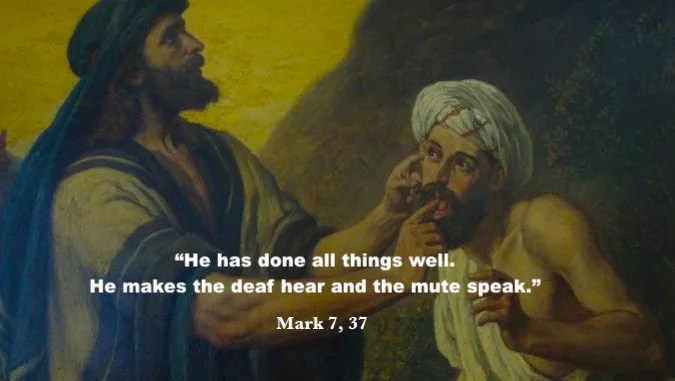
This morning’s Gospel is the story of a miraculous healing, in this case, Jesus healing a man who was deaf and mute. There’s nothing unusual about that in the Gospels but if we look at this story a little closer, there are quite a few things about it that does mark this story out as quite unusual. The first thing that’s strange about this story is that neither Matthew nor Luke mentions it in their Gospels and as they both retell almost all of Mark’s stories, that is unusual. And it’s generally thought that the reason Matthew and Luke don’t retell this story is that it portrays Jesus almost as a magician, a pedlar of magical cures.

The first thing we have to understand about this miracle is that it took place in the Decapolis, the Gentile region to the South and East of the Sea of Galilee. So Jesus was not among Jews. And the cure itself wasn’t like most of the other miracles we read about in the Gospels. Most of those took place in public, with either a simple touch or command from Jesus, or simply on account of the faith of the person who went to Jesus for help. But here things are very different. First of all Jesus takes the man away from the crowd to heal him in private. Then Jesus touches the man’s ears, he spits, touches his tongue, groans and finally gives the command “Ephphatha”  which we’re told means ‘Be opened’. But while this is unusual for Jesus, there are parallels for these kinds of actions in Gentile magic and the ‘cures’ of Gentile magicians of the time.

Taking a sick person aside, perhaps to be alone or in the company of a few close relatives with the healer, was, and in some parts if the world still is, a common practice of faith healers and magicians. So too is touching the parts of the body in need of healing. Many cultures believed, and again still do believe in the healing properties of saliva too, hence the spitting. The Roman historian Tacitus, for example, tells a story of a blind man asking the emperor Vespasian to anoint his eyes with spittle so that he might be cured of his blindness. And groaning and speaking in foreign languages during healings are things we find in magical texts of the time. We have to remember here that even if “Ephphatha” is Aramaic for ‘Be opened’ (and that’s not certain), Aramaic was Jesus’ language, not necessarily the language of the Gentiles of the Decapolis. All these things are strongly suggestive of Jesus using Gentile practices to heal a Gentile in Gentile territory. In other words, of Jesus using the beliefs, values and customs of the society he was working in to proclaim the Good News that the Kingdom of God was upon them. And the end result was that people were so astonished by what Jesus had done that they believed in him and went out to spread the word about him.

As I said earlier, this 3-stage process of mission and evangelism is something we find in scripture and it’s something the Church has used throughout its history because it works. And if it worked in scripture and in history, there’s no reason why it shouldn’t work today. Of course, the beliefs, values and customs of today are different those of the past, but that’s true of every society throughout history. All that means is that we have to keep up to date with what those beliefs, values and customs are. As I’ve said in the past, there’s no point in trying to carry on as we always have been. We can’t use the methods that worked in the 1980’s or 90’s, for example, or any other time in the past either because we’re not living in the past, we’re living in the present and we have to do our mission and evangelism in the present. Society has changed and so we have to change too so that stage 1 and 2 of the mission and evangelism process is relevant to the society we live in today.

The Church does and is trying to do this. But the danger the Church is facing at this time, perhaps one of the greatest dangers the Church has ever faced, is that in its efforts to be relevant to today’s society and find a way of doing mission and evangelism in today’s society, it’s in danger of forgetting what the purpose of mission and evangelism is. To put it in terms of the process I’ve outlined, the Church is working hard at stage 1 so that it can find an effective stage 2. But it’s focussing and working so hard on this this that it seems to be in danger of neglecting the most important part of the process, stage 3. And that is the most important part of the process because that is the ultimate goal of the process.  

We mustn’t ever forget that the ultimate aim of our mission and evangelism is to proclaim the Gospel and the faith of the Church and to bring people to that faith. Whatever changes happen in society and whatever changes we have to make to adapt to and assimilate those changes so that our mission and evangelism is relevant to the society we live in and works in that society, we mustn’t ever forget that the ultimate goal is not for us to change to suit society but for society to change to suit the Lord. The goal of the process is not to change what the Church teaches so that it becomes acceptable to society, but for the Church to change the way it works so that we can make society acceptable to God.

Amen.


Propers for the 23rd Sunday of Ordinary Time (Trinity 15) 8th September 2024

Entrance Antiphon
Lord, you are just, and the judgements you make are right.
Show mercy when you judge me, your servant.

The Collect
God, who in generous mercy sent the Holy Spirit upon your Church in the burning fire of your love:
grant that your people may be fervent in the fellowship of the gospel that,
always abiding in you,
they may be found steadfast in faith and active in service;
through Jesus Christ your Son our Lord,
who is alive and reigns with you,
in the unity of the Holy Spirit,
one God, now and for ever.
Amen.

The Readings
Missal (St Mark’s)       
Isaiah 35:4-7
Psalm 146:7-10
James 2:1-5
Mark 7:31-37

RCL (St Gabriel’s)          
Isaiah 35:4-7
Psalm 146
James 2:1-17
Mark 7:24-37
Sermon for the 22nd Sunday in Ordinary Time (Trinity 14), 1st September 2024

When I was working in industry, on quite a few occasions I was asked to help with the training of apprentices and trainees. On the whole, that was something I enjoyed doing. It was quite satisfying to help someone learn new skills and to see them grow in confidence about what they were doing and become capable of doing the job without help and supervision. I do say on the whole though because on some occasions it could be very difficult to help people and in fact, on one or two occasions it proved to be all but impossible to help someone learn the job. And when that happened it was invariably because they had an ‘I know best’ attitude. They simply wouldn’t listen to what they were being told, wouldn’t do things the way that they’d been shown how to do them, and they couldn’t learn because they simply refused to accept that they were ever wrong.

For example, on one occasion I asked a trainee to fit a new contactor to a lift control panel. It was simple job of disconnecting the wiring, unclipping the old contractor to remove it from the panel, fitting the new one and then reconnecting the wires. It was the first time he’d done this so I made it as simple as I could for him by marking the wires so that wire 1 went to terminal 1, wire 2 to terminal 2 and so on. When he’d finished we switched the lift back on, but it wouldn’t run. So I checked what he’d done, and he’d put some of the wires in the wrong terminals. But he simply wouldn’t accept that. He said that he hadn’t connected those wires. Well there were only the two of us there and I hadn’t done it but when I said that he then said that I’d numbered them incorrectly. I pointed out to him that he hadn’t reconnected them the way I’d numbered them, but he still wouldn’t accept it. So I suggested that if we put the wires back the way I had numbered them, and the lift ran, would that prove that they were numbered correctly but hadn’t been connected correctly. He accepted that but when I did it and the lift ran, he again refused to accept that he’s done anything wrong and said that it was my fault because I hadn’t told him what to do properly. I’m sure you can understand how frustrating it is trying to help someone with an attitude like that. And it was sad too because it seems he was like that with everybody he worked with and, in the end, he was sacked because he never learned how to do the job.

That’s perhaps an extreme example but that kind of thing isn’t uncommon because that kind of attitude isn’t uncommon either. I’m sure we all know people who always think that they know best, can never accept that they’re wrong and blame other people when they clearly are wrong.

What this attitude is really showing is a refusal to take responsibility for one’s own actions, and perhaps especially a refusal to accept the consequences of one’s own mistakes. It’s about people wanting to do just exactly what they want to do but not wanting to suffer any consequences if things go wrong for them. And trying to escape the consequences of their own mistakes by blaming someone else for the wrong decisions and bad actions that they’ve freely chosen to take.

This is a problem in society, a very big one I would say, but it’s also a problem within the Church because it’s a problem, an attitude, which affects individual Christians. I can think, for example, of quite a few people who’ve offered themselves for ordination to the priesthood who’ve thought that they knew better than their parish priest and the vocations team. People who haven’t listened to what they’ve been told, haven’t done what they’ve been asked or advised to do but then, when they haven’t been accepted for ordination (and some people seem to think that they should be accepted immediately they’ve applied), have left their church and gone to another, perhaps another denomination, or perhaps even set up their own Church. And all the while blaming everyone else for their not being accepted for ordination. Saying people haven’t helped or encouraged them, haven’t given them the right advice and so on. Never for one moment have they accepted that they have been helped and encouraged and well advised but they haven’t been prepared to listen to the advice they’ve been given or do what they’ve been advised they need to do. And that’s just one example of how this kind of attitude can adversely affect individual Christians and the Church.

In this morning’s Gospel, we hear a teaching of Jesus that, perhaps not directly, but nevertheless does have something very important to say to us about the danger that this ‘I know best so I’m never wrong and so everything that goes wrong for me must be someone else’s fault’ attitude poses to us.

In the Gospel, Jesus says,

“Hear me, all of you, and understand:There is nothing outside a person that by going into him can defile him, but the things that come out of a person are what defile him.”

Strictly speaking, in this instance, when Jesus says that nothing outside a person can defile them, he’s talking about food and drink. But the important point with regard to the kind of problem I’m speaking about is Jesus’ assertion that it’s what comes out of a person that defiles them. Later in this teaching Jesus speaks about the evil things that come from the heart being what defiles a person and we know that for ancient people the heart was the centre of person; it was the seat of reason and will  as well as emotion. So the message is clear. It’s not external things that defile a person  but what they freely decide to do and their resulting actions that defile them.

Of course we could say, and with some justification, that what happens to a person does affect their thoughts and their decision making. But even that doesn’t defile a person. If something bad happens to someone, it’s quite understandable if it has an effect on them, and very probably a lasting effect on them. We could even say that the experience defiles them. But that would be a defilement of mind and perhaps body. The kind of defilement Jesus is speaking about here is spiritual defilement, defilement in God’s eyes and even the worst human experience can’t do that. God doesn’t look down on us because another human being has done something bad to us. Only we can defile ourselves in God’s eyes and we do that ourselves through our own thoughts and our own actions.

We know that, very often, when someone has gone through a bad experience at the hands of another person, it can lead them to treat others in bad way too. Bad experiences can leave people feeling angry, betrayed, hurt, vulnerable, mistrustful, and with all kinds of negative feelings and emotions. And these feelings can lead people to see fault in others where there is none, to take offence where none is intended, to see threats where none are posed. They can make people vengeful; they want to get their own back on those who’ve hurt them but very often they end up taking it out on people who’ve done them no harm at all. All that is understandable. But as the saying goes, ‘two wrongs do not make a right’ or to put it in scriptural terms,

‘Do not repay evil with evil.’ 

And the reason we should never do this is because it’s not what’s done to us that defiles us in God’s eyes, but what we do to ourselves and to others.

This is not always easy. Our own bad experiences can sometimes make it hard for us to treat people as well as we should. But also, to treat people well in the light of our own bad experiences requires us to take responsibility for our own actions. It requires us to think about the consequences of our actions to other people before we act. It most certainly too requires us to accept that we can be and sometimes are wrong. And when we’re wrong it requires us to admit it rather than trying to blame someone else for what we’ve freely decided to do and done and blame them for the trouble we’ve got ourselves into and that we’ve caused for others. This is something we must do as Christians because if we don’t, if we choose to act in ways that cause problems and trouble both for ourselves and others, and then try to blame others for the problems and trouble we’ve caused, what are we doing other than denying our own sins by imposing them on another? From a Christian point of view isn’t that exactly what we’re doing when we blame someone else for something that we’ve done?

It’s a natural human trait to try and get ourselves out of trouble if we can, but unfortunately, people very often try to do that by blaming someone else for what they’ve done wrong. As common as it is, it isn’t acceptable behaviour in any walk of life, and we only have to think about how we felt when it happened to us to understand that (and I’m sure it has happened to all of us at some time). It most certainly isn’t acceptable behaviour from Christians. Whatever happens to us, or has happened to us, it’s up to us how we respond. And it is our response, our thoughts and our actions, that defile us in God’s eyes, never what others do or have done to us.

Jesus warned us,

“…do not fear those who kill the body but cannot kill the soul. Rather fear him who can destroy both soul and body in hell.”

In this respect, we can be our own biggest enemy because rather than acting as though we fear the one who can destroy our soul in hell, we can help in our own soul’s destruction through our unwillingness to accept that we can be wrong, our unwillingness to accept it when we are wrong and our only too eager willingness to blame others for what we’ve done wrong. Jesus is speaking here about the evil one, the devil, call him what you will. But there’s no one better at defiling us in God’s eyes than us ourselves.

Amen.


Propers for the 22nd Sunday of Ordinary Time (Trinity 14) 1st September 2024

Entrance Antiphon
I call to you all day long, have mercy on me, O Lord.
You are good and forgiving, full of love for all who call to you.

The Collect
Almighty God,
whose only Son has opened for us a new and living way into your presence:
give us pure hearts and steadfast wills to worship you in spirit and in truth;
through Jesus Christ your Son Lord,
who is alive and reigns with you,
in the unity of the Holy Spirit,
one God, now and for ever.
Amen.

The Readings
Missal (St Mark’s)        
Deuteronomy 4:1-2, 6-8
Psalm 15:2-5
James 1:17-18, 21-22, 27
Mark 7:1-8, 14-15, 21-23

RCL (St Gabriel’s)          
Deuteronomy 4:1-2, 6-9
Psalm 15
James 1:17-27
Mark 7:1-8, 14-15, 21-23

Sermon for the 21st Sunday in Ordinary Time (Trinity 13) 25th August 2024

If someone were to ask us to sum up, in a few words, what it means to be a Christian, what would we say? We might think that’s quite a hard thing to do but I think we could do that very easily in just three sentences . First of all we must pay attention to those words spoken by the Father at Jesus’ Transfiguration and listen to Jesus. Next we must pay heed to Jesus’ own words and believe in him. And lastly, we must then follow Jesus, we must do our level best to live our lives in the way that he said we should. So we could sum up what it means to be a Christian very simply by saying it means listening to Jesus, believing in Jesus and following Jesus in the way we live.  

I don’t think anyone could dispute that these things are essential to anyone who wants to call themselves a Christian. Isn’t it ironic then that so many people who do call themselves Christians, don’t do these things. And they don’t. Like all people, people who call themselves Christians want to live their lives in their own way rather than in Jesus’ way, especially when Jesus’ way is difficult. And to do that and still call themselves Christians, they tend to listen only to those words of Jesus that suit them, and to believe only those teachings of Jesus that fit in with their own ideas and understanding of how things should be, and how life should be lived. And what’s even more ironic is that so many people who do these things are only too ready and willing to criticise others for not listening to Jesus, for not believing in Jesus and for not following Jesus, simply because those other people aren’t doing things their way. Very often, Jesus has nothing whatsoever to do with it.  

Over the last few Sundays we’ve been hearing Jesus’ words about the need to believe in him and about the need to eat his flesh and drink his blood if we want to have eternal life. We also know, by listening to Jesus, that we eat his flesh and drink blood through receiving bread and wine in remembrance of him in the sacrament of Holy Communion. And yet this is one of the ways in which people who call themselves Christians most frequently fail to listen to Jesus, to believe in Jesus and to follow Jesus.  

In spite of Jesus’ words, and the most ancient belief of the Church, there are many people who simply cannot accept that the bread and wine we receive at Holy Communion is the body and blood of Jesus. And they can’t accept  that for many reasons.  

For some, what’s known as the real presence, the belief that the body and blood of Jesus are really present and really received in the sacrament of Holy Communion, is an invention of the medieval Catholic Church. They would argue that what Jesus really meant when he said the bread is his body and the wine is his blood wasn’t this is my body and blood, but this symbolises, my body and blood. But there are numerous problems with that interpretation. For one thing, if we start to change the words of scripture generally, and the especially the words of Jesus in scripture, to suit our own understanding, what are we left with? How can we be sure of anything? How do we know what to listen to, what to believe or what to follow? In fact, if we go down this road, we’re just left with a mess in which anything goes because everyone is free to make up their own mind about what Jesus said.  

Another problem with this interpretation is that the Greek words for ‘is’ and ‘symbol’ are completely different. So surely if Jesus meant ‘symbolises’, rather than ‘is’, that’s what it would say in scripture. We know that the Scriptures were written within living memory of the events of Jesus’ life, so these words of Jesus can’t be an invention of the medieval Catholic Church. In fact the very first mention of The Lord’s Supper, and the words Jesus spoke there are found in St Paul’s First Letter to the Corinthians which was written in the mid-50s AD. St Paul even says that he received this ‘from the Lord’, in other words, from Jesus himself. And we also find a clear belief in the real presence in the writings of the Church Fathers in the late 1st and early 2nd Century, so we know that this belief goes back to the very beginning of the Church. So, unless we’re going to change the words of scripture to suit ourselves, we must conclude that these words, and the Church’s belief in the real presence that stems from them, goes back to Jesus and the words he spoke at that last supper with his disciples on the eve of his death.  

I think what many people are doing when they say that belief in the real presence is a medieval invention is confusing that belief with the idea of transubstantiation. We first come across the idea of transubstantiation in the 11th Century, so we could say that is a medieval invention. But although the real presence and transubstantiation are related, they’re completely different things. The doctrine of the real presence is the belief that the bread and wine we receive at Holy Communion are the body and blood of Jesus. Transubstantiation, on the other hand, is a philosophical attempt to explain how that bread and wine becomes the body and blood of Jesus. Transubstantiation isn’t where belief in the real presence comes from, it’s an attempt to explain a belief that had already existed for over a thousand years; from the very beginning of the Church.  

Another reason people sometimes give for their refusal to believe in the real presence is that it was, in fact, the early Church who invented this doctrine. They claim that Jesus would never have said such things, no Jew would have said them given the strict prohibitions in the Books of Leviticus and Deuteronomy on consuming blood. But doesn’t this morning’s Gospel deal with that very problem? Jesus had just spoken about the need to eat his flesh and drink his blood, and we’re told, 

‘When many of his disciples heard it, they said, “This is a hard saying; who can listen to it?”’ 

The Gospel openly admits that what Jesus was saying was abhorrent to the Jews; it was sacrilegious, and, as a result, 

‘After this many of his disciples turned back and no longer walked with him.’ 

In fact, what Jesus said was so hard to accept, he even asked the twelve if they wanted to leave too.  

We have to remember that the early Church was a Messianic sect within mainstream Judaism. The early Christians were Jews themselves and they were called to proclaim the Gospel to other Jews. It would have made no sense whatsoever then, for them to have made something like this up because it would simply have made their task that much harder. In fact, if they were going to change anything in this case, it would have made more sense for them not to say anything at all about eating Jesus’ flesh and drinking his blood. The fact that they did can only mean that these words were so important that they had to say them. And what possible reason could there be for these very difficult and controversial words being so important other than that they were the words of Jesus?  

Another problem people have with accepting the real presence in the Eucharist is that it goes againstcommon sense. What I mean by that is that the bread and wine we receive at Holy Communion don’t appear to have changed at allfrom what they originally were. The bread still looks and tastes like bread. I’m sure none of us have ever tasted human flesh but I believe it tastes like pork. Well the bread of Holy Communion doesn’t taste like pork or any other meat either. I’m sure we all do know what blood tastes like though, because we’ll all have had blood in our mouths at some time in our lives, perhaps because of a cut or dental work . And the wine we receive at Holy Communion certainly doesn’t taste like that. It doesn’t look like blood either. But this is where belief is so important. Common sense tells us that a man can’t change water into wine, he can’t walk on water, he can’t feed 5,000 people with five loaves and two fish. A man can’t raise people from the dead and neither can he be raised from the dead either. And yet we believe all these things about Jesus. Why then can’t some people believe Jesus when he says that this bread is his body, and this wine is his blood? The Holy Communion hymn, Now, my tongue, the mystery telling  puts it very well, I think, when it says; 

‘faith, our outward sense befriending,  
makes our inward vision clear.  

It is a matter of faith. We’ve listened to Jesus, we believe in Jesus, and we want to follow Jesus. So when it comes to the sacrament of Holy Communion, no matter how difficult it is for us to understand, no matter what our senses tell us, faith tells us that this bread is Jesus’ body and faith tells us that this wine is his blood. And faith tells us these things simply because this is what Jesus said they are, and we have faith in him.  

Amen.  


Propers for the 21st Sunday of Ordinary Time (Trinity 13) 25th August 2024

Entrance Antiphon 
Listen Lord, and answer me. 
Save your servant who trusts in you. 
I call to you all day long. Have mercy on me ,O Lord. 

The Collect 
Almighty God, 
who called your Church to bear witness 
that you were in Christ reconciling the world to yourself: 
help us to proclaim the good news of your love, 
that all who hear it may be drawn to you; 
through him who was lifted up on the cross, 
and reigns with you in the unity of the Holy Spirit, 
one God, now and for ever. 
Amen. 

The Readings 
Missal (St Mark’s)
Joshua 24:1-2, 15-18 
Psalm 34:2-3, 16-23 
Ephesians 5:21-32 
John 6:60-69 

RCL (St Gabriel’s)
Joshua 24:1-2, 14-18 
Psalm 34:15-22 
Ephesians 6:10-20 
John 6:56-69