Sermon for Advent, 1st December 2024

A question that I’m sure we’re all going to be asked over the next few weeks, and perhaps have already been asked is,

“Are you ready for Christmas?”

And we know what people mean in asking that question; have we made all our plans for Christmas dinner, arranged to meet with our family to exchange greetings and gifts, have we indeed bought the gifts we need to buy, and have we written and sent the Christmas cards we need to send. Because for most people doing all these things is what being ready for Christmas is all about. If you have done these things, you’re ready; if you haven’t done them, you’re not. And most people will be busy during these next few weeks getting ready for Christmas in those ways.

Today we begin the season of Advent which is the Church’s time for getting ready for Christmas. But what does being ready for Christmas mean from the Church’s point of view? We, in the Church, know that being ready for Christmas is about being ready to celebrate the birth of our Lord Jesus Christ, and that being ready for that isn’t about turkey and tinsel, cards and presents or any of the other paraphernalia that people usually mean when they talk about being ready for Christmas. But what does it mean for Christians?

For many Christians, being ready for Christmas will mean coming to Church during Advent, perhaps especially for a Christmas Carol Service, getting involved in the various Church activities that go on at this time of year, things like Christmas Fairs, putting up the Crib and decorating the church, and doing all these in readiness to celebrate the birth of our Lord Jesus Christ either on Christmas Eve, at Midnight Mass, or on Christmas morning. But as nice and good and necessary as those things are, is that really what it means for a Christian to be ready for Christmas? To answer that question, we need to think first about just what it is we’re getting ready for. Christmas, of course. But what is Christmas, what is it we’re celebrating?

In fact, we can answer those questions very easily by turning to the Gospel reading we read at the end of Midnight Mass and as the gospel of the day on Christmas Day; the prologue to the Gospel of St John:

‘In the beginning was the Word, and the Word was with God, and the Word was God. He was in the beginning with God. All things were made through him, and without him was not any thing made that was made… And the Word became flesh and dwelt among us…’

This is what we’re celebrating at Christmas, and this is what we’re getting ready for during Advent, the coming into the world of God himself in the person of his Son. The coming into the world of a child who would go on to reveal to us, in person, the very words and ways of God. And when we think about just how awesome a thing this is, we really do have to think afresh about just what it means to be ready for Christmas.

Awesome is a word that gets bandied about a lot these days isn’t it? For example, it’s awesome that Manchester United’s new manager has got off to a good start, it would be even more awesome, I’m sure, if they could beat Manchester City  in a couple of weeks’ time. That said, it would also be awesome if Manchester City could win any game at all the moment! People use awesome to describe things like this. What they actually mean is ‘good’. An awesome thing is something that is mind-bogglingly unbelievable. Something that is miraculous, out of this world, something that’s so wonderful and impressive that it defies belief and explanation. And Christmas is awesome in that sense because it truly is something out of this world that has come into this world.

Perhaps we can begin to understand just how awesome a thing this is by comparing it to another truly awesome thing, the cosmos. The Universe is truly awesome, the distances and timescales involved in trying to understand and explain the universe are mind boggling. In spite of our best efforts, there’s so much we simply don’t understand and can’t explain about the Universe and the more we find out, the more we realise just how much we don’t know and don’t understand. But as Christians, we believe that all this was brought into being at God’s command, at his word. So if the Universe is awesome, how much more awesome is God and God’s word which brought it into being? And it is this awesome God, and word of God, the word that brought everything into being, that came to earth at Christmas. And when we think about Christmas in these terms, we really do have to think long and hard about just what it means to be ready for Christmas, and to rethink what being ready for Christmas means. But we’re not without help in doing that.

One of the great figures of Advent is John the Baptist, whom we’ll read about over the next few Sundays. John was sent by God to prepare the way for the Word and his message was a simple one; repent and be forgiven. Turn away from all the things we do that are contrary to the word of God so that we can be forgiven for all the times we haven’t listened to his word and followed it. And if we want to be ready for Christmas, that’s what we have to do. And if we don’t do that, or don’t at least try to do that, anything else we do is simply window dressing; humbug as a well-known literary character associated with Christmas puts it.

One of the great difficulties we have in getting and being ready for Christmas in a meaningful way though, is our tendency to justify our disobedience to God’s word by distorting his word. I’ve spoken about this many times. We do have a tendency to absolve ourselves from any guilt of disobedience to God’s word by saying what amounts to, ‘Well, I know Jesus said this, but what he actually meant was…’ and then say that what Jesus actually meant suggests that we’ve not done very much, if anything at all, wrong. Or we say ‘Well, what Jesus said was, but that can be interpreted in more than one way’ and then we put an interpretation on Jesus words that, again, absolve us from any wrongdoing. But when we’re tempted to do this kind of thing, we need to stop for a moment to consider whose word it is we’re twisting to our own ends. These are the words of the incarnate Son of God, the Word who brought all things into being . When we distort his words, we’re distorting the very word of God. How dare we have the effrontery to even consider doing such a thing?

Some of you will perhaps be familiar with a photograph known as the Pale Blue Dot. It’s an image taken form the outer reaches of the Solar System which shows the Earth as a barely visible, pale blue dot in the vastness of space. But the vastness of space in the photo is an unimaginably miniscule part of the Universe which was created at God’s word. And we are an unimaginably miniscule speck on that pale blue dot. How dare we call into question God’s Word or think that we know better than God?

If we’re going to be ready for Christmas we need to think about just what it is we’re getting ready for, and we need to listen again to the Advent call of John the Baptist. We need to prepare for the coming of the Lord by repenting for all the things we’ve done that are contrary to God’s word so that we can be forgiven for those things.

We can’t look to absolve ourselves from guilt or justify our disobedience by distorting God’s word, and Jesus doesn’t allow us that option.

Just think about the quite staggering things Jesus said.

“I am the way, and the truth, and the life. No one comes to the Father except through me.”

Not this is God’ way or that is God’s way, but I am the way. And on many occasions he spoke in these terms;

“You have heard that it was said, ‘You shall love your neighbour and hate your enemy.’ But I say to you, Love your enemies and pray for those who persecute you…”

Which is an answer to those who would distort the meaning of God’s word to justify their own disobedience. And Jesus claimed the authority to say such things like this:

“If anyone loves me, he will keep my word, and my Father will love him, and we will come to him and make our home with him. Whoever does not love me does not keep my words. And the word that you hear is not mine but the Father’s who sent me.”

So Jesus does not leave us the option of arguing about his words or their interpretation, he only commands us to listen to his words and keep them. And he does this because he is the Word made flesh; he is the Word of God that brought all things into being come into the world so that we might hear and understand that Word, and how to live that Word in our own lives. That is what we’re getting ready for at Christmas, and we can’t prepare for that with turkeys and tinsel, cards and presents or any of the other accoutrements of the ‘Festive Season’. We can’t even prepare by what we do in church if what we do in church doesn’t bring about that change of heart, that repentance, that John the Baptist urges us to.

So are we ready for Christmas? Probably not. But we do know what it means to get ready and what it means to be ready so let’s use this Advent season to prepare so that we are as ready as we possibly can be to celebrate the awesome event  that we call Christmas, the coming into the world of the Word made flesh in Jesus Christ our Lord.
Amen.


Propers for Advent 1, 1st December 2024

Entrance Antiphon
To you, I lift my soul, O my God. In you, I have trusted; let me not be put to shame.
Nor let my enemies exult over me;
and let none who hope in you be put to shame.

The Collect
Almighty God,
give us grace to cast away the works of darkness and to put on the armour of light,
now in the time of this mortal life,
in which your Son Jesus Christ came to us in great humility;
that on the last day,
when he shall come again in his glorious majesty to judge the living and the dead,
we may rise to the life immortal;
through him who is alive and reigns with you,
in the unity of the Holy Spirit,
one God, now and for ever.
Amen.

The Readings
Jeremiah 33:14-16
Psalm 25:4-5, 8-10, 14
1 Thessalonians 3:12-4:2
Luke 21:25-28, 34-36

Post Communion
O Lord our God,
make us watchful and keep us faithful as we await the coming of your Son our Lord;
that, when he shall appear,
he may not find us sleeping in sin,
but active in his service and joyful in his praise;
through Jesus Christ our Lord.
Amen.
Sermon for Christ the King, 24th November 2024

I was born in the old St Mary’s Hospital on the corner of Whitworth Street West and Oxford Street in the city centre of Manchester, and my first home was in Miles Platting and so I am, undeniably, a Mancunian. Having said that I spent my school years and up until my mid-twenties living in a place that was once part of Cheshire and so for all those years, as far as the Church is concerned, we were in the diocese of Chester. That didn’t mean much to me for a long time but when I returned to the Church as an adult, one thing I noticed  was the rather low opinion some people in the diocese of Chester had of Manchester. As I began to be more involved in the Church and visit different churches, I came across quite a few people who expressed the opinion that Manchester was a very ‘Godless’ place.

I’d not heard anyone say that for a long time until quite recently when I was chatting to someone who’d had people from America over here visiting  them. They told me that their American visitors  had said that although they found the people here very nice, they’d never in their lives visited such a Godless place. Leaving aside the theological absurdity, not to say heresy of that statement for a while, that God can be absent from any place, I must say that perhaps they do have a point after all. And that was brought home to me with a vengeance this week.

I’d planned to visit St Paul’s bookshop at Salford Cathedral, but I discovered that it closed down permanently earlier this year. According to the Diocese of Salford’s website, the bookshop and café had been losing money for a number of years and the Diocese had decided that it could no longer sustain those losses. To the best of my knowledge, that means that there is no longer a single Christian bookshop in the central Manchester area. I know a lot of people do their shopping online these days but nevertheless, what the closure of  this shop means is that, in city that often claims the distinction of being the UK’s Second City, the biggest and most important city after London, there are not enough customers, enough people, to support even one shop selling Christian books and other Christian items and goods. But let me put that another way.

In this morning’s Gospel, we read an excerpt from Jesus’ trial, specifically, that part of his interrogation by Pontius Pilate when Jesus is asked if he is a king. And we hear Jesus’ answer;

“You say that I am a king. For this purpose I was born and for this purpose I have come into the world—to bear witness to the truth. Everyone who is of the truth listens to my voice.”

Many of you will know that St Paul’s bookshop used to be called The Catholic Truth Society Bookshop. So we could say that the last Christian bookshop in the central Manchester area has closed because there are no longer enough people in the area interested in the truth to keep the shop open. No longer enough people in the area who are prepared to listen to Jesus’ voice to keep even one shop dedicated to proclaiming the truth Jesus spoke, open. In which case perhaps Manchester is, after all, a rather Godless place. But why should that be?

First of all let me say that I don’t think Manchester is particularly any worse than any other city when it comes to a lack of interest in Jesus and the truth he came to proclaim. It’s a problem that extends far beyond the boundaries of the City of Manchester. The well publicised difficulties of the Church in this country tells us that it’s a national problem. One of the reasons for that is that so many people today could, and would, echo Pilate’s question to Jesus and ask,  “What is truth?”  Because there are so many competing versions of ‘truth’ aren’t there? Do we believe in what science tells us or what faith tells us? And if we go with faith, which faith is telling the truth? There are so many to choose from. But we don’t even have to consider different faiths, which version of the Christian faith do we believe? Which denomination of the Church do we choose to belong to? And ultimately, that is a question about which version of the truth we take to be the one Jesus proclaimed and spoke about during his trial. And then of course we have the various versions of the truth proclaimed by politicians, the media, not to mention the plethora of truths posted on the internet and on social media.

Sadly though, the Church itself is partly to blame for the Godlessness of our city and our nation because how can the Church expect people to be Godly when those in the Church act in such un-Godly ways?

I could cite many instances of this kind of thing but I’m not going to. Partly because they’ve been publicised enough in the media but also for another reason. As terrible as these high-profile cases of the un-Godly ways of some high-profile Church people are, they’re simply the tip of the iceberg. Each and every one of us is partly to blame for the Godlessness of others because we are all, in part, to blame for the un-Godliness of the Church. Each and every time we act in ways that are contrary to the teachings of Christ, we are, in effect, turning a deaf ear to Jesus’ voice and to the truth he proclaimed. We might think that our little lapses are as nothing compared to the kind of things we hear about in the media but the only difference between them is one of degree. We might think that there is a world of difference between the kind of thing that leads to the resignation of an archbishop, for example, and the kind of gossip and rumour mongering we might hear in Church on a Sunday morning, for example. But the difference is only one of magnitude. They are the same type of thing: they are both sins, un-Godly behaviour, plain and simple. They are both failures of those who say they listen to Jesus’ voice and hear the truth he speaks, to do either of those things. And the magnitude of one is more than balanced out both by the sheer number of the other and of the likelihood that those both outside and inside the Church will come across and be directly affected by the other.

Today we celebrate the Feast of Christ the King, and I think that our understanding of kingship is both part of the problem of the un-Godliness of the Church but also a way that can help us solve the problem.

We know what kings are because we have one ourselves don’t we. But in all honesty, having a king makes very little difference to the way we live does it? We might listen to what the king has to say, and for many people, listening to the King’s Speech on TV will be an integral part of Christmas Day. But we don’t really have to listen to what the king says, that is, we don’t have to pay attention to what he says and change our ways accordingly. We’re quite at liberty to ignore what the king says and do what we want to do, even if that’s the exact opposite of what the kings says we should be doing. As long as what we decide to do isn’t illegal, nothing’s going to happen to us for not listening to the king, we’re not going to be arrested or thrown into prison for not listening to him. But that wasn’t always the case. At one time subjects were expected to listen to the king and if they didn’t, if they didn’t do as the king said, on their own heads be it, at least for as long as they had a head that is! I think the problem we have is that we acclaim Jesus as our king, and treat him as a modern king, one we don’t have to listen to or obey. But we should be treating him as an old-style king, one we’d be very well advised to listen to and obey.

It’s up to us which type of king we treat Jesus as and obviously, if we choose to call Jesus our King but not to listen to his voice and obey it, nothing is going to happen to us – at least for the moment. We won’t be the loyal subjects of Christ we claim to be, we won’t be very good disciples of Jesus, but we won’t be arrested, imprisoned or executed for that. But in the end, we will have to answer for those things to the King himself. We’ll have to stand before Christ, our Lord and Saviour, our King and our Judge, and answer for all the times we chose not to listen to his voice; for all the times we chose not to live according to the truth he bore witness to. We’ll have to answer for all the un-Godly things we chose to do and for the extent to which our un-Godliness contributed to the Godlessness of the time and place we were given to live in. And what will we say then? Do we think that pointing the finger at other people and saying, ‘Well at least we weren’t as bad as them.’ will help us at all?

Next Sunday is Advent Sunday so we’ll enter the time of year when we’re called to prepare, both for the coming of our Lord and Saviour into the world on that first Christmas Day, and also for the time when he’ll return in glory, as our Judge. The Church calls us to prepare for these things by keeping Advent as a penitential season, a time for thinking about our own lives by measuring ourselves against the teaching and example of Jesus. So Advent is a time when we really do need to listen to Jesus’ voice, to hear and take notice of the truth he came into the world to bear witness to. It’s a time when we’re called to put our lives in order by making sure that we’ve not only listened to Jesus but have really heard him and taken notice of what he’s saying. A time to repent of our un-Godliness and be the loyal subjects of Christ our King that we’re called to be. It’s a time when we prepare to celebrate Christmas, the Incarnation of the Son of God so let’s not forget that,

“…God did not send his Son into the world to condemn the world, but in order that the world might be saved through him.”

and let’s stamp out the un-Godliness in our own lives so that we can help lessen the Godlessness of the time and place we live in.

Amen.


Propers for Christ the King, 24th November 2024

Entrance Antiphon
The Lamb who was slain is worthy to receive strength and divinity, wisdom and power and honour: to him be glory and power for ever.

The Collect
Eternal Father,
whose Son Jesus Christ ascended to the throne of heaven
that he might rule over all things as Lord and King:
keep the Church in the unity of the Spirit and in the bond of peace,
and bring the whole created order to worship at his feet;
who is alive and reigns with you,
in the unity of the Holy Spirit,
one God, now and for ever.
Amen.

The Readings
Missal (St Mark’s)        
Daniel 7: 13-14
Psalm 93:1-2, 5
Revelation 1:5-8                                   
John 18:33-37

RCL (St Gabriel’s)          
Daniel 7:9-10, 13-14
Psalm 93
Revelation 1:4-8                                    
John 18:33-37

Sermon for the 33rd Sunday in Ordinary Time (2nd Sunday before Advent) 17th November 2024

It’s an undeniable fact that, as people get older, they tend to look back and reminisce about ‘the good old days’. I think that very often though, people do look at times gone by through rose-tinted glasses but nevertheless it’s something people do and seem to enjoy doing as they get older. And something that usually crops up in these nostalgic trips down memory lane are the things that we don’t see anymore, things that have gone from our lives and from life in general. As I read the Gospels for this morning one thing that sprang to my mind that would fit under the category of things we don’t see any more is the Sandwich Man.

By the Sandwich Man I don’t mean someone who sells butties; there’s no shortage of people selling food these days. No, I mean the man who walked around wearing a wooden tabard with advertisements on the front and back. We used to see people like that quite often a few years ago but we very rarely, if ever see them these days. But the Sandwich Man who sprang to my mind as I read the Gospels wasn’t one advertising a product or service, it was a man I used to see every time I went to a speedway meeting at Sheffield, which was quite often, who used to walk up and down outside the stadium wearing a sandwich board that on one side said, ‘The End is Nigh’ and on the other side said, ‘Repent and be Saved’.

We very rarely, if ever, see things like that these days. But that doesn’t mean that people expressing those views have disappeared from society because they haven’t. What they seem to have done is swap the sandwich board for the keyboard and moved online. If you look at Christian pages on social media you’ll soon come across people telling you that the end is indeed nigh, interpreting current events to prove it, and telling you that you need to repent, turn to Jesus and be saved.

I know that very often, people who say these things are dismissed as cranks or religious nutcases, but before we do that we should remember that people have been thinking and saying these things for almost the past 2,000 years; they’ve been saying these things for as long as there’s been a Church. We know they have because we read it in scripture. Just think about what St Paul says when he writes about marriage in his First Letter to the Corinthians: 

This is what I mean, brothers: the appointed time has grown very short. From now on, let those who have wives live as though they had none, and those who mourn as though they were not mourning, and those who rejoice as though they were not rejoicing, and those who buy as though they had no goods, and those who deal with the world as though they had no dealings with it. For the present form of this world is passing away.

It’s quite clear from this that St Paul believed that his generation were living in the end times and Christ would return very soon. He might easily have said ‘The end is nigh. Repent and be saved.’

But throughout the past 2,000 years people have thought that the end was nigh in their time, and they’ve urged others to put their lives in order, to repent, turn to Jesus and be saved now, while there’s still time, before it’s too late. It might have been because of unusual astronomical events or events on earth like plague, war, famine or natural disaster. But whatever it’s been, people have interpreted the events of their day as signs that the end is nigh. And people are still doing it today, usually based on their interpretation of that state of the world. But no matter how often people have thought the end is nigh, we’re still here, the end hasn’t come. So what should we make of all this?

I think the first thing we need to do is to remember that we’re Christians; we’re disciples of Jesus Christ and so we need to really look at what Jesus said before we listen to anyone else’s spin on what he said.

Today we have two different Gospel readings on the same theme – the end times. In one, Jesus speaks about the destruction of the temple in Jerusalem and the disciples ask him to tell them when this will happen and what signs to look for. And Jesus speaks about false prophets who’ll try to lead his people astray. But he also says,

“…when you hear of wars and rumours of wars, do not be alarmed. This must take place, but the end is not yet. For nation will rise against nation, and kingdom against kingdom. There will be earthquakes in various places; there will be famines. These are but the beginning of the birth pains.”

It’s usually thought that Jesus is speaking here about the destruction of the temple and the general devastation that happened during the Jewish-Roman War that would happen 30-40 years after he was speaking. That would make sense because there’s no doubt that many people living in those times would have wondered if this was the end of all things and perhaps believed that it was. But Jesus explicitly states that this is not the end, merely the beginning of “the birth pains”. In other words, something painful, yes, but something that must happen before the new life can begin. And as we read on it’s obvious from what Jesus says that, despite what so many people have done and are still doing,  we can’t take things like wars, natural disasters (and we surely can include plagues and pandemics in that category), or famines as signs that the end is nigh. So what are the signs of the end times?

Well, Jesus tells us that quite explicitly:

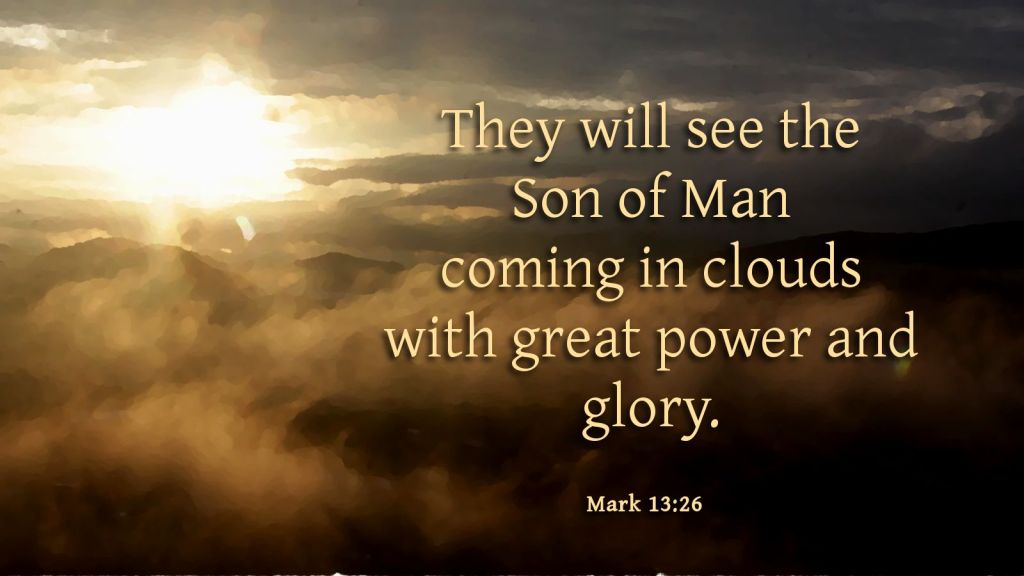
“But in those days, after that tribulation, the sun will be darkened, and the moon will not give its light, and the stars will be falling from heaven, and the powers in the heavens will be shaken. And then they will see the Son of Man coming in clouds with great power and glory.”

The most obvious interpretation of this is that the signs that herald the end will be seen in the heavens, not on the earth. But these words are almost identical to those used by Isaiah to speak about God’s judgement on Babylon. So what Jesus seems to be saying here is that there will be a time of great tribulation, a time of war and plague and natural disaster and famine which will only end when he returns to judge the world. In other words, things will carry on as they always have, there will always be trouble in the world. There will be wars and plagues and famines and natural disasters. So don’t worry about these things being signs that the end is coming. These things are not signs that the end is nigh they are just the way the world is and the way it will be until he returns in glory. But when will that be?

We have to say that Jesus’ words about this are a bit of a problem for us because he says,

Truly, I say to you, this generation will not pass away until all these things take place.”

The most obvious meaning of this is that those who were living at the time of Jesus, his contemporaries, would live to see the end and his return in glory. But we can’t take the most obvious meaning as the true meaning of his words because Jesus then says,

 “But concerning that day or that hour, no one knows, not even the angels in heaven, nor the Son, but only the Father.”

So what is Jesus saying here? What does he really mean?

I think we have to accept that we simply don’t know for certain. It’s a problem of translation. Jesus spoke Aramaic, but the Gospels were written in Greek and we’re reading an English translation. We do know that, in Greek, ‘this generation’ could mean Jesus’ contemporaries, the people who were living at that time. But it could also mean, ‘this race’, in which case Jesus would seem to be saying that in spite of the great tribulation that’s coming, the Jews will not pass away before he returns. But it could also mean ‘this age or time’ and if that’s the case Jesus is simply saying that the time of tribulation won’t end until he returns. It’s perhaps significant that Jesus uses the term ‘pass away’ rather than ‘die’. The Greek words are different and when he speaks about death Jesus doesn’t use the word that we translate as ‘pass away’. So there’s no sense that Jesus is saying here that his contemporaries won’t die before the end comes.

So after all that what can we say about the end? Well, I think we have to accept that we’re still going through what Jesus called the birth pains and that these will only end when Christ returns in glory. And as terrible as they are, we shouldn’t regard war, plagues and pandemics, famines and natural disasters as signs that the end is nigh. We’ll know when the end is near because the signs will be on a cosmic scale, and they’ll be unmistakable. But we simply don’t know when those signs will appear or when end will come so it’s useless to speculate. Rather, what we should do is live as though the end is nigh, as though our generation, as though we will not pass away before the end comes. Because above all else, this is the point  Jesus is trying to make in this chapter of St Mark’s Gospel. After all is said and done, his final words on the subject of the end are these;

Be on guard, keep awake. For you do not know when the time will come. It is like a man going on a journey, when he leaves home and puts his servants in charge, each with his work, and commands the doorkeeper to stay awake. Therefore stay awake—for you do not know when the master of the house will come, in the evening, or at midnight, or when the cock crows, or in the morning— lest he come suddenly and find you asleep.  And what I say to you I say to all: Stay awake.”

Amen.


Propers for the 33rd Sunday of Ordinary Time (2 before Advent) 17th November 2024

Entrance Antiphon
The Lord says, my plans are peace and not disaster;
when you call to me, I will listen to you,
and I will bring you back to the place from which I exiled you.

The Collect
Heavenly Father,
whose blessed Son was revealed to destroy the works of the devil,
and to make us the children of God and heirs of eternal life:
grant that we, having this hope,
may purify ourselves even as he is pure;
that when he shall appear in power and great glory,
we may be made like him in his eternal and glorious kingdom;
where he is alive and reigns with you,
in the unity of the Holy Spirit,
one God, now and for ever.
Amen.

The Readings
Missal (St Mark’s)     
Daniel 12:1-3
Psalm 16:5, 8-11
Hebrews 10:11-14, 18
Mark 13:24-32

RCL (St Gabriel’s)          
Daniel 12:1-3
Psalm 16
Hebrews 10:11-25                                    
Mark 13:1-8