Sermon for the Epiphany of the Lord, 5th January 2025

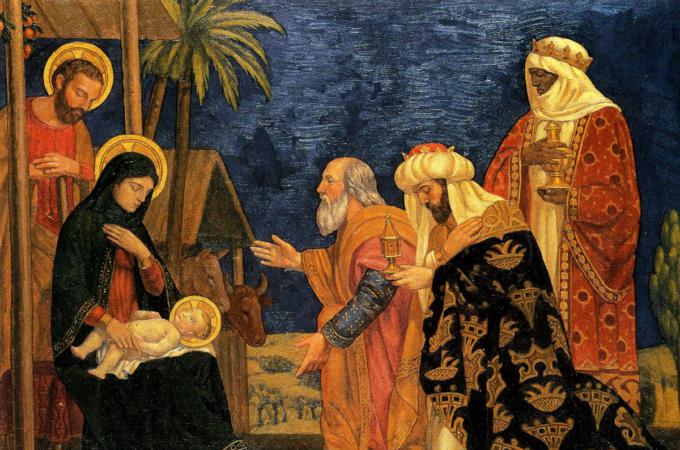
If I were to ask most people what today’s feast, the Epiphany of the Lord was all about I’m sure I’d get quite a few blank looks. Perhaps a few people would know that it has something to do with the visit of the Three Wise Men to Bethlehem and the baby Jesus, but I’m sure that a lot of people would have no idea whatsoever what the day is about, many probably wouldn’t even that the day exists at all. Maybe some would say that it’s the traditional day for taking down Christmas decorations but I’m sure a lot of people wouldn’t even know that because if you take notice of the media and what goes on in the supermarkets these days you’d think that the Twelve Days of Christmas begin on December 13th and that Christmas ends on the stroke of midnight on December 25th. In fact I have heard people in the media express exactly that view. And as we all know, if you go into a supermarket after Christmas Day the only hint you’d get that Christmas had happened at all are a few Christmas goods on sale at cut prices because the shelves that had been stacked with Christmas goods up to Christmas Eve have been emptied and re-stocked with Easter Eggs.

But it wasn’t always like that. At one time everyone would have known that the Twelve Days of Christmas referred to the twelve days of celebrations that began on Christmas Day and ended on Feast of the Epiphany. In fact, it could be said that the celebration of Christmas actually built up over the twelve days and culminated with the great feast of Twelfth Night on or on the eve of the Feast of Epiphany. And that’s a measure of how important a feast Epiphany was once held to be. But that doesn’t seem to be the case even in the Church these days where the secular view of Christmas seems to have crept in too. For example, I was being asked in November when the Christmas Tree could go up and when the Crib could be set up, but then, within days after Christmas Day, people began to ask me when the tree could come down and how long do we have to leave the Crib up before we can take that down and ‘get back to normal’?

I think we, in the Church, need to get back to celebrating Christmas in the way we once did. We need to get back to starting our preparation for Christmas on Advent Sunday and using Advent as a time to prepare for Christmas rather than as a time to start our Christmas celebrations. And we need to get back to celebrating Christmas during Christmas, during the twelve days between Christmas and Epiphany. And we need to get back too, to celebrating Epiphany as it should be celebrated. Not simply as the day when we can finally take the Christmas Trees and Cribs down, and ‘get back to normal’, but as the great feast of the Church it is and always should be.

And Epiphany is a great feast of the Church. The visit of the Magi to the Christ-child marks the revelation of Christ to the Gentiles and so it marks the day when we, who were once not God’s people, realised that God had offered us the chance to become his people. And we become God’s people by recognising who the child born in Bethlehem really is and following the example of the Magi in coming to him, offering  our gifts to him and worshipping him.

Of course we don’t have to offer the exact same gifts to Jesus as the Magi did and we can’t offer any gifts to Jesus in the same way they did anyway because Jesus isn’t physically here on earth now as he was then. But we know what their gifts were, and we can offer to Jesus what their gifts symbolised. Gold, a gift fit for a king. And we can offer Jesus a gift fit for a king by treating him as our King, by listening to his words and obeying them as commands. Frankincense, an offering to God. We can offer Jesus that kind of gift by treating him as our God, by treating him as though he not only has power over us in this life, but in the next life too. As though he has power over our lives both now and in eternity, power over us body and soul. And myrrh, a gift for healing and embalming the dead. And we can offer this kind of gift to Jesus by turning to him in prayer for healing in our lives and in faith that he will heal us in this life and raise us to eternal life when this life comes to an end. So we can all offer Jesus the gifts of the Magi by recognising him as our King, our God and our Saviour, and treating him as all these things. But there’s more to the example of the Magi than offering these gifts.

I think one of the ways, perhaps the main way, in which we all fail to live up to the example of the Magi is in our lack of commitment. In the last verse of the Christmas Carol, In the Bleak Mid-winter, we find these words;

What can I give him, poor as I am?
If I were a shepherd I would bring a lamb;
if I were a wise man I would do my part,
yet what I can I give him: give my heart.

And to give our heart to Jesus means to give him everything, just as the Magi gave Jesus much more than gifts of gold, frankincense and myrrh. They put their all into searching for him and finding him. They looked for signs and found a star. We think that they probably came from Persia, modern day Iran, and so the journey to Bethlehem would have taken them about two months. But we know from Herod’s questioning of them that it had been about two years between the Magi first seeing the star and arriving at Jerusalem, so it was a journey a long time in the planning. The fact that they went to Jerusalem means that, when they set off, they weren’t even sure exactly where to go. And after having spent so long travelling to Jerusalem, only to find they’d gone to the wrong place and still had further to travel, they didn’t give up, they set off again. And in spite of the fact that they’d been told by Herod, a king who seems to have had no qualms whatsoever about doing away with anyone who crossed him, to return to Jerusalem and tell him where the child was, they didn’t because they knew that Herod’s stated wish to worship the child was a lie.

How many of us are so committed to Jesus? How often do we miss opportunities to meet Jesus or to allow him to enter our lives simply because we’re not looking for him in our lives? How often do we dither about doing something or going somewhere in connection with our faith? And if you think people don’t do that, try to organise a pilgrimage! I’ve been doing that for over twenty years now and I’ve never yet taken all the people who, at one time or another, have told me they want to go, or even are going to go. I want to go but the dates aren’t convenient, it’s too far ahead to plan for, the journey’s too long, I’ll go if I can have an en-suite room, if I can travel with this person, if I don’t have to travel with that person. And so the list goes on. But it’s not just when it comes to making that kind of journey that we dither. How many times do we miss going to church on a Sunday or other day of obligation because we’ll have to make a bit more effort than usual to go? If we’re away from home for work or on holiday, for example, and we can’t go to the church we usually go to there will be a church, or perhaps a few churches that we could go to but how many of us actually take the trouble to go and find one?

And how easily are we put off by what people say and do and how often do we use what others say and do as an excuse for not doing what we know we should be doing? The Covid-19 lockdown that forced us to close our churches is almost five years ago now, but how many people are still using Covid as an excuse for not coming to church? In this benefice the churches stayed open until we were told we had to close them, and we reopened them as soon as we could. But how many churches seemed to use Covid as an excuse to remain closed long after they could have re-opened? One of the most appalling things I heard with regard to this was from a priest who said that the churches should not reopen because that gives people the message that we in the Church think things are back to normal and they’re not. So we should keep the churches closed so that we can identify with the brokenness of the world. But by that reasoning surely we should never open the churches, ever, because when is the world anything but broken in some way? If a member of our congregation can’t come to church because they’re ill and in hospital, does that mean we should suspend services until they’re well enough to join us in church again? If a church in Ukraine, for example, is bombed to destruction, does that mean we should close our church until that church is rebuilt and reopened for worship?

The words of In the Bleak Mid-winter urge us to emulate the part of the Wise Men by giving our hearts to Jesus. They urge us to do as the Wise Men did and show our full commitment in looking for Jesus, searching for him in our lives and in worshipping him as our King, our God and our Saviour. The Feast of the Epiphany reminds us of what they did and so it should remind us of what we need to do. But it can’t do that if we don’t treat this feast as it should be treated. The Feast of the Epiphany can’t remind us of these things if we treat it as little more than a reminder that it’s time to take our Christmas decorations down and get back to normal. So let’s treat it as it once was treated as the culmination of our celebration of Christmas, the time when we realise just who the babe of Bethlehem really is, our King, our God and our Saviour whose birth gives us the opportunity to be God’s people.

Amen.


Propers for the Epiphany of the Lord, 5th January 2025

Entrance Antiphon
Behold, the Lord, the Mighty One, has come;
and kingship is in his grasp, and power and dominion.

The Collect
O God,
who on this day revealed your Only Begotten Son to the nations by the guidance of a star.
Grant in your mercy that we, who already know you by faith,
may be brought to behold the beauty of your sublime glory.
Through our Lord Jesus Christ, your Son,
who lives and reigns with you in the unity of the Holy Spirit,
God, for ever and ever.
Amen.

The Readings
Isaiah 60:1-6
Psalm 72:1-2, 7-8, 10-13
Ephesians 3:2-3, 5-6
Matthew 2:1-12

Post Communion
Go before us with heavenly light, O Lord,
always and everywhere,
that we may perceive with clear sight, and revere with true affection,
the mystery in which you have willed us to participate.
Though Christ our Lord.
Amen.
Sermon for The Holy Family, 29th December 2024

It’s no secret among people who know me that my favourite Christmas story is Charles Dickens A Christmas Carol. There are quite a few film adaptations of the story and it’s always part of my Christmas to watch a few of them, but my favourite has always been the 1951 version in which Alistair Sim plays the role of Ebeneezer Scrooge. Having said that, there is one thing about that version, and others too it must be said, that I do find a little annoying because it’s so strikingly incongruous, and that is the upper-class accents of the Cratchit family. I mean, the Cratchits are supposed to be a rather down-trodden, poor family from Camden Town. They hardly have two ha’pennies to rub together, and yet they speak with the kind of aristocratic accent that’s taught at Eton or some other very expensive boarding school.

It may be that the incongruity of the Cratchit’s accent was a deliberate dramatic device to show that the Cratchits are actually much better people that their lowly estate would suggest. But whatever the reason for it, what I think it does show are the prejudices of our society.

Many of us, I’m sure, will be able to remember when it was quite unusual to hear regional accents on the TV and almost everyone in British films, probably up to the 1960s, spoke like a 1930’s BBC announcer unless, that is, they were playing a rather dubious character. It was almost as though rough, uncouth people or criminals spoke in one way whilst nice, well-educated people spoke in a completely different way. But as the famous playwright, George Bernard Shaw once said,

“It is impossible for an Englishman to open his mouth without making some other Englishman hate or despise him.” 

And of course, we’re not supposed to hate and despise the Cratchits, and so perhaps this is why, on film, they speak in the way that ‘nice’ people speak.

Such is the power of accents, the way we speak, to define in the eyes of others the kind of people we are. It’s prejudice and bigotry, plain and simple, but it’s a fact of the society we live in. And it isn’t only the way someone speaks that affects the way others think about them is it?

People are prejudiced against others because of where they come from, where they live, their family background and their social and economic status, not to mention their faith, their race and the colour of their skin.

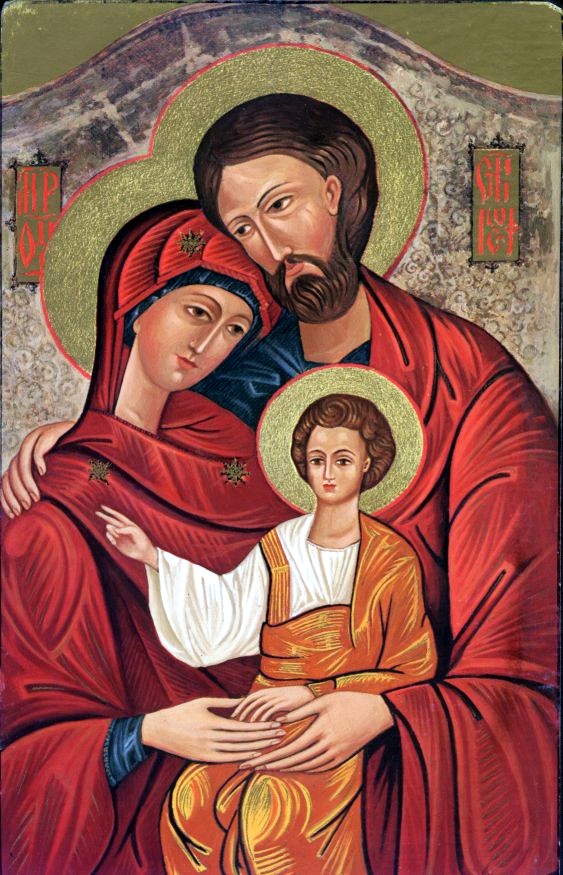
It would be nice to say that we don’t find such prejudice and bigotry in the Church, but sadly, we do. Individual Christians can be every bit as prejudiced against others as anyone else, and the Church as an institution can show prejudice too. That’s understandable in one sense because we all grow up surrounded by the prejudices of the society we live in and to some extent the Church can’t help but reflect that society. But that isn’t the way it should be. As disciples of Christ we, as individuals, should show no prejudice against others and so the Church which is made up of individual Christians, shouldn’t either. And if we ever are tempted to look down on other people for any reason, we should take a moment to think about our Lord Jesus Christ and his earthly family, first.

Who were the Holy Family? What were they? First of all, Mary and Joseph were from Nazareth in Galilee, and that wasn’t a particularly well-respected part of the Jewish world. Galilee was predominantly Jewish in their day, but it was a largely rural, agricultural society surrounded by Gentile nations and to the more urban and urbane, the more well-educated and wealthy Jews of the south, Galileans were seen as country bumpkins, ill-educated peasants. Nazareth itself though, seems to have been a predominantly  Gentile town and even other Galileans looked down on Nazareth. Hence Nathaneal’s question,

“Can anything good come out of Nazareth?” 

But Mary and Joseph were forced to come out of Nazareth and travel south to Bethlehem where people would have looked down on them, perhaps even hated them simply because of where they came from. And Mary was forced to give birth in a stable, an animal house because she and Joseph couldn’t find anywhere else to stay. Was that because there was no room at the inn, or because no one would give them room because of who and what they were? We know they didn’t have much money because when Jesus was presented at the temple, their offering to God ‘a pair of turtle doves, or two young pigeons’ was the offering the poor were expected to make. So they wouldn’t even have been able to pay a bit over the odds to get a room. And what would people have made of and said about the fact that Mary had to give birth in a stable, and that her son’s first bed was a manger, an animal trough? What kind of parents would do that?

Then the family were forced to leave Bethlehem and run for their lives out of Judea and into Egypt; they became asylum seekers. Whether they were ever granted what we’d now call refugee status with rights and legal protection, we simply don’t know. What we do know is how much prejudice there is today against asylum seekers and refugees. We know that there was a Jewish community in Egypt at the time the Holy Family travelled there, but how happy would they have been to accept a family running from Herod, the puppet king of the Romans, the very same people who also ruled Egypt at that time? And even if people didn’t know that was why the family had gone into Egypt, they were still Nazarenes and what kind of reception would the community have given to a family from Nazareth? It wasn’t as though they could hide that because on the night of Jesus’ arrest, wasn’t Peter given away as a disciple by his Galilean accent?

We also know that Jesus faced opposition during his ministry because of his background. When Nicodemus tried to defend Jesus during a dispute about whether Jesus was the Christ or not, the Pharisees insulted those who believed in Jesus for their ignorance of the law and insulted Nicodemus too;

“Are you from Galilee too? Search and see that no prophet arises from Galilee.”

In other words, “Are you an ill-educated peasant who doesn’t understand the law too?” In fact, prophets did arise from Galilee, Jonah and Nahum were both from Galilee, so the Pharisees were probably just assuming  people’s ignorance and playing on the widespread prejudice against Galilee and Galileans to try to discredit Jesus.

But it didn’t end with prejudice against Galilee and Galileans. People also brought up the controversial nature, shall we say, of Jesus’ conception to try to discredit his teaching. When Jesus said that true children of Abraham wouldn’t be seeking to kill someone who spoke God’s truth to them, they insisted that they were Abraham’s children and said,

“We were not born of sexual immorality.”

And you can almost hear the unspoken ‘unlike you’ that’s implicit in that statement.

The lives of the Holy Family, were filled with so many things that cause prejudice today and must have caused people to be prejudiced against them in their day. Prejudice because of where they were from. Prejudice because of the nature of Jesus’ conception and the poverty of his birth. Prejudice because of their social and financial status, and of how they spoke. And prejudice because they were asylum seekers.

As he grew up as part of this family in Galilee, Jesus must have been aware of all these prejudices against his family. And the prejudice Jesus suffered from during his ministry must have impacted on his earthly family too. And yet, as unworthy and unsuitable for such a great vocation this family might have seemed in the eyes of other people, this was the family God chose for his Son. This family of poor, rough speaking country bumpkins was the family God chose our Lord and Saviour to be born into. And this is something that we should never forget.

We believe that the Son of God became man in order to save the world. So that he could show by word and example what it means to live as God’s people. So that he could make on the Cross that one, full and sufficient sacrifice for sin that takes our sins away. But more than that, we believe that he had to be fully human so that he would fully know what it is to live as a human being, to suffer the trials of human life and to be tempted as we are and yet not sin. And we should never forget that in order to do that, the Son of God wasn’t born into a high and mighty family of great wealth and high status. He wasn’t born into a family who looked down in contempt on others, but into one that was looked down upon with contempt. He was born into a family that suffered from the prejudices of society. And so whenever we feel the temptation to look down on others because of where they’re from, how they speak, how much money they’ve got, where they live or any of the other things that society thinks are so important in defining a person’s worth. Before we look down on someone because of the situation they find themselves in, such as the asylum seeker or the refugee, let’s pause for a moment to remember that Jesus and the Holy Family found themselves in just these situations. And before we utter a word in prejudicial judgement on them, let’s ask ourselves, who is standing in Christ’s shoes, those who show their prejudices against others, or those who suffer because of those prejudices?

Amen.


Propers for Holy Family Sunday, 29th December 2024

Entrance Antiphon
The shepherds went in haste,  
and they found Mary and Joseph, and the infant lying in a manger.

The Collect
Holy Family
O God,
who were pleased to give us the shining example of the Holy Family,
graciously grant that we may imitate them in practicing the virtues of family life,
and in the bonds of charity,
and so, in the joy of your house,
delight one day in eternal rewards.
Through our Lord Jesus Christ, your Son,
who lives and reigns with you in the unity of the Holy Spirit,
God, for ever and ever.
Amen.

The Readings
1 Samuel 1:20-22, 24-28
Psalm: 84:2-3, 5-6, 9-10
1 John 1:1-2, 21-24
Luke 2:41-52

Post Communion
Bring those you refresh with this heavenly sacrament,
most merciful Father, to imitate constantly the example of the Holy Family,
so that, after the trials of this world,
we may share their company for ever.
Through Christ our Lord.
Amen.

Sermon for the Nativity of the Lord, 2024

I don’t’ know what your experience of opening presents on Christmas morning is, but for our family it tended to happen in one of two ways. Sometimes we’d come downstairs and find everyone’s presents arranged in groups, one for each member of the family. But at other times we’d find lots of presents all piled together and then we’d have to sort through them to find those with our name on them. And of course when that happened we’d be very eager and excited to sort through the presents and to find those with our name on them so we could get on with the important business of opening them. And even if you haven’t been through that experience of Christmas morning yourself, I’m sure you can imagine the excited chaos of the ‘That’s mine, this is yours. Whose is this? It doesn’t say’ scene.  

The presents I’m talking about here, of course, are worldly gifts but we’re here, in church at Christmas, to celebrate the giving of an altogether different kind of present. We’re here to celebrate God’s gift to us of his incarnate Word through the birth of our Lord and Saviour Jesus Christ. This is, as I said in my sermon on Advent Sunday, a truly awesome thing, the most wonderful and awesome present we have ever been given. And yet how many people have failed and still fail to see that? How many people treat this most awesome gift as though it was a present they’ve picked up on Christmas morning that doesn’t have their name on it, have laid it aside and haven’t even looked to see what it is?  

And I do think that many people, have and do treat this most awesome gift from God in just that way, as something for someone else, and not for them. But they couldn’t be more wrong. In one sense this gift from God is for the family, the whole human family. As the angels said to the shepherd’s on that first Christmas Day: 

“Fear not, for behold, I bring you good news of great joy that will be for all the people. For unto you is born this day in the city of David a Saviour, who is Christ the Lord.” 

So this is a gift for everyone. But it’s also a personal gift. It’s a gift that’s labelled, if you like, with your name, and with my name, and with the name of each and every individual person in the human family.  

We know that because we’re told in scripture that God knows each and every one of us intimately, that he knows us by name. As Jesus said,  

“Why, even the hairs of your head are all numbered…”   

We know too that the reason God gave us this awesome gift was that so we might be saved from our sins and have eternal life. But we also know that if we are going to be saved and inherit eternal life, we have to use this gift. Again, as Jesus said,  

“…everyone who acknowledges me before men, the Son of Man also will acknowledge before the angels of God, but the one who denies me before men will be denied before the angels of God.”  

And if we’re going to acknowledge the Son of Man before our fellow men, we have to get to know him. And we can’t do that by laying this awesome gift from God aside, as though it were a present labelled with someone else’s name. We have to see our name on the gift, then open it, and use it.  

There are so many people though who don’t do this. We know that but I think too that we who have recognised this awesome gift from God as a gift for us, can sometimes be guilty of not appreciating it as we should. And I think that comes from over-familiarity with the gift.  

I’m sure we’ve all been given books at Christmas at one time or another. We’ve probably been very happy and grateful for that gift, but once we’ve read a book we tend to lay it aside don’t we? We put it on the bookshelf and there it stays, gathering dust. We don’t often use that gift again do we? And why would we? It’s a book and we’ve read it; we know what it’s about, so we don’t need to read it again. I’m sure too that we’ve all been given games at Christmas. Again, we’ve probably been happy and grateful to receive that gift. But how many games have we played incorrectly because we haven’t really read the rules properly? We’ve probably skimmed through the rules when we first got the game so that we can start playing, and we’ve done that because we want to play the game rather than spend time reading about how to play it. But because we didn’t take the trouble to read the rules properly, we don’t actually play the game as it was intended to be played. And we never do because once we can play the game well enough to get through it, we think we know how to play it, so we don’t need to read the rest of the rules.  

And that’s ok until we play the game with someone else who’s done exactly the same thing as us, only they’ve read a different bit of the rules to us. And we all know what happens then: we end up spending more time arguing about the rules than actually playing the game. That’s why the Church is so divided. Think about it! 

But we can’t treat this awesome gift from God like this. We need to treat it as a book that we have to read over and over again if we’re ever going to understand the story. Or as a game we have to learn the rules to, no matter how long that takes, if we’re ever going to be able to finish the game. Perhaps a good analogy of the way we should treat this gift from God is like the gift in a game of pass the parcel. We all know how to play that game, we pass the parcel round until the music stops, then we take of a wrapping, and as soon as the music starts again, we pass the parcel on. But in some versions, there’s a small gift inside each wrapping and so every time the music stops, we uncover this small gift. And so it goes on until the last person unwraps the big gift inside the final wrapping. And that’s what this awesome gift from God can be like for us if only we take the time and trouble to start to unwrap it. Each time the music of our life stops, perhaps in a time of need or trouble, or just in some quiet time, if we look again at God’s Word, try to unwrap a little more of the awesome gift God gave us at Christmas, we’ll find a small gift, something to lead us through the present time until the music of life starts to play again. And if we can carry on with the game  until the music of this life comes to a final end, then we’ll receive the big gift inside the final wrapping; the gift of eternal life which is the very reason God gave us the gift of his Son.  

People sometimes ask, where is the peace on earth that was promised on that first Christmas Day. But to ask that is to misunderstand the angel’s message. The angels weren’t speaking about peace between people, but about peace between us and God. To enjoy that peace we have to please God, and Jesus left us in no doubt that what is most pleasing to God is to know and love and obey the Word he sent into the world at Christmas. So let’s try to do just that by seeing this awesome gift from God as one that’s labelled with our name, then opening it and using it every day of our lives so that, when the music of this life does come to an end, we’ll receive that that other great gift that God wants to give us, the gift of eternal life.  

Amen.  


Propers for the Nativity of the Lord, 24th – 25th December 2024

Entrance Antiphon

Midnight Mass
Let us all rejoice in the Lord, for our Saviour has been born in the world.
Today true peace has come down to us from heaven.

Christmas Day
A child is born for us, and a son is given to us; his sceptre of power rests upon his shoulder,
and his name will be called Messenger of great counsel.

The Collect

Midnight Mass
Eternal God,
who made this most holy night to shine with the brightness of your one true light:
bring us, who have known the revelation of that light on earth,
to see the radiance of your heavenly glory;
through Jesus Christ your Son our Lord,
who is alive and reigns with you,
in the unity of the Holy Spirit,
one God, now and for ever.
Amen.

Christmas Day
Almighty God,
you have given us your only-begotten Son,
to take our nature upon him and as at this time to be born of a pure virgin:
grant that we, who have been born again and made your children by adoption and grace,
may daily be renewed by your Holy Spirit;
through Jesus Christ your Son our Lord,
who is alive and reigns with you,
in the unity of the Holy Spirit,
one God, now and for ever.
Amen.

The Readings

Midnight Mass
Isaiah 9:2-7
Psalm: 96:1-3, 11-13
Titus 2:11-14
Luke 2:1-14

Christmas Day
Isaiah 52:7-10
Psalm: 98:1-6
Hebrews 1:1-6
John 1:1-18

Post Communion

Midnight Mass
God our Father,
in this night you have made known to us again the coming of our Lord Jesus Christ:
confirm our faith and fix our eyes on him until the day dawns
and Christ the Morning Star rises in our hearts.
To him be glory both now and for ever.
Amen.

Christmas Day
God our Father,
whose Word has come among us in the Holy Child of Bethlehem:
may the light of faith illumine our hearts,
and shine in our words and deeds;
through him who is Christ the Lord.
Amen.