Sermon for Lent 1, 9th March 2025

Today is the first Sunday of Lent and so, as always, our Gospel reading today is the story of Jesus’ temptation in the wilderness. And, as people who preach on this story usually do, I’m going to speak today about temptation, about how we can be faced with the same or similar temptations Christ was, and about how, unlike him, we can succumb to temptation and be led astray from the right path of life. But I’m going to try to look at these things in a slightly different way than perhaps we usually do.

The first temptation Jesus faced was to turn stones into bread. Of course that’s something we can’t do, we don’t have the power, but Jesus did. His answer to this temptation though was to say,

“It is written, ‘Man shall not live by bread alone.’”

And that calls to mind the full scripture quotation, written in the Book of Deuteronomy,

‘…man does not live by bread alone, but man lives by every word that comes from the mouth of the Lord.’ 

But as Christians we believe that Jesus is both word and bread. He is the ‘Word made flesh’, the incarnate Son of God. And he is the ‘Bread of Life’. Or, to put it in Jesus’ own words,

“I am the living bread that came down from heaven. If anyone eats of this bread, he will live for ever. And the bread that I will give for the life of the world is my flesh.”

So in Jesus we have both bread and word. But what do we do with this wonderful gift from heaven? Do we see it as the means of life for the world, or do we use it for our own selfish purposes? Sadly, I think it’s far too often the latter. As we break the bread of life in church, we say,

“We break this bread to share in the body of Christ.

Though we are many we are one body, because we all share in one bread.”

We say this but we know that we’re not one. And what’s worse, we use both word and bread as weapons in our petty internecine arguments. We argue about the word and say that those who don’t agree with our version of the word are not part of the body.

We argue about holy orders, about whose ordination has been done properly and whose hasn’t. And if people don’t do it our way, we say that their bread isn’t the true bread, that it isn’t the body of Christ.

I hear these kinds of statements so often. Not too long ago an ex-Anglican I know who’s now been received into the Roman Catholic Church told me that his parish priest told him that he’d been wasting his time all the years he was an Anglican. Why? Do we proclaim a different Gospel to the Roman Catholic Church? Do we believe that someone other that Jesus Christ is our Lord and Saviour?

We might not have the power to turn stones into bread, but we certainly do seem to have the power to turn bread into stones. We’re often tempted to do that, and we very often give in to that temptation. We turn bread into stones and then we pick up those stones and throw them at one another.

The second temptation Jesus faced was to turn his back on God and worship the devil in return for earthly power and glory.

That’s a temptation we know only too well because we’re surrounded by people who’ve done that. We live in an age when our society in general seems to have turned its back on God in favour or earthly riches, power and glory. A very selfish society in which the motto to live by seems to have become ‘What’s in it for me?’ We might like to think that we’re not like that. And to some extent at least, that’s true. At least we’re here in church worshipping the Lord and giving thanks for the good things he’s blessed us with, both the spiritual and the worldly. But still, if we’re honest, isn’t it true that we live in a kind of halfway house in which we follow Christ as long as that doesn’t become too hard for us in worldly terms? How many of us are really prepared to suffer any kind of economic or physical hardship for the sake of the Church, or our neighbour, let alone for an enemy? And yet we proclaim Jesus Christ,

‘… who, though he was in the form of God, did not count equality with God a thing to be grasped, but made himself nothing, taking the form of a servant, being born in the likeness of men. And being found in human form, he humbled himself by becoming obedient to the point of death, even death on a cross.’ 

not only as our Lord and Saviour but as the way, the truth and the life, and as our example.

Jesus was taken up to see all the kingdoms of the world and their power and glory, but we don’t have to be, we’re surrounded by it in our daily lives. We can see the world’s glory at home on our televisions, and wherever we are through the wonders of modern technology, through laptops, smart phones and the internet. Perhaps part of the problem is that, in being able to see so much so easily, we end up not being able to really see any further than the end of our noses. In the film Enter the Dragon, Bruce Lee’s character is trying to explain something to his student and says,

“It’s like a finger pointing away to the Moon.”

The student looks at the finger, Lee slaps him on the head and says,

“Don’t concentrate on the finger or you will miss all that heavenly glory”

I think we can be so tempted by the finger, by what’s right in front of us that we can lose sight of all the heavenly glory that God has in store for us.

The final temptation Jesus faced was to put God to the test by throwing himself from the top of the temple, forcing God into acting to save him.

I don’t think any of us would be so stupid as to test God in this kind of way. I’m sure some of you will have seen the photographs of John Barber and myself on the scaffolding at the top of St Mark’s Bell tower. I certainly didn’t think to throw myself down in an attempt to prove to the people of Chadderton and Middleton Junction that God loves us, and they should all be in church on a Sunday. I’m pretty sure John didn’t either. I’m also pretty sure that if I had done, I would have landed with an almighty splat! And you’d now be looking for a new vicar. But we can and do put God to the test in other ways, and we do put him to the test, often.

On your way into church this morning, you may have noticed a picture of a man leaning on a shovel. The words on the picture say,

God is in control, but he doesn’t expect you to lean on a shovel and pray for a hole to appear. He asks you to dig a hole and trust that he’s shown you where to dig it.

And this is one way we put God to the test. We pray for something and expect God to give us what we want. Perhaps what we’d be far better doing in many cases is praying to God to show us how to deal with the problem we’re praying about. Rather than praying,

Father, please let someone leave us some money (or let us win the lottery) so we can keep this church open,

our prayer should be more along the lines of,

Father, help us to see how we can proclaim the Gospel in ways that will bring people to faith.

So we can put God to the test in the way we pray. But perhaps we put God to the test most often is in our attitude towards sin.

We are all sinners. But how many of us sin, know that we’re doing wrong at the time, but do it anyway and then think it’s OK, and that God will forgive us because it’s only a little sin and it’s not as bad as some things other people do? Perhaps we think that we’ll be forgiven because we come to church whereas so many other sinners don’t. But isn’t that just like throwing yourself off the top of the temple, or a bell tower trusting God to save us? Isn’t it the same as doing something stupidly dangerous thinking no harm will come to us because we believe in God? And thinking we can commit sins quite deliberately and get away with it is stupidly dangerous because when we do that we’re not just taking chances with our mortal lives but with our prospects of immortal life. We might believe that our sins are forgiven through the Cross of Christ, but Jesus said that only those who do the will of the Father will be saved and the Father’s will is not that we should put him to the test by expecting forgiveness and eternal life from him whilst being serial, unrepentant sinners.

There are so many ways we can be tempted to sin, and so many ways we can succumb to the temptation. We should always be aware of this, but Lent above any other is the time of the Church’s year when we’re called to think about these things. So let’s use these 40 days wisely, as a time to think about how we’re tempted, about what tempts us, and about how and why we succumb to temptation. And as a time for prayer too. Not simply for forgiveness and salvation, but for guidance so that we might have the wisdom and the strength to find sin less of a temptation and to be able to follow Christ’s example of resistance a little more closely.

Amen.  


Propers for the 1st Sunday of Lent, 9th March 2025

Entrance Antiphon
When he calls on me, I will answer him;
I will deliver him and give him glory,
I will grant him length of days.

The Collect
Grant, almighty God,
through the yearly observances of holy Lent,
that we may grow in understanding of the riches hidden in Christ,
and by worthy conduct pursue their effects.
Through our Lord Jesus Christ, your Son,
who lives and reigns with you in the unity of the Holy Spirit,
God, for ever and ever
Amen.

The Readings
Deuteronomy 26:4-10
Psalm 91:1-2, 10-15
Romans 10:8-13
Luke 4:1-13

Prayer after communion
Renewed now with heavenly bread,
by which faith is nourished, hope increased,
and charity strengthened,
we pray, O Lord,
that we may learn to hunger for Christ,
the true and living Bread,
and strive to live by every word which proceeds from your mouth.
Through Christ our Lord.
Amen.

Sermon for the 8th Sunday in Ordinary Time, 2nd March 2025

When I was growing up, virtually every house I went in, whether it was of family or friends, had something in common, and that was their vacuum cleaner, and their washing machine if they had one, were both made by Hoover. I believe that originally, Hoover made electric motors and only entered the domestic appliance market as an outlet for their motors. But nevertheless they were incredibly successful at selling those appliances.

There were at least two very good reasons for that. First of all, their products were very good. Secondly, their workforce had it drummed into them just how good those products were. One member of my family and a very good family friend had both worked for Hoover at one time and they told me that at company sales conventions and the like, at some point they’d all be up on their feet singing Hoover’s advertising slogan:

All the dirt, all the grit,

Hoover gets it every bit;

for it Beats as it Sweeps as it Cleans.

The intended result was to produce a highly motivated workforce who really believed in the company’s products. And it must have worked because Hoover were very successful at selling their products. So successful in fact that, even today when they might never have owned a  vacuum cleaner made by Hoover, people still talk about ‘Getting the Hoover out’ and of using their vacuum cleaner as ‘Hoovering up.’ 

Hoover became very successful at selling domestic appliances through a combination of manufacturing good products and creating a motivated team who really believed in those products. And we can apply those same ideas to the Church and its mission.

First of all, what is our product, what is it that we’re trying to sell? Well it’s not eternal life because it’s not in our power to grant that. The gift of eternal life is one that only God can give to people. What we do have though, is the instruction book on how to achieve eternal life. The Gospel is our product and that’s what we’re trying to sell to people. We could liken it, I suppose, to a search for buried treasure. We can’t give the treasure to people ourselves because don’t have the treasure, God has it. But we know how to find it because Jesus has given us the map. So what we can do is let people have copies of the map.

If you think about, this is something that everyone should want. No matter how successful we are in worldly terms, no matter how good our life is or how happy we are with life, we can all be brought crashing down to earth very quickly with the certain knowledge that one day it will all come to an end because we’re all going to die and there’s absolutely nothing that we can do to alter that fact. So something that shows people how they can live forever should be the most sought-after thing on earth. So why aren’t people banging on church doors pleading with us to be let in and pleading with us to share this wonderful thing we call the Gospel with them?

I think one very good reason for that is that our product is so unbelievably good that a lot of people don’t believe it. There’s a well-known saying in advertising isn’t there, especially when it comes to advertising get-rich-quick financial schemes, and that is,

“If it sounds too good to be true, it probably is!” 

And I think for a lot of people, eternal life is something that probably does sound too good to be true.

Perhaps another reason that people aren’t stampeding to the Church to get their hands on what we’re selling is that it’s not a get-rich-quick scheme. What we’re selling isn’t something you simply buy into and ‘Hey presto’ you’re going to live forever. It’s not that kind of product. It’s not really like a vacuum cleaner either. That made life a lot easier for people because before they had vacuum cleaners when people wanted to clean their rugs and carpets they had to take them up, hang them over a washing line and beat the living daylights out of them with a paddle, whereas all you have to do with a vacuum cleaner is plug it in, switch it on and push it round. The Gospel though is something you have to study, to learn how to use and then put to use every single day of your life if you’re going to get the reward it promises. It’s like searching for buried treasure, the doubloons don’t simply fall into your lap because you’ve got the map, you have to get out there, follow the map to where the treasure can be found and then dig for it. So even if you have the Gospel, there’s still a lot of work to do if it’s going to work for you. And that brings us to another reason, perhaps the main reason, that people aren’t falling over themselves to get hold of what we’re trying to sell them.

To put it in worldly terms, the Church has a product, the Gospel. We are the people asked to sell the Gospel to those who don’t yet have it, and to offer on-going support in helping people understand and use the Gospel so that it has it’s desired end result, i.e. the people who use the Gospel are raised to eternal life. The world calls it advertising and sales and customer support; we call it mission and evangelism, and discipleship. But we’re struggling to sell this product we have. The quality of the product isn’t in question, how can it be, it was made by God and given to us by God’s own Son. So if it’s not the product that’s at fault then surely we have to look at the team who are doing the advertising and selling and customer support. We have to look at our own motivation and to ask, for all our fine words, whether or not we really do believe in what we’re trying to sell to other people.

We know that being a Christian isn’t easy, but Jesus never said it was going to be easy, quite the contrary in fact. And because it’s not easy, and because living according to the Gospel is something we have to try to do at all times throughout each and every day of our lives, it’s understandable that we get things wrong sometimes. But I don’t think that’s really the problem. The problem is when we do things knowing them to be contrary to the Gospel but then try to excuse those things or shrug them off as though they don’t matter. And that is a very big problem for the Church and for its mission, evangelism and discipleship.

One of the most exasperating things I find about being a parish priest is having to deal with petty squabbles between members of the same congregation. And they are almost always petty, extremely petty because very often they’re about nothing more than people stamping their feet and spitting their dummies out simply because they want their own way and can’t have it. Perhaps the thing that makes me most angry as a parish priest is losing people from a congregation because of the un-Christian behaviour and attitudes of another Church member, whether that be an archbishop or the people sitting alongside one another in the pews. All these things stem from a failure of discipleship, a failure of Christians to act in accordance with the teachings of Christ as revealed in the Gospel, the very thing we’re trying to sell to others. And these things make it so difficult for the Church, for us, to engage in mission and evangelism because how can we sell the Gospel to others if we in the Church don’t use it ourselves? How can we convince people that we really believe in the Gospel we’re trying to sell if we ourselves act as though we don’t really believe in it?

When we do these things, what are we but blind guides, asking people to become disciples of Christ when our own example of discipleship is so far from being Christ-like. Is it any wonder that people see what we do and accuse us of hypocrisy? Why should anyone buy what we’re trying to sell when our voices say “We believe” but our actions say otherwise? And if our actions show that we don’t really believe in the Gospel, how can we expect and why should we expect anyone else to believe us when we try to proclaim the Gospel?

So what can we do to show that we really do believe and help others to believe through us? In one sense there isn’t very much we can do if the one who’s acted in ways contrary to the Gospel is a bishop or an archbishop except to tell other people that this is not the way of Christ and to pray for those concerned. But when we’re guilty of un-Christian behaviour and are involved in disputes because of un-Christian behaviour  we can always start by trying to see things through the other person’s eyes and simply say  to them “I’m sorry.” And if we think that we’re the one who’s been sinned against, we might want to remember that we are all sinners, think about the Lord’s Prayer and remember that God will forgive us only to the extent that we are willing to forgive others. So we might want to be a little more forgiving. And if we’re ever tempted to stop coming to church because of the words or actions of another Church member, we might want to remember why we come to church in the first place. We come to church to worship God and to give thanks to him for his love towards us. Is it God’s fault if someone else is less loving towards us than they should be? No, it’s not, so why should we stop worshipping God because of the un-Christian behaviour of another person? And if we think everyone else in the congregation is a hypocrite, so what. That doesn’t mean we have to be one too does it?

In the Gospel we have a great product. If we, at least, can be those humble, loving, forgiving, thankful, worshipping people the Gospel calls us to be then we’ll be showing that we, at least, really do believe in the Gospel we’re trying to sell and perhaps we. at least, might be able to sell it to someone else.

Amen.


Propers for the 8th Sunday of Ordinary Time 2nd March 2025

Entrance Antiphon
The Lord became my protector.
He brought me out to a place of freedom;
he saved me because he delighted in me.

The Collect
Grant us, O Lord, we pray,
that the course of our world
may be directed by your peaceful rule
and that your Church may rejoice,
untroubled in her devotion.
Through our Lord Jesus Christ, your Son,
who lives and reigns with you in the unity of the Holy Spirit,
God, for ever and ever.
Amen.

The Readings
Ecclesiasticus 27:4-7
Psalm 92:2-3, 13-16
1 Corinthians 15:54-58
Luke 6:39-45

Prayer after Communion
Nourished by your saving gifts,
we beseech your mercy, Lord,
that by this same Sacrament
with which you feed us in the present age,
you may make us partakers of life eternal.
Through Christ our Lord.

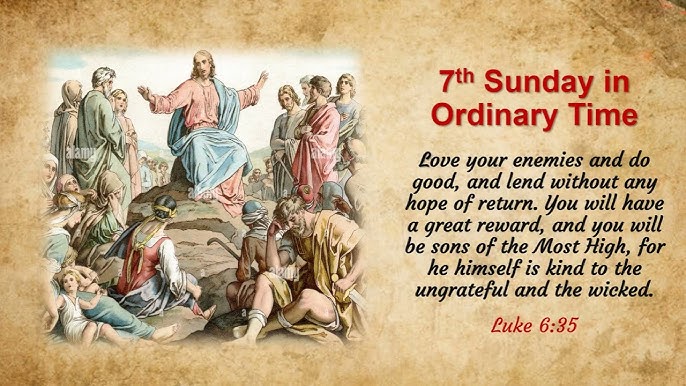
Propers for the 7th Sunday in Ordinary Time, 23rd February 2025

Entrance Antiphon
O Lord, I trust in your merciful love.
My heart will rejoice in your salvation.
I will sing to the Lord who has been bountiful with me.

The Collect
Grant, we pray, almighty God,
that, always pondering spiritual things,
we may carry out in both word and deed
that which is pleasing to you.
Through our Lord Jesus Christ, your Son,
who lives and reigns with you in the unity of the Holy Spirit,
God, for ever and ever.
Amen.

The Readings
1 Samuel 26:2, 7-9, 12-13,22-23
Psalm: 103:1-4, 8, 10, 12-13
1 Corinthians 15:45-49
Luke 6:27-38

Prayer after Communion
Grant, we pray, almighty God,
that we may experience the effects of the salvation
which is pledged to us by these mysteries.
Through Christ our Lord.
Amen.