
Sermon for the 18th Sunday in Ordinary Time, 3rd August 2025

Photo by Amaury Gutierrez on Unsplash

We all have interests in life don’t we? If I were to ask what your interests are, I’d expect to get lots of different answers because our interests can be as varied as we are. I’d expect a lot of people to say football, others might say music, some might say films or perhaps the theatre. Others might say reading or knitting or cooking or eating or drinking. Some might say walking or the countryside or animals, and I’m sure that some would say dogs. So we all have interests, and perhaps more than one interest, and whatever our interests are, we indulge in them, that is, we spend time and effort and often money on these things because they give us pleasure.

There’s nothing whatsoever wrong with having interests in life, in fact it’s a very healthy thing to have interests in life. And yet there have been, and no doubt still are, many people in the Church who actively try to discourage Christians from having interests outside the Church. There are people in the Church who say that outside interests, or certain outside interests at least, are sinful and are things that Christians simply should not be indulging in and , if they are, they should desist from them immediately. And I’ve met a lot of people over the years who’ve been lost to the Church for this very reason; that someone in the Church has told them that they must stop doing something they enjoy doing because it’s a sin. But the simple fact has often, and even usually been, that there’s been nothing sinful at all in what that person’s been doing, it’s just that the one pontificating about it doesn’t share their interests and, for whatever reason, doesn’t approve of it either.

For example, as I’m sure you all know, my great sporting interest in life is speedway racing, I’ve followed it all my life and I’ve raced too. But after I was ordained, a priest told me that I should give that interest up, partly because it would take my attention away from my duty to God, and that I should especially give up racing because it was sinful to compete against other people because that was simply about wanting to prove yourself better than another human being. I’ve rarely heard such complete and utter rubbish in all my life quite frankly, which is an opinion I expressed at the time. Speedway racing was, and is, an interest of mine, but a pastime, something I indulge in in my spare time and to the best of my knowledge, it’s never adversely affected my ministry; whenever there’s been a clash of dates, even when I was still racing, the Church has always come first. And whether I beat someone on track or lost to them, it never affected my opinion of them, or myself, as a human being.

To be fair to them, I think people who do pontificate about the sinfulness of people’s interests are often well-meaning in that I’m sure they think that they’re simply trying to help people be better Christians – to bring people closer to God. But what they’re often doing in fact, is conflating their own opinions with the Christian faith, and confusing simple interests and pastimes with the kind of earthly desires that St Paul speaks about in this morning’s reading from his Letter to the Colossians. Perhaps especially, they’re confusing simple leisure interests with that ‘covetousness which is idolatry.’

I’m sure we all know that to covet something is to want it, but covetousness is a particular kind of wanting; it’s an excessive desire to have something that’s often accompanied by envy and greed: covetous people want something so badly that they’re prepared to go to inordinate lengths to get it. And one of the driving forces behind covetousness is often jealousy; covetous people see what someone else has and want it for themselves. And these things can, and do, lead to idolatry, to making the object of our desire the be all and end all of life. In effect, making

the thing we want our god by loving it with all our heart and soul and mind. And of course that is sinful. It’s sinful because it’s contrary to the Great Commandment and wanting something so badly that we’re prepared to go to any lengths to get it can, and almost certainly will, lead us into all kinds of other sinful activities too. So one thing we do always have to be careful to avoid is allowing our interests to become overwhelming passions. We need to avoid allowing something we do because we enjoy it from becoming something that we want it so much that it takes over our lives.

This is something we often find in people who excel in something. I don’t know if anyone here watched the Prom concert on TV last night but between the pieces of music we heard from a musician and a conductor who said, “Music is life and life is music” and “This (playing music) is what we live for.” There may be some hyperbole in those statements, but equally there may not be. I’ve mentioned my interest in speedway racing, and what I heard last night reminded me of some word written by Ivan Mauger, who I’m sure some of you will have heard of. In terms of individual world title wins, he’s the most successful speedway rider ever, and in a book he wrote shortly after becoming the first man ever to win three consecutive individual world titles he wrote,

‘To win a Word final you have to be dedicated. You have to give up some of the pleasures of life. This means you give up absolutely everything in your quest. You must want it badly enough to give up everything.

You must have only one thought on your mind …how you are going to beat the rest of the world. And you must be prepared to work to that end.’

What is that but a covetousness which is idolatry, of making a god, in this instance, of a world championship gold medal? I’m sure that kind of mentality is quite fundamental to becoming the best in the world, but what is the cost? We know, for example, that many athletes have used performance enhancing drugs to win Olympic gold medals. And we also know that not a few have died young as a result. But isn’t that the lesson of the parable of the Rich Fool? And in using drugs to achieve success, how many other, perhaps younger, athletes have been encouraged to do the same, or even felt that they had no choice other than to use them simply in order to compete at a high level? And how many people have become wealthy by supplying those drugs? So the sin of making a god of success can so easily lead to more sin that in turn can so easily draw other people into sin.

We might think that there’s not much danger of us becoming so single minded about our interests that we’d be prepared to give up absolutely everything for them. So there’s no chance of us becoming covetous to the point of idolatry or of our interests leading us into sin is there? Well, to be honest, it’s actually something we all do perhaps without even realising that’s what we’re doing.

One of the things I’ve often found wryly amusing over the years is when people apologise that they won’t be able to come to church because they’re ill or have to work, or have some other important business that they simply have to attend to, only for me to find out that they’ve actually gone to the seaside or for a walk in the country or to visit some tourist attraction or other, in effect, they’ve indulged an interest rather than come to church (and in this day and age if people are going to do things like this, they really should be more careful about what they post on social media!).

Now, you might say that’s not really anything too serious. But, if people really believe they’re not really doing anything wrong when they do this kind of thing, why do they feel the need to be dishonest about it? Is lying in order to make an excuse not to be in church worshipping the Lord not a sin? It’s certainly not loving the Lord your God with all your heart and soul, and mind is it? And when the people who do this are supposed to be taking some part in the worship, reading, leading intercessions, even being on sidesperson’s duty, aren’t they then expecting someone else to do something for the Lord that they said they would do and so should have done? Is that not a sin?

But perhaps the most common way people put their interests before the Lord is when it comes to supporting the Church with their time and money. We’re always looking for people to take on roles and responsibilities in our parish churches, and in almost every parish I’ve been in either as a lay person or since I’ve been ordained, we’ve always been in the position of needing to raise more money. And yet people often say that they don’t have time to take anything on for the Church and can’t afford to give more than they do. But people can still usually find time and money to indulge their interests. Of course that’s not the same as being covetous and idolatrous, but nevertheless, it is putting earthly things before heavenly things. We’ve all done it at one time or another, and when we do it, what are we being but rich fools?

As I’ve said, there’s nothing wrong with having interests outside the Church; in fact, it’s healthy to have those interests and to indulge in them. And despite what some people say, there’s nothing inherently sinful about the interests that most of us will have and indulge in, so we don’t need to lose them. But we do have to make sure that don’t indulge those interests in a sinful way, and that’s simply a matter of getting our priorities right by setting our minds on heavenly things rather than earthly things. That means making sure that our interests don’t become overwhelming passions that we pursue at the expense of everything else, that we don’t want anything earthly so much that we make a god of it. That might bring us some earthly reward but at the end of the day, while I’m sure a world’s championship or Olympic gold medal is a very nice and wonderful thing to have, what good will even those things do any of us when God makes the demand for our soul?

Amen.


Propers for the 18th Sunday in Ordinary Time, 3rd August 2025

Entrance Antiphon
O God, come to my assistance; O Lord, make haste to help me! You are my rescuer, my help; O Lord, do not delay.

The Collect
Draw near to your servants, O Lord, and answer their prayers with unceasing kindness, that, for those who glory in you as their Creator and guide, you may restore what you have created, and keep safe what you have restored. Through our Lord Jesus Christ, your Son, who lives and reigns with you in the unity of the Holy Spirit, God, for ever and ever.
Amen.

The Readings
Ecclesiastes 1:2, 2:21-23
Psalm 95:3-6, 12-14, 17
Colossians 3:1-5, 9-11
Luke 12:13-21

Prayer after Communion
Accompany with constant protection, O Lord, those you renew with these heavenly gifts and, in your never-failing care for them, make them worthy of eternal redemption. Through Christ our Lord.
Amen.
Propers for the 17th Sunday of Ordinary Time, 27th July 2025

Entrance Antiphon
God is in his holy place, God who unites those who dwell in his house; he himself gives might and strength to his people.

The Collect
O God, protector of those who hope in you, without whom nothing has firm foundation, nothing is holy, bestow in abundance your mercy upon us and grant that,
with you as our ruler and guide, we may use the good things that pass in such a way,
as to hold fast even now to those that ever endure. Through our Lord Jesus Christ, your Son, who lives and reigns with you in the unity of the Holy Spirit, God, for ever and ever.
Amen.

The Readings
Genesis 18:20-32
Psalm 138:1-5, 7-8
Colossians 2:12-14
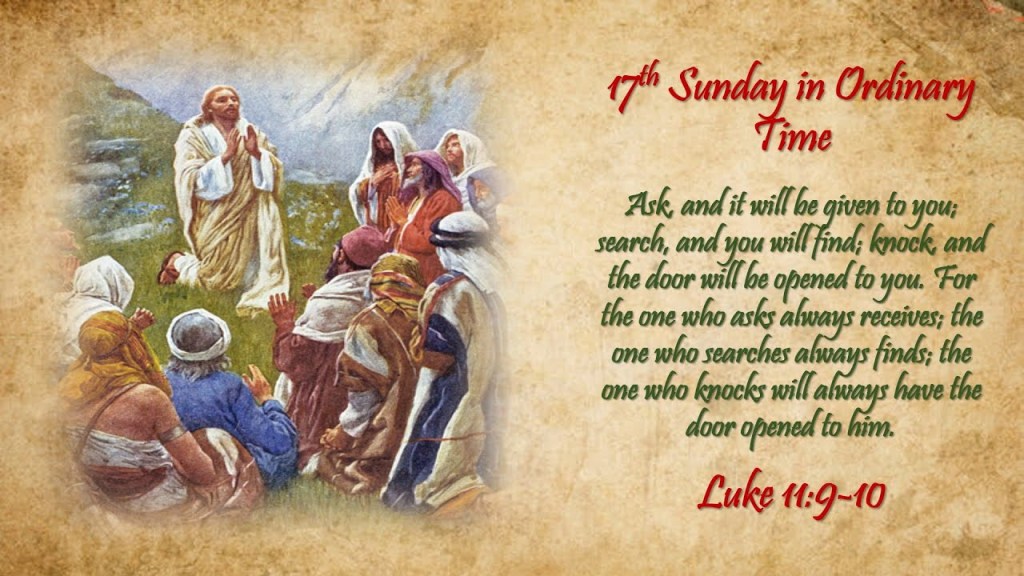
Luke 11:1-13

Prayer after Communion
We have consumed, O Lord, this divine Sacrament, the perpetual memorial of the Passion of your Son; grant, we pray, that this gift, which he himself gave us with love beyond all telling, may profit us for salvation. Through Christ our Lord.
Amen.

Sermon for the 16th Sunday in Ordinary Time, 20th July 2025

Martha and Mary’s hospitality to the Lord

As I’m sure most if not all of you know, I trained for ordination at the College of Resurrection at Mirfield. At the time I was there, the college was unique  amongst Church of England theological colleges and one of the ways in which it was unique is that it was the only college which was attached to and run by a monastic community, the Community of the Resurrection. Because of that, the college was run along the same lines as the Community. Every student had duties in the college that we were required to carry out. In my first year, for example, I was the college Stationer, the Transport Officer and an Assistant Sacristan. But in addition to that, every student was required to help out with other duties, cleaning, gardening, making up rooms, working in the library and so on. In my final year at Mirfield I was the College Sacristan which was one of the most time-consuming offices to hold. That meant I didn’t have to help out with general chores around the college, but I was also the college Pilgrimage Officer that year too. And of course in addition to all this we still had to study, to attend lectures, write essays and revise for and sit exams. So being an ordinand at Mirfield meant being very busy.

I’m sure you’ll have noticed that so far, I’ve missed something out from my description of life as an ordinand at Mirfield; I’ve not mentioned the spiritual side of life there. But that was just as full. We were required to attend Morning and Evening Prayer every day. There was a daily Mass which we were expected to attend. On high days and holy days, we were required to pray and worship with the Community which meant additional times of prayer and worship. In our final year, we were sent on attachment to a local parish where we were required to join in with parish life too. For me that meant that after Morning Prayer and Mass at Mirfield on Sunday morning, I had to get to my attachment parish to worship there too. That sometimes meant another two Masses because it was a united benefice. I also attended one of their midweek masses, preached, led intercessions, took out home communions and visited the local school to lead RE lessons. So life as an ordinand at Mirfield was very full and very busy. It was, as my personal tutor Fr Peter Allen used to say, ‘Relentless’.

The purpose of all this was to teach us just how full and busy parish life can be, and it did that very well. But perhaps the most important lesson that Mirfield tried to teach us was, in the midst of so much going on that had to be done, how not to be too busy for God. How in the midst of all the business and busyness of college and church life, to be quiet and still and simply be with the Lord.

For me, at least, Mirfield was simply a wonderful place to be. The worship there, to me, was a joy to be part of. In fact, whenever I hear or sing the hymn, O worship the Lord in the beauty of holiness, it reminds me of the beauty and holiness of the worship at Mirfield. But we found time to simply be, at Mirfield, through silence too. Being part of the community meant that we were in silence after the final Office of the day, Compline, until after breakfast the following morning, with the exception of Morning Prayer and Mass of course. On high days and holy days, there would be no lectures and apart from prayer and worship, we’d be in silence all day. And every year we had to go on retreat for a week where, again apart from prayer and worship, we were in silence from after our evening meal on the first day until after breakfast on the last day.

And that was Mirfield; a place where the pace of life was relentless; a place where there always seemed to be something more to do and not really enough time to do it in. A place where there was so much to do. And yet, at the same time, a place where there was always time and space to do nothing except simply be with the Lord, in the beauty and holiness of worship, and of the place itself in many ways, and in silence.

I think it would be wonderful if we could bring something of that life, that Mirfield way, into parish life. But when I’ve mentioned this to people over the years a lot have said it’s not practical. They’ve said that living that way in the ivory tower of Mirfield is one thing, doing it in the real world of parish life is something else entirely. I admit that being in a theological college run by monks is not the same as being in a parish, but I don’t accept that we can’t bring something of that way of life, at least, into parish life. But we have to want to do it.

I must be honest and say that I don’t think the Church itself is particularly helpful in this respect. The Church often speaks of the need to stop doing and simply be, doesn’t it? And yet, at the same time, the Church is not only constantly urging us to do more but expecting us to do more. To use imagery from this morning’s Gospel, the Church asks us to take a break from being Martha’s and take some time to be Mary’s. But, at the same time, the Church constantly distracts us from doing that by asking, and even expecting, more and more from us.

I’m not saying that what the Church is asking us to do is wrong. We’re being asked, for example, to engage more with our communities and become that visible, serving presence in our communities that we should be. And good things are being done in this respect in this benefice. Good things are being done at St Mark’s through allowing community groups to use the church. That’s raised St Mark’s profile in the community; more people now know that we and the church are here than was the case a few years ago, and that can only help us to proclaim the Gospel. Good things are being done at St Gabriel’s especially through social events and events for children and young people, and that’s being reflected in an increase in Sunday congregations which again can only help us in our proclamation of the Gospel. These are good things and that’s why I’ve encouraged them and will continue to encourage them. But in the midst of all this busyness we have to find the time and space to stop doing and simply be with the Lord. And that’s something we still need to work at.

One thing I’ve noticed since coming to this benefice is what I can only describe as a lack of any great sense of the holiness of our churches. I must say that I’ve noticed exactly the same thing in many other places too, so this isn’t a problem in this benefice only. What I mean by this is, when we come to church to pray and worship, we come into a holy place, a place dedicated to God; we literally do stand on holy ground. We come to church to meet the Lord in word and sacrament. We come as Mary’s, to sit at the feet of the Lord, and listen to him. And yet, and I’ve said this so many times, before services begin, our churches are more like market places than places of prayer and worship. They’re full of people talking, and talking loudly at that, about all sorts of things except the Lord. Of course we have other things to do, including business concerning the church, but when we come to church to pray and worship, those other can wait until after we’ve done what we’re here to do, until after we’ve worshipped the Lord in holiness, hopefully in the beauty of holiness.

And we can find that holiness, that time to be like Mary and be with the Lord, here, in this benefice. The problem is that very few people are taking advantage of the opportunities to do that.

As you know, we have a monthly healing liturgy in the benefice, a service in which there’s a time of silent prayer during which people receive the laying on of hands and anointing for healing and the forgiveness of sins. In the past we’ve had Exposition of the Blessed Sacrament here, a time of silent prayer in the presence of the Lord in the Holy Sacrament of the Altar. Earlier this year, we had a service of Benediction, a service during which we have a time of prayer and silent reflection before the Blessed Sacrament which ends with being blessed by the Lord in the Blessed Sacrament. All these things are very powerful ways in which we can simply be with the Lord. Ways in which we can experience his presence with us through the laying on of hands and anointing or in the Holy Sacrament of the Altar. And yet these services have not been very well attended at all. Perhaps in the past these very simple and yet very powerful ways to be with the Lord and experience his presence with us were neglected here. For example, to have Exposition and Benediction of the Blessed Sacrament we need a monstrance. Well we have one, at St Mark’s. But how many even of St Mark’s congregation knew that before I found it lying on it’s side, broken and covered in dust, on top of the wardrobe in the Vicar’s Vestry? Not many I’m assuming, or I wouldn’t have found it where I did, nor in the condition I did. And such neglect is, again, I think indicative of a lack of any great sense of holiness, the holiness of the place, the holiness of what we do in this place and the holiness of the things we use in what we do in this place. And this is something we also need to work on.

Of course I know that there are times when we have to be like Martha and be busy with the day-to-day business of the church and the parish. And there are some very good things happening in this benefice in this respect. But in being busy with business, we mustn’t allow ourselves to neglect the spiritual side of being disciples of Christ and a Church. So we have to make sure that we do take the time to simply be with the Lord, to lay the busyness of business aside for a time and come into the Lord’s presence and experience his presence with us. There are opportunities to do that here, in this benefice, so make the most of them. Don’t neglect to take that better part that Mary chose but take the opportunities you have to come into the Lord’s presence and simply be with the Lord.

Amen.


Propers for the 16th Sunday of Ordinary Time, 20th July 2025

Entrance Antiphon
See, I have God for my help.
The Lord sustains my soul.
I will sacrifice to you with willing heart,
and praise your name, O Lord, for it is good.

The Collect
Show favour, O Lord, to your servants,
and mercifully increase the gifts of your grace,
that, made fervent in hope, faith and charity,
they may be ever watchful in keeping your commands.
Through our Lord Jesus Christ, your Son,
who lives and reigns with you in the unity of the Holy Spirit,
God, for ever and ever.
Amen.

The Readings
Genesis 18:1-10
Psalm 15:2-5
Colossians 1:24-28
Luke 10:38-42

Prayer after Communion
Graciously be present to your people, we pray, O Lord,
and lead those you have imbued with heavenly mysteries,
to pass from former ways to newness of life.
Through Christ our Lord.
Amen.