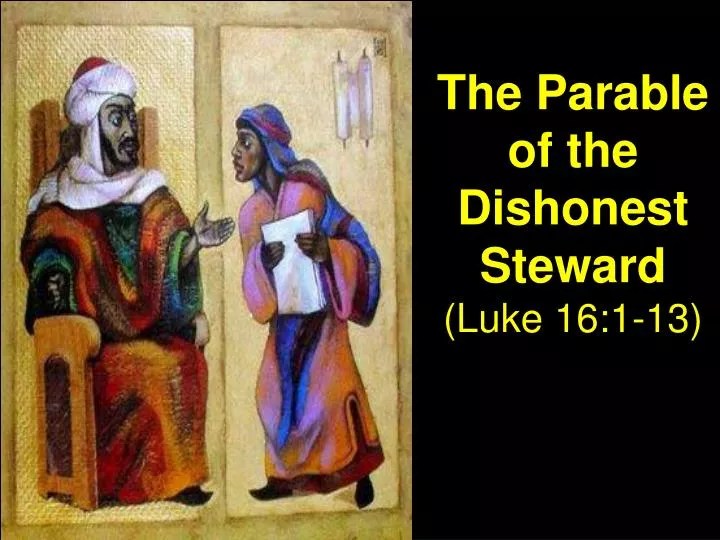
If you find this morning’s Gospel reading a little difficult to understand, don’t worry, you’re not the only one! This parable of the Dishonest Manager is one that’s taxed the minds of a great many people including biblical scholars and theologians. The problem with this parable is seeing what Jesus is actually trying to teach us through it. Because he seems to be saying things in this parable that are not only contradictory in themselves but that also contradict our understanding of his teaching in general.
Just think about it. Jesus tells us about a rich man who had a manager who was accused of wasting the rich man’s possessions. So the rich man decides to sack the manager but first he wants an account from the manager of what he’s been up to . And the manager’s in a tiswas because he has to do something very quickly otherwise he’s not only going to be out of a job, but he’s also going to be out on the streets. So what he decides to do is call in as much of his master’s debt as he can and because he hasn’t got much time, he cooks the books in an attempt to make things look right on paper. But this is where the parable takes a strange turn. The manager is getting the boot for not looking after things properly and now it looks like he’s making things worse by fiddling the accounts to cover his tracks but when the master finds out, he actually praises the manager for his shrewdness; he might be dishonest but he’s no fool when it comes to business. And here is where it becomes strange.
The parable reads as a commendation of dishonesty doesn’t it? And we would expect some kind of condemnation of this kind of shenanigan from Jesus, but he actually seems to commend it to his followers, suggesting that they should act in the same way;
“The master commended the dishonest manager for his shrewdness.
For the sons of this world are more shrewd in dealing with their own
generation than the sons of light. And I tell you, make friends for
yourselves by means of unrighteous wealth, so that when it fails they may
receive you into the eternal dwellings.”
But surely Jesus can’t be saying that his followers should be like the dishonest manager in the parable, that they’ll receive a heavenly reward for being dishonest. That flies in the face of everything we know and understand about Jesus and his teaching doesn’t it? So what is going on here, what is Jesus really saying in this parable? To be honest, I think what Jesus is trying to say in this parable becomes easier to understand if we read what he says after the parable before we actually read the parable itself.
As we heard this morning, after the parable, Jesus goes on to speak about the importance of faithfulness, in essence he asks if people can’t be faithful with earthly riches, how can they hope to be trusted with heavenly riches. In other words, if we can’t be faithful with what we’ve been entrusted with in this life, how can be given eternal life. To all intents and purposes he says that we are either children of darkness, children of the world, or children of the light , children of God. And we can’t have a foot in both camps, we either serve God or mammon, which is earthly wealth and possessions. And reading on a little further still we find that what Jesus said here brought him into conflict with the Pharisees who we’re told were ‘lovers of money’. And if we read the parable with these things in mind, we see it as both a comparison and a contrast.
So first of all the comparison. The manager is someone who’s been unfaithful. He’s wasted what his master had trusted him with. The manager himself says that he’s not strong enough to work and too proud to ask for charity. So here’s someone who’s abused his position of trust, not least by taking advantage of it by being lazy and thinking that he’s a bit better than other people. But now the party’s over, he’s been found out and asked to give an account of himself. And that spurs him into action, he knows he’s got to do something to save his own skin, and he’s got to do it very quickly. So he does and is spite of the fact that what he does is rather dodgy, his master recognises how shrewd the manager’s been and praises him for it.
And we can compare that to the way God will treat us. We’ve all been entrusted with things by God, and we’ve been charged with being good managers of what God has given us. Now we can be faithful managers of what we’ve been entrusted with, or we can be unfaithful managers of those things, we can either use them, or we can waste them. But one thing is certain, and that is that we will all eventually be asked to give an account of what we’ve done with the things God has entrusted to us. And if we’ve been unfaithful and wasted those things God has entrusted to us we’re going to find ourselves out in the cold, or perhaps in a very hot place in this case! And because we don’t know when we’re going to have to give that account of our management of what God’s entrusted us with, we can’t afford to hang around either. We need to put our affairs in order ASAP and we need to start doing that even sooner. Now.
If we were in this sort of fix in our everyday, worldly lives we would do something about it ASAP, but we delay doing anything when it comes to heavenly matters because we don’t recognise the fix we’re in, it’s not immediately apparent to us and so we think we’ve got plenty of time to put things right with God. And I think this is what Jesus is driving at when he says,
“For the sons of this world are more shrewd in dealing with their own
generation than the sons of light.”
So we need to recognise the trouble we’re in and do something about putting things right, and we need to get on with it without delay.
The contrast in the parable is in how wealth is used by the children of the world and the children of light. In the parable, the manager fiddles the accounts to try to save his own skin. He’s in trouble for not doing his job properly in the first place and now he tries to put things right as best as he can by cheating his master out of what he’s due. But far from getting into even more trouble, he’s actually praised for his shrewdness, for being smart enough to see a way out, even though it is dishonest. The master, a rich man, a man of the world and no doubt a shrewd businessman himself, recognises a kindred spirit, a shrewd operator and fellow man of the world, and so he praises the dishonest manager.
In contrast, Jesus says to his disciples,
“…make friends for yourselves by means of unrighteous wealth, so that
when it fails they may receive you into the eternal dwellings.”
Unrighteous wealth is any kind of wealth that holds us back from God. It’s any kind of wealth that we might become so attached to that it stops us from living out the Gospel, any wealth that we might be tempted to use for selfish or even evil purposes. Jesus tells us though to use this to make friends for ourselves. But then he reminds us that wealth will fail.
We know that. We can fall into hard times and run out of wealth and if we’ve used it to buy friends and friendship, how many of those friends remain friends when the wealth does fail? Not many usually. And wealth always fails in the end because we all die and what good is all our unrighteous earthly wealth to us then? None at all. So what does Jesus mean here?
Well the friends he urges us to make are those who can receive us into heaven so he’s not talking about ordinary human friends. Because who can receive us into heaven but God? So Jesus is telling us to use our wealth in such a way that we make a friend of God. He’s telling us to use our wealth in ways that are pleasing to God, so that we become kindred spirits with Jesus. And we know that means using our wealth, whatever it might be, to help other people rather than using it simply to help ourselves. And this is simply another way of saying, as Jesus does a little later,
“You cannot serve God and money.”
This parable then, that seems so strange, is actually not so hard to understand really because all Jesus is trying to say to us is that we need to be faithful managers of what God has entrusted to us, and if we haven’t been, we need to put things right ASAP. He’s telling us that if we’ve used what God has entrusted to us to feather our own nest, we need to stop doing that and start using those things in the way God intended us to use them, that is, to make a friend of God by using what he’s entrusted to us in loving service of others. We have to be shrewd in the service of God, not of earthly wealth, because that is the way to be commended by God for our good management of the things he’s entrusted to us and that is the way to be admitted to the eternal dwelling of heaven.
Amen.
Propers for the 25th Sunday of Ordinary Time, 21st September 2025
Entrance Antiphon
I am the salvation of the people, says the Lord. Should they cry to me in any distress, I will hear them, and I will be their Lord for ever.
The Collect
O God, who founded all the commands of your sacred Law upon love of you and of our neighbour, grant that, by keeping your precepts, we may merit to attain eternal life. Through our Lord Jesus Christ, your Son, who lives and reigns with you in the unity of the Holy Spirit, God, for ever and ever.
Amen.
The Readings
Amos 8:4-7
Psalm 113:1-2, 4-8
1 Timothy 2:1-8
Luke 16:1-13
Prayer after Communion
Graciously raise up, O Lord, those you renew with this Sacrament, that we may come to possess your redemption both in mystery and in the manner of our life. Through Christ our Lord.
Amen.
 Parish Church of St Mark Chadderton