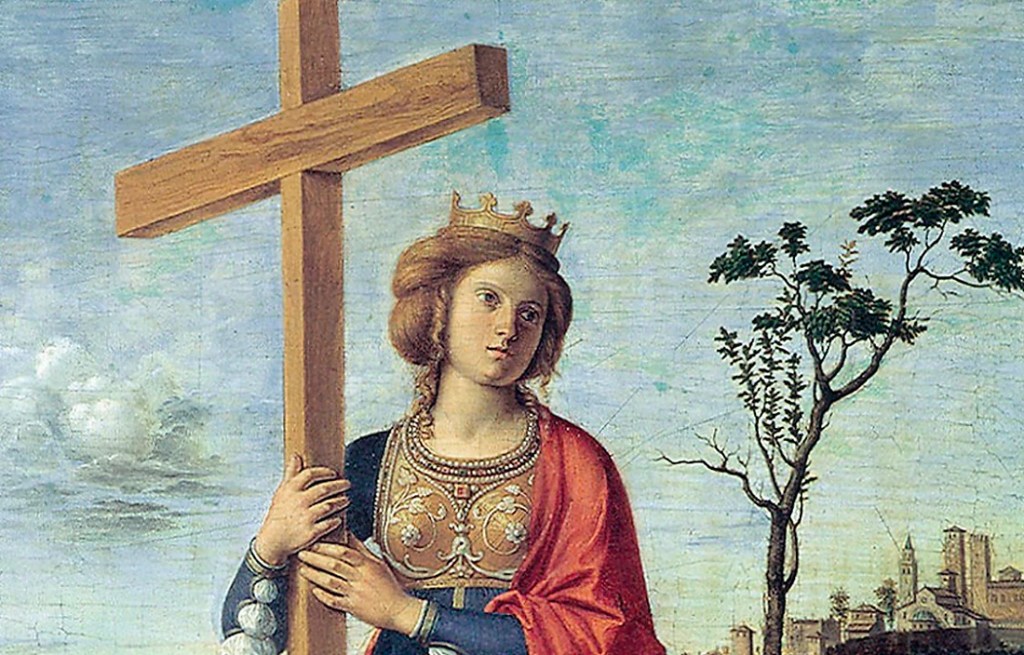
If we walk into a church and we’re unsure of what denomination it belongs to, or any Anglican church and we’re not sure which tradition it belongs to, one way to work that out would be to simply look round and see what kind of crosses are in that church. If we saw crucifixes rather than plain crosses, we could be fairly certain that we were in either a Roman Catholic or Anglo Catholic church whereas if we saw plain crosses, we could be fairly sure that we were in a Reformed church of some kind, or an Anglican church of a more Reformed or Protestant tradition. Because different denominations and traditions do tend to favour one or the other, the plain cross or the crucifix.
And there are quite understandable reasons for that. Catholics tend to favour the crucifix because it emphasises the sacrifice of Christ and this is what lies at the very heart of the liturgy, Christ’s sacrifice on the Cross, the breaking of his body and shedding of his blood for the forgiveness of sins. Those of the Reformed and Protestant churches and traditions though favour the plain, empty cross because this reminds us that Christ is no longer on the Cross but has been raised to life. So the plain cross symbolises Christ’s Resurrection and his victory over sin and death. So who’s got this right?
Actually, both are right, but in a sense, both are wrong too. Those who favour the plain, empty cross are right because we must never forget that the foundational event of the Christian faith is Christ’s Resurrection; without the Resurrection there would be no Christian faith. I know that when we hear academics on the TV talking about Jesus and the early Church they usually say that that the foundational event of the Christian faith is Christ’s death on the Cross, but they are utterly wrong. If there had been no Resurrection, Jesus would have died on the Cross, and his movement would have died with him; end of story. Jesus’ death on the Cross is only given meaning in the light of the Resurrection. We Christians are called an Easter people are we not? We’re not called a Good Friday people are we? And for good reason because our faith is founded on our belief in Christ’s Resurrection from the dead.
Having said that, those who favour the crucifix are also right because we Christ couldn’t have been raised from the dead if he hadn’t first died, and that’s simply common sense. And while his Resurrection gives us the assurance that we can be raised to eternal life, it was his death on the Cross which made that possible because his death takes away our sins, the sins that would have prevented us from inheriting eternal life. So we simply cannot have the Resurrection without the Crucifixion; we can’t have the plain, empty cross without the crucifix. And this is why those who favour one over the other are both wrong, because we simply can’t have one without the other.
What we really need to do is to be able to look at a crucifix, see the cost of our salvation, Christ’s death on the Cross for the forgiveness of sins, but then look beyond that to see Christ’s victory over sin and death. We need to be able to see what Christ’s sacrifice and death on the Cross leads to, his Resurrection. But when we look at a plain, empty cross, we still need to be able to see Christ on the Cross. In seeing the empty Cross as a symbol and reminder that Christ is risen, we still need to be able to see that the Cross was also, and first, the instrument of his death and the means by which our sins are forgiven, and the Resurrection was enabled. In this morning’s Gospel, I think we hear Jesus saying this, albeit in a slightly different way.
In our first reading we heard the story of Moses and the bronze serpent. The people were being plagued by deadly serpents and in answer to Moses’ prayer God tells Moses to make a bronze serpent and set it on a pole so that anyone who was bitten could look at the bronze serpent and live. And Jesus uses this story to speak about himself:
“And as Moses lifted up the serpent in the wilderness, so must the Son of Man be lifted up, that whoever believes in him may have eternal life.”
It’s quite common in John’s Gospel to find double meanings in Jesus’ words and what Jesus means by being “lifted up” here has been interpreted in a number of ways. He could mean lifted up on the Cross, in which case he’s referring to his death. He could though mean lifted up from death and be talking about his Resurrection. He could even mean lifted up from the earth and be referring to his Ascension. He could mean any of those things, or any one of them or all of them. This is one of the reasons John’s Gospel is not the easiest to understand. What we do know though is that later in the Gospel, when Jesus speaks in a similar way, John tells us quite explicitly that Jesus was referring to his death, to being lifted up on the Cross:
‘“And I, when I am lifted up from the earth, will draw all people to myself.” He said this to show by what kind of death he was going to die.’
I don’t think it’s unreasonable then, to assume that in this morning’s Gospel when Jesus speaks about being “lifted up” he was, perhaps primarily, speaking about being lifted up on the Cross. And I think that’s made more likely given the context of the Old Testament background story because that’s a story about being saved from death. Moses lifted up the bronze serpent so that anyone who looked on it would live, and Jesus was lifted up on the Cross so that those who look on him – believe in him, would live forever by virtue of his death on the Cross which takes away the sins that otherwise would have condemned us to death.
What I think we should notice here is what people are called to look at. In the reading from the Book of Numbers, the people aren’t called to look on the pole in order to be saved, they’re called to look at the bronze serpent. And neither are we called to look at the Cross for our salvation, but at the one who was lifted up on the Cross, to Christ. And this doesn’t only agree with what we’ve read this morning, but it’s in accordance with Old Testament prophecy more generally. The prophet Isaiah, in the Suffering Servant prophecy which is so central to our understanding of Jesus’ Passion and death says,
‘Behold, my servant shall act wisely, he shall be high and lifted up and shall be exalted.’
And Isaiah then goes on to describe the suffering that the Lord’s servant will go through. And through the prophet Zechariah, God says that after pouring out a spirit of grace and prayer on people,
“…when they look on me, on him whom they have pierced, they shall mourn for him, as one mourns for an only child.”
And John explicitly links this prophecy to Christ being pierced by a lance as he hung on the Cross.
So the message is clear. When the people of Israel wanted to be saved from death, and God raised up for them a bronze serpent on a pole, they weren’t told to look at the pole, but at the serpent. And in the same way, when God wanted to save us from the death of sin, and his Son was raised up on a Cross, we weren’t told to look at the Cross, but to look at the one who was raised up on it. We’re called to look at Jesus.
Today is the feast of The Exaltation of the Holy Cross. It’s a day when we exalt the Cross, when we lift up the Cross and sing its praises. But even today, we mustn’t take our eyes off Christ because it’s Christ who gives meaning to the Cross through his sacrifice on the Cross. Even as we think of the Cross as the means of our salvation, we mustn’t take Christ off the Cross because it is he who accomplished our salvation. And even if we look to the empty Cross as a symbol of Christ’s Resurrection, we mustn’t take Christ off the Cross because we cannot have the Resurrection without first having the Crucifixion.
I think the relationship between Christ and the Cross is wonderfully expressed in the 9th Century Anglo Saxon poem, The Dream of the Rood. It begins with a vision in which the dreamer sees the Cross and describes it as ‘wondrous’ and ‘beautiful’, ‘surrounded by light’, ‘the tree of victory’. All things which we might well say today. In the poem, the Cross then begins to speak, and it describes the horror of the crucifixion and its own distress at being put to such terrible use. Eventually the Cross goes on to speak about the honour that people now give it, but it’s an honour that it knows it owes entirely to Christ who once hung and died upon it. It says,
‘Now, my loved man, you have heard
how I endured bitter anguish at the hands of evil men.
Now the time is come when men far and wide in this world,
and all this bright creation, bow before me; they pray to this sign.
On me the Son of God once suffered;
wherefore I now stand on high, glorious under heaven;
and I may heal all those who stand in awe of me.
Long ago I became the cruellest of tortures,
hated by men, until I opened to them the true way of life.
Lo! The Lord of Heaven, the Prince of Glory honoured me,
and exalted me above all other trees…
It’s right that we should exalt the Cross as the instrument of our salvation, but we must always remember that, in and of itself, the cross is a symbol of humiliation, torture and death. It is only given honour and glory because of the one who hung and died on it for our salvation; because it is Christ’s Cross. As the mantra of the Society of the Holy Cross says,
We should glory in the Cross of our Lord Jesus Christ,
for he is our salvation, our life and our resurrection,
through him we are saved and made free.
Amen.
The Propers for the Exaltation of the Holy Cross, 14th September 2025
Entrance Antiphon
We should glory in the Cross of our Lord Jesus Christ, in whom is our salvation, life and resurrection, through whom we are saved and delivered.
The Collect
O God, who willed that your Only Begotten Son should undergo the Cross to save the human race, grant, we pray, that we, who have known his mystery on earth, may merit the grace of his redemption in heaven. Through our Lord Jesus Christ, your Son, who lives and reigns with you in the unity of the Holy Spirit, God, for ever and ever.
Amen.
The Readings
Numbers 21:4-9
Psalm 78:1-2, 34-38
Philippians 2:6-11
John 3:13-17
Prayer after Communion
Having been nourished by your holy banquet, we beseech you, Lord Jesus Christ, to bring those you have redeemed by the wood of your life-giving Cross to the glory of the resurrection. Who live and reign for ever and ever.
Amen.
 Parish Church of St Mark Chadderton