One of the things that people in the Church often complain about is the alterations that are sometimes made to the words of hymns. That does happen a lot nowadays and, as with so many changes that are made to traditional things these days, the reason for the changes is often said to be to make hymns less offensive. But one of the great problems with doing this is that, unless the changes are made very carefully and with regard to scripture and theology, the meaning of a line or verse in a hymn can be completely changed. And one very good example of that is the well-known Advent hymn, Lo, he comes with clouds descending.
In the second verse of that hymn, the original words are,
Ev’ry eye shall now behold him
robed in dreadful majesty;
those who set at nought and sold him,
pierced and nailed him to the tree,
deeply wailing, deeply wailing, deeply wailing,
shall the true Messiah see.’
But in many modern hymn books, the word ‘those’ has been changed to ‘we’. And the reason given for that is that the original words are ‘antisemitic’ because they blame the Jews for Jesus’ betrayal arrest and crucifixion. Well, I’m sorry if people don’t like that, but the Gospel says the Jews, that is, the religious leaders who plotted Jesus’ downfall, Judas who betrayed him, and to some extent even the disciples who abandoned him, were the ones who set at nought and sold him. But surely it was the Romans, Pilate who unjustly, and knowingly so, condemned him to death by crucifixion, and the Roman soldiers who carried out the sentence who were responsible for piercing and nailing Jesus to the tree. So if the words of the hymn are antisemitic, by the same reasoning they surely must be anti-Roman too. And in fact, when we see this, we can understand that what the original words of the hymn are saying is that all people, both Jew and Gentile were responsible for Jesus’ betrayal, arrest and crucifixion. And that is what we find in the Gospel. The Gospel tells us that they all laid hands on him which in itself is a Jewish symbol of the transference of sin from the people to the scapegoat. So the original words are both scripturally and theologically correct: the Jews betrayed him, the Gentiles put him to death, and the sins of all were transferred to Jesus.
That’s one example of how changing words can distort what was originally meant and written; how doing that can even distort scripture. But we have another example of that in this morning’s Gospel.
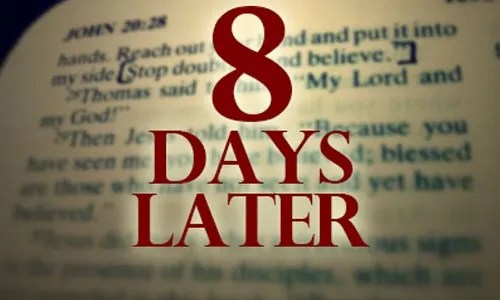
When Jesus appears to the disciples for the second time and shows Thomas the wounds in his hands and side, Thomas responds with a great profession of faith,
“My Lord and my God!”
But what was Jesus’ reply? In the translation we read today, Jesus said,
“Have you believed because you have seen me? Blessed are those who have not seen and yet have believed.”
But many translations change the word ‘blessed’ and have Jesus saying ‘happy’ instead. So which is it? And does it make any difference? Well yes, actually, it does make a difference.
The problem is the Greek word here ‘makarios’ can mean both blessed and happy but that doesn’t mean that we can translate it either way and still mean what Jesus meant. There are reasons why we might translate it one way or the other, but I think it’s sometimes translated as ‘happy’ because people understand what that word means whereas they might not necessarily understand, or at least understand so well, what ‘blessed’ means in a scriptural context.
We all know what it means to be happy, it means to feel pleasure or contentment, or to be cheerful. It can also mean to experience a sense of trust or confidence in person or situation. But while being blessed can include those things, there’s also a divine element to blessedness. In the Scriptures, there’s an element of gift and offering in being blessed. So people can bless God by offering him praise and worship. And God blesses people by giving them his favour and protection. So when it comes to people being blessed, we can sum up the difference between happiness and blessedness by saying that to be blessed by God is to be happy because God has done something for us or given us something or will do these things for us. And one of the places in scripture we see this most clearly is in The Beatitudes.
The word ‘beatitude’ means ‘blessing’, a supreme blessing actually. And The Beatitudes are sayings of this ‘happy because of what God will do for us’ nature. So in the first Beatitude, for example, Jesus says,
“Blessed are the poor in spirit, for theirs is the kingdom of heaven.”
And who can give us the kingdom of heaven but God himself. So what we see in this Beatitude is a gift of God to the ‘poor in spirit’, which makes them ‘blessed’. Or does it make them happy?
I ask that because, as I’m sure we all know, The Beatitudes themselves are sometimes translated as ‘Happy are’ rather than ‘Blessed are’ but doing that can distort the meaning of Jesus’ teaching because saying ‘happy are’ gives the sense of limiting that happiness to the present time. ‘Happy are’ means to be happy now doesn’t it? If we’re talking about future happiness we’d say ‘Happy will be’ or ‘Happy shall be’ wouldn’t we? And many of The Beatitudes do speak of something that God will endow us with in the future. The third Beatitude, for example, says,
“Blessed are the meek, for they shall inherit the earth.”
‘Shall’ is the future tense. So whereas ‘happy are’ suggests a present state of happiness, ‘blessed are’ suggests a state of happiness that is timeless; it can be in the present and in the future and both. So in The Beatitudes, Jesus can say the reward of the kingdom ‘is’, that is, ‘it is now’ because the kingdom is both now and yet to come, but that other rewards ‘shall’ be, that is, they will be in the future. So what did Jesus mean when he answered Thomas; that those who believed without seeing are ‘happy’ as some translators would have it, or that they’re ‘blessed’ as the translation we read this morning says?
I think we have to conclude that he meant ‘blessed’ because those who haven’t seen the risen Lord with their own eyes, yet who can still acclaim Jesus as their Lord and God, can be happy both now and in the future. They can be happy now because they believe that Christ is risen and so they can believe that all he said was and is true. They can have that deep sense of joy, of happiness, that I spoke about in my sermon last week; and they can have that now. That is God’s gift to them, and to us, now, the gift of faith. But that happiness will never come to an end because, as Jesus told us, and as we believe,
“…as Moses lifted up the serpent in the wilderness, so must the Son of Man be lifted up, that whoever believes in him may have eternal life.
For God so loved the world, that he gave his only Son, that whoever believes in him should not perish but have eternal life.”
So whilst we can be happy as Christians, we must also, as Christians, be blessed because our happiness can never be taken away from us. God makes us happy now through his gift of faith and the reward for our acceptance of his gift of faith is the blessing of a happiness that shall be ours for ever. So let’s count our blessings and thank God for them. Let us bless God by offering him our praise and worship for blessing us with the means of our present and future happiness. For sending his Son into the world to save us from our sins and for the gift of faith in his Son so that we can be raised to eternal life and to a happiness that shall never end.
Amen.
Propers for the 2nd Sunday of Easter, 27th April 2025
Entrance Antiphon
Like newborn infants, you must long for the pure, spiritual milk,
that in him you may grow to salvation, alleluia.
The Collect
God of everlasting mercy,
who in the very recurrence of the paschal feast
kindle the faith of the people you have made your own,
increase, we pray, the grace you have bestowed,
that all may grasp and rightly understand
in what font they have been washed,
by whose Spirit they have been reborn,
by whose Blood they have been redeemed.
Through our Lord Jesus Christ, your Son,
who lives and reigns with you in the unity of the Holy Spirit,
God, for ever and ever.
Amen.
The Readings
Acts 5:12-16
Psalm 118:2-4, 22-27
Revelation 1:9-13, 17-19
John 20:19-31
Prayer after Communion
Grant, we pray, almighty God,
that our reception of this paschal Sacrament
may have a continuing effect in our minds and hearts.
Through Christ our Lord.
Amen.
 Parish Church of St Mark Chadderton