When I was going through the selection process for ordination training, one of the priests who was advising and helping me once asked me which was my favourite Gospel. And without hesitation I said,
“John.”
But the priest then said that this was a question I was almost certain to be asked at a Selection Conference (which I was) and he advised that if I was, It’d be far better to say that one of the synoptics was my favourite rather than John. Obviously, I asked why, and he said that I’d be asked to explain why John was my favourite and the problem with doing that is that John is so full of hidden meanings that, in trying to explain what I liked about John’s Gospel, I could very easily show how little I actually understood it. So I took his advice and when I was asked that question at my Selection Conference, I ‘ummed and ahhed’ a little and eventually said,
“Mark.”
Nevertheless, and although all the Gospels are wonderful in their own way, if I had had to choose a favourite now, it would still be John. But that priest was right in what he said about John’s Gospel; it is so full of hidden meanings that, if you try to explain what you like about the Gospel, or even about a particular part of the Gospel or story in it, it is very easy to show how much of it you don’t understand, how much of the meaning you’ve missed. And this morning’s reading is a very good example of that.
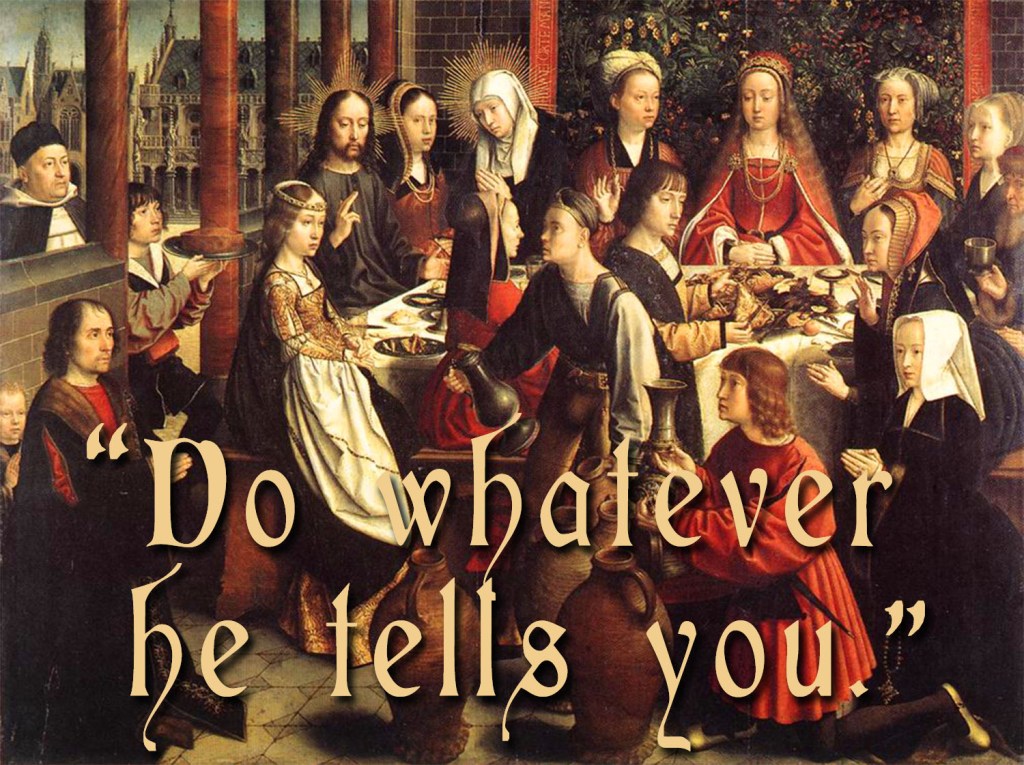
On the surface, the story of the Wedding at Cana is a simple one; Jesus is at a wedding with his mother and some of his disciples and, when the wine runs out, at the request of his mother, Jesus turns some water into wine. And at the end of the story, John tells us what it’s about:
‘This, the first of his signs, Jesus did at Cana in Galilee, and manifested his glory. And his disciples believed in him.’
But even if that is the overall meaning of this story, and the reason John tells the story, there’s so much more going on in the way John tells it than at first meets the eye.
To begin with, we’re told that this wedding took place ‘On the third day’ . For us, as Christians, the third day immediately draws our minds to Jesus’ Resurrection. But the third day is significant in many ways in the Scriptures. Very often we find that some great revelation of God’s power, or even of God himself takes place on the third day. So in starting the story in this way, John sets the scene for the glory of God to be revealed in some way at the wedding. And given that John has already told us at the very beginning of his Gospel that Jesus is the incarnate Word of God, in this instance he perhaps intends to draw our minds to the Book of Exodus when, on the third day, God himself appeared to the people of Israel on Mount Sinai. He seems to be saying to us that, as God showed his glory on the third day then, so now, on the third day, God’s Son will show his glory too.
John then tells us about some of the people at the wedding:
‘…the mother of Jesus was there. Jesus also was invited to the wedding with his disciples.’
It’s noticeable that John makes a distinction here. Jesus’ mother was ‘there’ whereas Jesus and his disciples were ‘invited’. At this point in the Gospel, Jesus’ ministry hadn’t really begun; all he’d done at this time was call his first disciples and Jesus’ mother, Mary, wasn’t named as one of them. So this hints to us that this is a story about faith and discipleship too. We don’t know why Mary was at the wedding, but she was simply ‘there’ whereas Jesus’ and his disciples were ‘invited’ it’s almost as though some people at the wedding were called to be there to witness what was about to happen, while others simply happened to be there when it happened. And if we look at it in this way, it helps us to make sense of what happens next.
One of the most difficult things to understand about this story is the abrupt, off-handed way that Jesus speaks to his mother. When Mary tells Jesus that the wine has run out he says,
“Woman, what does this have to do with me? My hour has not yet come.”
On the face of it, that does seem like a very strange way for a son to speak to his mother. But Jesus words are very reminiscent of something we find in St Matthew’s Gospel when he drives some demons from two possessed men. The demons say to Jesus,
“What have you to do with us, O Son of God? Have you come here to torment us before the time?”
We know that Jesus’ ‘time’ refers to his death and Resurrection, the time when his true identity will be openly revealed to the world. Until that time, his identity is only revealed to those who have faith in him. We also know that only those with faith were given the privilege of seeing his glory, witnessing the signs he gave of his true identity. So Jesus’ question to his mother can be seen as a question about her faith. The demons were not Jesus’ disciples and so they asked what Jesus had to do with them, at this time before his glory was to be openly revealed to all? In asking Mary what her question had to do with him, in essence he’s asking her, “Why are you bringing this to me at this time when revelation is only for those who believe in me? Do you have faith in me? You’re here at this time, at this wedding, but can you be invited as my disciple? And Mary’s response is an unequivocal ‘Yes’ because she demonstrates her faith in Jesus by telling the servants,
“Do whatever he tells you.”
One of the ways the Church sees the Wedding at Cana is as a revelation of the new creation in Christ. And we see that in what happens next in John’s story. Jesus tells the servants to fill six stone jars with water and he then turns the water into wine. In other words, he creates something new from the water. And this mirrors what we read in the creation story in the Book of Genesis;
‘In the beginning, God created the heavens and the earth. The earth was without form and void, and darkness was over the face of the deep. And the Spirit of God was hovering over the face of the waters.’
We’re not told that God created the heavens and the earth from nothing, but from ‘the waters’. God takes the waters and gives them new form. And it was a better form because when he looked on what he’d created,
‘God saw that it was good’.
We know from the Scriptures than wine was seen as something good too. It was seen something given by God as a sign of his goodness and favour towards us, something to gladden men’s hearts, as it says in Psalm 104. So wine was part of the goodness of God’s creation. But John tells us that the wine that Jesus created from the water at the Wedding in Cana was better than the wine that people had already drunk. So what John seems to be saying here is that the new creation in Christ isn’t only new and good, it’s better than what was before. He could be hinting here that Christ is ushering in the new creation prophesied by Isaiah, but he could also be speaking about the Church.
In his Second Letter to the Corinthians, St Paul speaks about Christ’s disciples as a ‘new creation’. He says,
‘…if anyone is in Christ, he is a new creation. The old has passed away; behold, the new has come.’
The Church is the people of this new creation. And we see so much of the Church in St John’s telling of the Wedding at Cana. Water for the baptism through which we become members of the new creation. Christ himself, the incarnate Word of God who reveals himself to us in church through our reading of the Scriptures and gives himself to us under the form of the bread of Holy Communion. And wine which we receive in the sacrament as the blood of Christ. As the first verse of the hymn puts it,
The church’s one foundation is Jesus Christ, her Lord.
She is His new creation by water and the Word.
From heaven, He came and sought her, to be His holy bride.
With His own blood He bought her, and for her life He died.
If we think about those words in the light of this morning’s Gospel reading, we find so much imagery in them that connects with St John’s telling of the story of the Wedding at Cana. And we find so much more in that story if we scratch beneath the surface and try to understand what John is trying to say and to tell us through the story.
I don’t know how many of you would also say that St John’s Gospel is your favourite, perhaps not many of you because I know it isn’t the easiest to read and it is hard to understand in places. But even if you do find it difficult, don’t give up on it: stick with it and try to get your heads round it. John doesn’t always make that easy but if you can do it, you will find it well worth the effort because you’ll find so much hidden in its depths that is good, and new to you, that isn’t always apparent if you just hover over its surface.
Amen.
Propers for the 2nd Sunday of Ordinary Time, 19th January 2025
Entrance Antiphon
All the earth shall bow down before you, O God, and shall sing to you,
shall sing to your name, O Most High!
The Collect
Almighty ever-living God,
who governs all things, both in heaven and earth,
mercifully hear the pleading of your people and bestow your peace on our times.
Through our Lord Jesus Christ, your Son,
who lives and reigns with you in the unity of the Holy Spirit,
God, for ever and ever.
Amen.
The Readings
Isaiah 62:1-5
Psalm: 96:1-3, 7-10
1 Corinthians 12:4-11
John 2:1-12
Post Communion
Pour on us, O Lord, the Spirit of your love,
and in your kindness make those you have nourished by this heavenly Bread,
one in mind and heart.
Through Christ our Lord.
Amen.
 Parish Church of St Mark Chadderton