It’s no secret among people who know me that my favourite Christmas story is Charles Dickens A Christmas Carol. There are quite a few film adaptations of the story and it’s always part of my Christmas to watch a few of them, but my favourite has always been the 1951 version in which Alistair Sim plays the role of Ebeneezer Scrooge. Having said that, there is one thing about that version, and others too it must be said, that I do find a little annoying because it’s so strikingly incongruous, and that is the upper-class accents of the Cratchit family. I mean, the Cratchits are supposed to be a rather down-trodden, poor family from Camden Town. They hardly have two ha’pennies to rub together, and yet they speak with the kind of aristocratic accent that’s taught at Eton or some other very expensive boarding school.
It may be that the incongruity of the Cratchit’s accent was a deliberate dramatic device to show that the Cratchits are actually much better people that their lowly estate would suggest. But whatever the reason for it, what I think it does show are the prejudices of our society.
Many of us, I’m sure, will be able to remember when it was quite unusual to hear regional accents on the TV and almost everyone in British films, probably up to the 1960s, spoke like a 1930’s BBC announcer unless, that is, they were playing a rather dubious character. It was almost as though rough, uncouth people or criminals spoke in one way whilst nice, well-educated people spoke in a completely different way. But as the famous playwright, George Bernard Shaw once said,
“It is impossible for an Englishman to open his mouth without making some other Englishman hate or despise him.”
And of course, we’re not supposed to hate and despise the Cratchits, and so perhaps this is why, on film, they speak in the way that ‘nice’ people speak.
Such is the power of accents, the way we speak, to define in the eyes of others the kind of people we are. It’s prejudice and bigotry, plain and simple, but it’s a fact of the society we live in. And it isn’t only the way someone speaks that affects the way others think about them is it?
People are prejudiced against others because of where they come from, where they live, their family background and their social and economic status, not to mention their faith, their race and the colour of their skin.
It would be nice to say that we don’t find such prejudice and bigotry in the Church, but sadly, we do. Individual Christians can be every bit as prejudiced against others as anyone else, and the Church as an institution can show prejudice too. That’s understandable in one sense because we all grow up surrounded by the prejudices of the society we live in and to some extent the Church can’t help but reflect that society. But that isn’t the way it should be. As disciples of Christ we, as individuals, should show no prejudice against others and so the Church which is made up of individual Christians, shouldn’t either. And if we ever are tempted to look down on other people for any reason, we should take a moment to think about our Lord Jesus Christ and his earthly family, first.
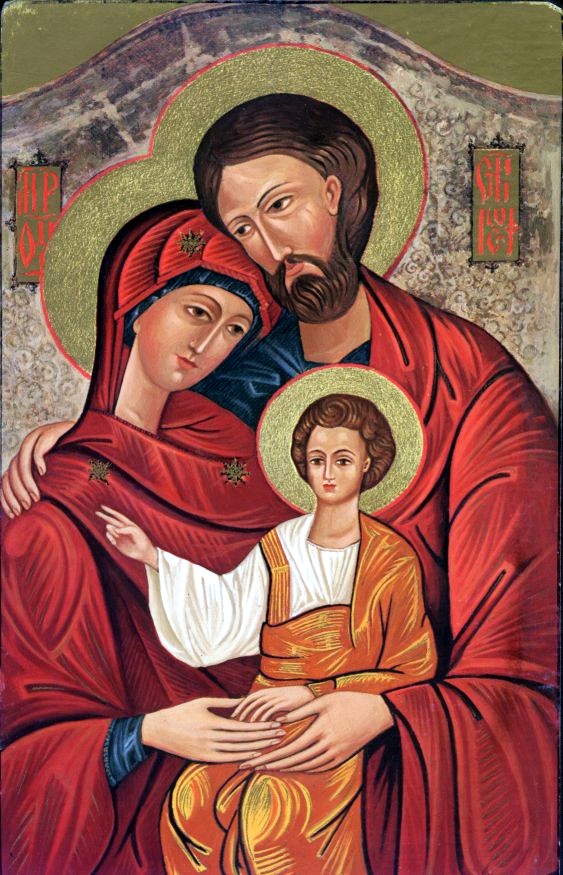
Who were the Holy Family? What were they? First of all, Mary and Joseph were from Nazareth in Galilee, and that wasn’t a particularly well-respected part of the Jewish world. Galilee was predominantly Jewish in their day, but it was a largely rural, agricultural society surrounded by Gentile nations and to the more urban and urbane, the more well-educated and wealthy Jews of the south, Galileans were seen as country bumpkins, ill-educated peasants. Nazareth itself though, seems to have been a predominantly Gentile town and even other Galileans looked down on Nazareth. Hence Nathaneal’s question,
“Can anything good come out of Nazareth?”
But Mary and Joseph were forced to come out of Nazareth and travel south to Bethlehem where people would have looked down on them, perhaps even hated them simply because of where they came from. And Mary was forced to give birth in a stable, an animal house because she and Joseph couldn’t find anywhere else to stay. Was that because there was no room at the inn, or because no one would give them room because of who and what they were? We know they didn’t have much money because when Jesus was presented at the temple, their offering to God ‘a pair of turtle doves, or two young pigeons’ was the offering the poor were expected to make. So they wouldn’t even have been able to pay a bit over the odds to get a room. And what would people have made of and said about the fact that Mary had to give birth in a stable, and that her son’s first bed was a manger, an animal trough? What kind of parents would do that?
Then the family were forced to leave Bethlehem and run for their lives out of Judea and into Egypt; they became asylum seekers. Whether they were ever granted what we’d now call refugee status with rights and legal protection, we simply don’t know. What we do know is how much prejudice there is today against asylum seekers and refugees. We know that there was a Jewish community in Egypt at the time the Holy Family travelled there, but how happy would they have been to accept a family running from Herod, the puppet king of the Romans, the very same people who also ruled Egypt at that time? And even if people didn’t know that was why the family had gone into Egypt, they were still Nazarenes and what kind of reception would the community have given to a family from Nazareth? It wasn’t as though they could hide that because on the night of Jesus’ arrest, wasn’t Peter given away as a disciple by his Galilean accent?
We also know that Jesus faced opposition during his ministry because of his background. When Nicodemus tried to defend Jesus during a dispute about whether Jesus was the Christ or not, the Pharisees insulted those who believed in Jesus for their ignorance of the law and insulted Nicodemus too;
“Are you from Galilee too? Search and see that no prophet arises from Galilee.”
In other words, “Are you an ill-educated peasant who doesn’t understand the law too?” In fact, prophets did arise from Galilee, Jonah and Nahum were both from Galilee, so the Pharisees were probably just assuming people’s ignorance and playing on the widespread prejudice against Galilee and Galileans to try to discredit Jesus.
But it didn’t end with prejudice against Galilee and Galileans. People also brought up the controversial nature, shall we say, of Jesus’ conception to try to discredit his teaching. When Jesus said that true children of Abraham wouldn’t be seeking to kill someone who spoke God’s truth to them, they insisted that they were Abraham’s children and said,
“We were not born of sexual immorality.”
And you can almost hear the unspoken ‘unlike you’ that’s implicit in that statement.
The lives of the Holy Family, were filled with so many things that cause prejudice today and must have caused people to be prejudiced against them in their day. Prejudice because of where they were from. Prejudice because of the nature of Jesus’ conception and the poverty of his birth. Prejudice because of their social and financial status, and of how they spoke. And prejudice because they were asylum seekers.
As he grew up as part of this family in Galilee, Jesus must have been aware of all these prejudices against his family. And the prejudice Jesus suffered from during his ministry must have impacted on his earthly family too. And yet, as unworthy and unsuitable for such a great vocation this family might have seemed in the eyes of other people, this was the family God chose for his Son. This family of poor, rough speaking country bumpkins was the family God chose our Lord and Saviour to be born into. And this is something that we should never forget.
We believe that the Son of God became man in order to save the world. So that he could show by word and example what it means to live as God’s people. So that he could make on the Cross that one, full and sufficient sacrifice for sin that takes our sins away. But more than that, we believe that he had to be fully human so that he would fully know what it is to live as a human being, to suffer the trials of human life and to be tempted as we are and yet not sin. And we should never forget that in order to do that, the Son of God wasn’t born into a high and mighty family of great wealth and high status. He wasn’t born into a family who looked down in contempt on others, but into one that was looked down upon with contempt. He was born into a family that suffered from the prejudices of society. And so whenever we feel the temptation to look down on others because of where they’re from, how they speak, how much money they’ve got, where they live or any of the other things that society thinks are so important in defining a person’s worth. Before we look down on someone because of the situation they find themselves in, such as the asylum seeker or the refugee, let’s pause for a moment to remember that Jesus and the Holy Family found themselves in just these situations. And before we utter a word in prejudicial judgement on them, let’s ask ourselves, who is standing in Christ’s shoes, those who show their prejudices against others, or those who suffer because of those prejudices?
Amen.
Propers for Holy Family Sunday, 29th December 2024
Entrance Antiphon
The shepherds went in haste,
and they found Mary and Joseph, and the infant lying in a manger.
The Collect
Holy Family
O God,
who were pleased to give us the shining example of the Holy Family,
graciously grant that we may imitate them in practicing the virtues of family life,
and in the bonds of charity,
and so, in the joy of your house,
delight one day in eternal rewards.
Through our Lord Jesus Christ, your Son,
who lives and reigns with you in the unity of the Holy Spirit,
God, for ever and ever.
Amen.
The Readings
1 Samuel 1:20-22, 24-28
Psalm: 84:2-3, 5-6, 9-10
1 John 1:1-2, 21-24
Luke 2:41-52
Post Communion
Bring those you refresh with this heavenly sacrament,
most merciful Father, to imitate constantly the example of the Holy Family,
so that, after the trials of this world,
we may share their company for ever.
Through Christ our Lord.
Amen.
 Parish Church of St Mark Chadderton