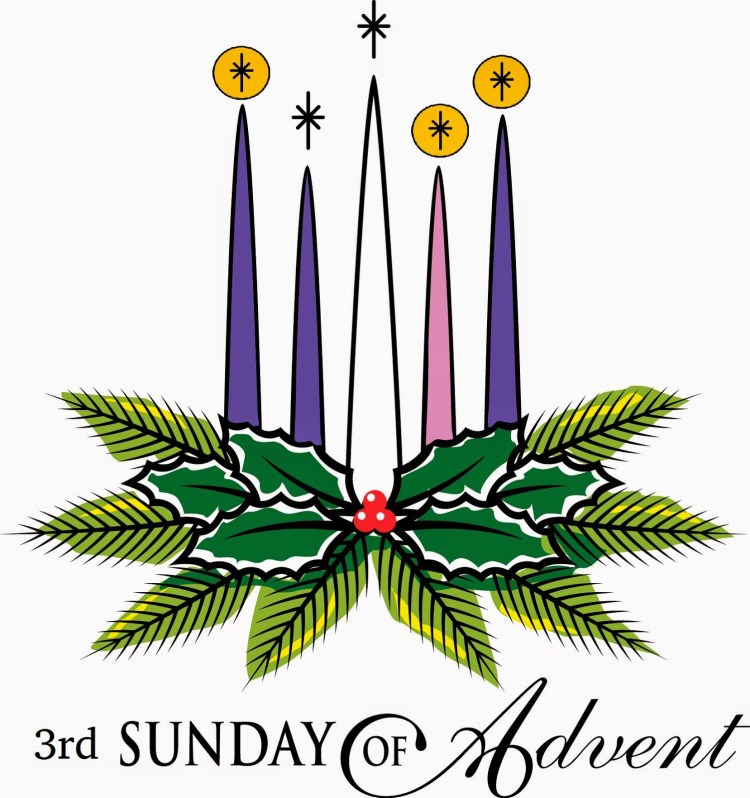
Today, the third Sunday of Advent, is one of only two Sundays in the Church’s year when we use rose as a liturgical colour, the other being the fourth Sunday of Lent. It’s no coincidence that both of these days are towards the end of these two great penitential seasons of the Church’s year. The usual liturgical colour the Church uses to denote penitence is purple, and the Church’s liturgical colour to denote celebration is white. So, as we come towards the end of Advent and Lent, we use rose to show that our time of penitential preparation is coming towards its conclusion, the time for celebrating the great feasts of Christmas and Easter is almost here, and so we use Rose because it’s seen as a mixture of purple and white, a mixture of penitence and celebration. And that’s reflected in this morning’s readings.
There’s no doubt whatsoever that the theme of our first three readings toady is praise and rejoicing. The prophet Zephaniah urges us to,
‘Rejoice and exult with all your heart…’
The Psalmist to,
‘Shout aloud and sing praise…’
And St Paul tells us to,
‘Rejoice in the Lord always…’
Given the nature of these readings, if we didn’t know that we were still in the season of Advent, we might think that Christmas had already come. But, to remind us that we’re not there yet, that we still have some time to go before we can fully celebrate the joy that’s coming into the world, along comes our Gospel reading and John the Baptist to remind us that we still preparing for that time, and that we still have work to do if we’re going to be ready for the coming of the Lord. And that’s obvious from the very beginning of this morning’s Gospel reading.
Last Sunday we heard John quoting the prophet Isaiah, urging people to,
“Prepare the way of the Lord.”
And if we were to read the few verses in between last Sunday’s Gospel and this Sunday’s Gospel, we’d hear John telling the crowds to,
“Bear fruits in keeping with repentance.”
And this morning’s Gospel begins with those crowds asking John,
“What then shall we do?”
In other words, how can we be ready for the coming of the Lord? And so this reminds us that even if we are very close to celebrating the Lord’s coming at Christmas, we’re not there just yet. We still have work to do and still a little more time to prepare. John’s answer to that question though might present us with something of a problem when it come to our own preparation.
John’s answer hints at the people who made up the crowds who went to hear him speak and be baptised by him. There were people who were perhaps a little more well-off than most; those who had “two tunics”. There were tax collectors and soldiers there too. So how does what John said to them apply to us?
First of all we have to accept that what John said does apply to us no matter how well-off we are and no matter what we do, or did, for a living. And we can show that by using some words St Paul’s Letter to the Colossians to sum up what John was saying.
‘…whatever you do, in word or deed, do everything in the name of the Lord Jesus…’
We have to take note of just what John does and doesn’t say in this morning’s Gospel. He doesn’t tell those with two tunics that they shouldn’t have two, but simply if they do, that they should share with those who have none. And the same goes for those who have food; again, share with those who don’t. John doesn’t tell the tax collectors to change their profession, but simply to do what they are doing honestly. And the same goes for soldiers. John doesn’t tell them to lay down their arms and do something else instead, but to avoid the obvious temptations of their profession; the abuse of power, of using force of arms, or even the threat of arms to take from others. We have to remember here too that, in those days, soldiers were very much involved in law enforcement, and they were paid from the same treasuries that fines for criminal behaviour were paid into, hence John’s warning not to make false accusations. So John doesn’t say that there’s anything wrong with being well-off, or even better off than others.
He doesn’t say that there’s anything wrong with doing certain things for a living. What he does say is that being ready to meet the Lord places moral and ethical demands on us. What ever we are and what ever we do, we need to live as God’s people, people who are honest in our dealings with others, people who avoid the temptation to abuse our position whether that be one of power and authority or of good fortune and wealth. If we’re going to be ready to meet the Lord when he comes, we have to love our neighbour because it’s only when we do that, that we can truly do what we do and say in the name of the Lord Jesus.
John’s words make it clear that this demand that being one of God’s people places on us extends to every aspect of our daily lives. So there’s no point in acting as a saint in church if you drop the act as soon as you walk out of church. Unfortunately, there are people who do this very thing. Indeed, there are people who can’t even keep the act up in church and I’m sure we’ve all met some of them! But there are people who seem to think that as long as they come to church on Sunday, or even to simply say that they believe in God, that in some way absolves them of their obligation to live as one of God’s people. Very often these are the people who, if you point out to them that what they’re doing is not very Christian, resort to name-calling and finger-pointing:
“Well I’m not as bad as so and so, they’ve done this, that and the other. At least I don’t do things like that “
As if there’s some kind of scale of what is and isn’t acceptable when it comes to sin and as long as you’re not as bad as someone else, you’re on the acceptable side, and OK. But where are the fruits of repentance that John, and Jesus himself, called for in that? Indeed, is there any repentance there at all?
I do think though, that most of us fall into this kind of error. We fall into what I’ve called a halfway house Christianity. We do try to be the people we know we should be, but we end up doing what we think is enough without it taking too much effort or being too hard or uncomfortable for us. So we might have half a dozen or more coats, and we’ll give one to the charity shop or the church jumble sale, but only after we’ve bought a new one to replace it. We have food enough and so we’ll donate to food banks, but we’ll still spend far more on food that we end up wasting because we have too much, than on what we’ve given to those who don’t have enough. I’m sure we’ve all had little dodges going at work so that we get away with not doing as much as we’re supposed do, to spend a bit of time skiving. And we’ll have excused that, at least to ourselves, by saying that everyone else does it so why shouldn’t we. And if we’ve even stopped for a moment to think about the poor unfortunate who’s got to do extra work to make up for what we haven’t done, we’ve probably just shrugged our shoulders and thought that’s just the way things are. But how annoyed have we been when the boot’s been on the other foot, and we’ve had to do extra to make up for a colleague who’s skived off? And how many of us, if we’ve been in a supervisory or management role have indulged in nepotism, the ‘blue-eye’ game, and given preferential treatment to our family, friends or people we like and treated those we don’t get on with less favourably? We probably haven’t been doing anything other people aren’t doing , but again, how have we felt when we think this kind of inequality has been shown to us?
I’m sure we’ve all done these things but when we have, we’ve shown a lack of love, both towards our neighbour by not treating them as we would like to be treated ourselves, and towards God who calls us love our neighbour as we love ourselves. When we’ve done these things, we’ve sinned and we’re in need of repentance. The fruits of repentance, the thing that John asks us to show in readiness for the coming of the Lord, are shown in our willingness and our ability not to do these things again when the same circumstances arise.
As the people of God, this is the kind of people we’re called to be. This is what John is saying to us; that to be ready for the coming of the Lord we have to become the people God wants us to be by rooting out and stamping out all that stops us from being those people, wherever we find it in our lives. So today, as we look ahead and glimpse a little of the joy that awaits us at Christmas, let’s remember that we still have some way to go and some work to do before we can celebrate the coming of the Lord. And let’s think about just how much more joyful Christmas might be if we could celebrate it as people who are just a little bit closer to readiness because we’re a little bit closer to being the kind of people we’re called to be.
Amen.
Propers for Advent 3, 15th December 2024
Entrance Antiphon
Rejoice in the Lord always; again I say, rejoice.
Indeed, the Lord is near.
The Collect
O Lord Jesus Christ,
who at your first coming sent your messenger to prepare your way before you:
grant that the ministers and stewards of your mysteries,
may likewise so prepare and make ready your way,
by turning the hearts of the disobedient to the wisdom of the just,
that at your second coming to judge the world,
we may be found an acceptable people in your sight;
for you are alive and reign with the Father,
in the unity of the Holy Spirit,
one God, now and for ever.
Amen.
The Readings
Zephaniah 3:14-18
Psalm: Isaiah 12:2-6
Philippians 4:4-7
Luke 3:10-18
Post Communion
We give you thanks, O Lord, for these heavenly gifts;
kindle in us the fire of your Spirit
that when your Christ comes again
we may shine as lights before his face;
who is alive and reigns now and for ever.
Amen.
 Parish Church of St Mark Chadderton