I was born in the old St Mary’s Hospital on the corner of Whitworth Street West and Oxford Street in the city centre of Manchester, and my first home was in Miles Platting and so I am, undeniably, a Mancunian. Having said that I spent my school years and up until my mid-twenties living in a place that was once part of Cheshire and so for all those years, as far as the Church is concerned, we were in the diocese of Chester. That didn’t mean much to me for a long time but when I returned to the Church as an adult, one thing I noticed was the rather low opinion some people in the diocese of Chester had of Manchester. As I began to be more involved in the Church and visit different churches, I came across quite a few people who expressed the opinion that Manchester was a very ‘Godless’ place.
I’d not heard anyone say that for a long time until quite recently when I was chatting to someone who’d had people from America over here visiting them. They told me that their American visitors had said that although they found the people here very nice, they’d never in their lives visited such a Godless place. Leaving aside the theological absurdity, not to say heresy of that statement for a while, that God can be absent from any place, I must say that perhaps they do have a point after all. And that was brought home to me with a vengeance this week.
I’d planned to visit St Paul’s bookshop at Salford Cathedral, but I discovered that it closed down permanently earlier this year. According to the Diocese of Salford’s website, the bookshop and café had been losing money for a number of years and the Diocese had decided that it could no longer sustain those losses. To the best of my knowledge, that means that there is no longer a single Christian bookshop in the central Manchester area. I know a lot of people do their shopping online these days but nevertheless, what the closure of this shop means is that, in city that often claims the distinction of being the UK’s Second City, the biggest and most important city after London, there are not enough customers, enough people, to support even one shop selling Christian books and other Christian items and goods. But let me put that another way.
In this morning’s Gospel, we read an excerpt from Jesus’ trial, specifically, that part of his interrogation by Pontius Pilate when Jesus is asked if he is a king. And we hear Jesus’ answer;
“You say that I am a king. For this purpose I was born and for this purpose I have come into the world—to bear witness to the truth. Everyone who is of the truth listens to my voice.”
Many of you will know that St Paul’s bookshop used to be called The Catholic Truth Society Bookshop. So we could say that the last Christian bookshop in the central Manchester area has closed because there are no longer enough people in the area interested in the truth to keep the shop open. No longer enough people in the area who are prepared to listen to Jesus’ voice to keep even one shop dedicated to proclaiming the truth Jesus spoke, open. In which case perhaps Manchester is, after all, a rather Godless place. But why should that be?
First of all let me say that I don’t think Manchester is particularly any worse than any other city when it comes to a lack of interest in Jesus and the truth he came to proclaim. It’s a problem that extends far beyond the boundaries of the City of Manchester. The well publicised difficulties of the Church in this country tells us that it’s a national problem. One of the reasons for that is that so many people today could, and would, echo Pilate’s question to Jesus and ask, “What is truth?” Because there are so many competing versions of ‘truth’ aren’t there? Do we believe in what science tells us or what faith tells us? And if we go with faith, which faith is telling the truth? There are so many to choose from. But we don’t even have to consider different faiths, which version of the Christian faith do we believe? Which denomination of the Church do we choose to belong to? And ultimately, that is a question about which version of the truth we take to be the one Jesus proclaimed and spoke about during his trial. And then of course we have the various versions of the truth proclaimed by politicians, the media, not to mention the plethora of truths posted on the internet and on social media.
Sadly though, the Church itself is partly to blame for the Godlessness of our city and our nation because how can the Church expect people to be Godly when those in the Church act in such un-Godly ways?
I could cite many instances of this kind of thing but I’m not going to. Partly because they’ve been publicised enough in the media but also for another reason. As terrible as these high-profile cases of the un-Godly ways of some high-profile Church people are, they’re simply the tip of the iceberg. Each and every one of us is partly to blame for the Godlessness of others because we are all, in part, to blame for the un-Godliness of the Church. Each and every time we act in ways that are contrary to the teachings of Christ, we are, in effect, turning a deaf ear to Jesus’ voice and to the truth he proclaimed. We might think that our little lapses are as nothing compared to the kind of things we hear about in the media but the only difference between them is one of degree. We might think that there is a world of difference between the kind of thing that leads to the resignation of an archbishop, for example, and the kind of gossip and rumour mongering we might hear in Church on a Sunday morning, for example. But the difference is only one of magnitude. They are the same type of thing: they are both sins, un-Godly behaviour, plain and simple. They are both failures of those who say they listen to Jesus’ voice and hear the truth he speaks, to do either of those things. And the magnitude of one is more than balanced out both by the sheer number of the other and of the likelihood that those both outside and inside the Church will come across and be directly affected by the other.
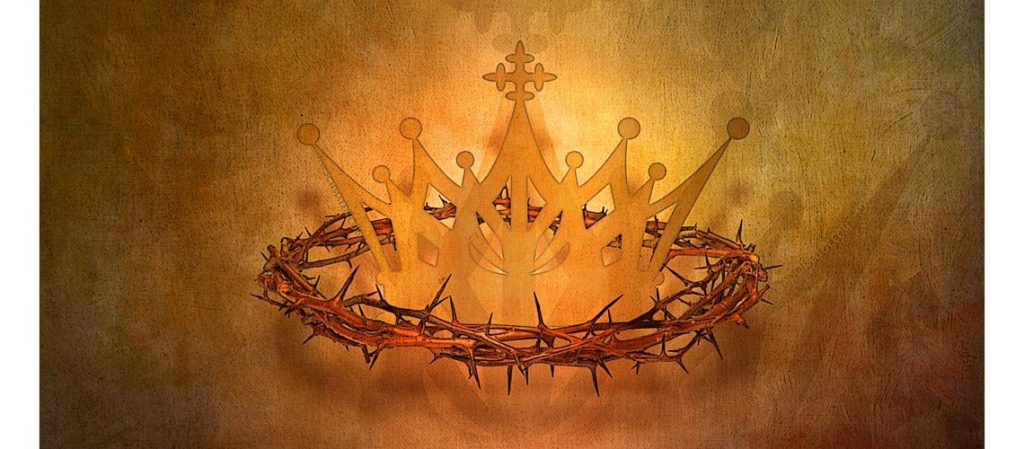
Today we celebrate the Feast of Christ the King, and I think that our understanding of kingship is both part of the problem of the un-Godliness of the Church but also a way that can help us solve the problem.
We know what kings are because we have one ourselves don’t we. But in all honesty, having a king makes very little difference to the way we live does it? We might listen to what the king has to say, and for many people, listening to the King’s Speech on TV will be an integral part of Christmas Day. But we don’t really have to listen to what the king says, that is, we don’t have to pay attention to what he says and change our ways accordingly. We’re quite at liberty to ignore what the king says and do what we want to do, even if that’s the exact opposite of what the kings says we should be doing. As long as what we decide to do isn’t illegal, nothing’s going to happen to us for not listening to the king, we’re not going to be arrested or thrown into prison for not listening to him. But that wasn’t always the case. At one time subjects were expected to listen to the king and if they didn’t, if they didn’t do as the king said, on their own heads be it, at least for as long as they had a head that is! I think the problem we have is that we acclaim Jesus as our king, and treat him as a modern king, one we don’t have to listen to or obey. But we should be treating him as an old-style king, one we’d be very well advised to listen to and obey.
It’s up to us which type of king we treat Jesus as and obviously, if we choose to call Jesus our King but not to listen to his voice and obey it, nothing is going to happen to us – at least for the moment. We won’t be the loyal subjects of Christ we claim to be, we won’t be very good disciples of Jesus, but we won’t be arrested, imprisoned or executed for that. But in the end, we will have to answer for those things to the King himself. We’ll have to stand before Christ, our Lord and Saviour, our King and our Judge, and answer for all the times we chose not to listen to his voice; for all the times we chose not to live according to the truth he bore witness to. We’ll have to answer for all the un-Godly things we chose to do and for the extent to which our un-Godliness contributed to the Godlessness of the time and place we were given to live in. And what will we say then? Do we think that pointing the finger at other people and saying, ‘Well at least we weren’t as bad as them.’ will help us at all?
Next Sunday is Advent Sunday so we’ll enter the time of year when we’re called to prepare, both for the coming of our Lord and Saviour into the world on that first Christmas Day, and also for the time when he’ll return in glory, as our Judge. The Church calls us to prepare for these things by keeping Advent as a penitential season, a time for thinking about our own lives by measuring ourselves against the teaching and example of Jesus. So Advent is a time when we really do need to listen to Jesus’ voice, to hear and take notice of the truth he came into the world to bear witness to. It’s a time when we’re called to put our lives in order by making sure that we’ve not only listened to Jesus but have really heard him and taken notice of what he’s saying. A time to repent of our un-Godliness and be the loyal subjects of Christ our King that we’re called to be. It’s a time when we prepare to celebrate Christmas, the Incarnation of the Son of God so let’s not forget that,
“…God did not send his Son into the world to condemn the world, but in order that the world might be saved through him.”
and let’s stamp out the un-Godliness in our own lives so that we can help lessen the Godlessness of the time and place we live in.
Amen.
Propers for Christ the King, 24th November 2024
Entrance Antiphon
The Lamb who was slain is worthy to receive strength and divinity, wisdom and power and honour: to him be glory and power for ever.
The Collect
Eternal Father,
whose Son Jesus Christ ascended to the throne of heaven
that he might rule over all things as Lord and King:
keep the Church in the unity of the Spirit and in the bond of peace,
and bring the whole created order to worship at his feet;
who is alive and reigns with you,
in the unity of the Holy Spirit,
one God, now and for ever.
Amen.
The Readings
Missal (St Mark’s)
Daniel 7: 13-14
Psalm 93:1-2, 5
Revelation 1:5-8
John 18:33-37
RCL (St Gabriel’s)
Daniel 7:9-10, 13-14
Psalm 93
Revelation 1:4-8
John 18:33-37
 Parish Church of St Mark Chadderton