It’s an undeniable fact that, as people get older, they tend to look back and reminisce about ‘the good old days’. I think that very often though, people do look at times gone by through rose-tinted glasses but nevertheless it’s something people do and seem to enjoy doing as they get older. And something that usually crops up in these nostalgic trips down memory lane are the things that we don’t see anymore, things that have gone from our lives and from life in general. As I read the Gospels for this morning one thing that sprang to my mind that would fit under the category of things we don’t see any more is the Sandwich Man.
By the Sandwich Man I don’t mean someone who sells butties; there’s no shortage of people selling food these days. No, I mean the man who walked around wearing a wooden tabard with advertisements on the front and back. We used to see people like that quite often a few years ago but we very rarely, if ever see them these days. But the Sandwich Man who sprang to my mind as I read the Gospels wasn’t one advertising a product or service, it was a man I used to see every time I went to a speedway meeting at Sheffield, which was quite often, who used to walk up and down outside the stadium wearing a sandwich board that on one side said, ‘The End is Nigh’ and on the other side said, ‘Repent and be Saved’.
We very rarely, if ever, see things like that these days. But that doesn’t mean that people expressing those views have disappeared from society because they haven’t. What they seem to have done is swap the sandwich board for the keyboard and moved online. If you look at Christian pages on social media you’ll soon come across people telling you that the end is indeed nigh, interpreting current events to prove it, and telling you that you need to repent, turn to Jesus and be saved.
I know that very often, people who say these things are dismissed as cranks or religious nutcases, but before we do that we should remember that people have been thinking and saying these things for almost the past 2,000 years; they’ve been saying these things for as long as there’s been a Church. We know they have because we read it in scripture. Just think about what St Paul says when he writes about marriage in his First Letter to the Corinthians:
This is what I mean, brothers: the appointed time has grown very short. From now on, let those who have wives live as though they had none, and those who mourn as though they were not mourning, and those who rejoice as though they were not rejoicing, and those who buy as though they had no goods, and those who deal with the world as though they had no dealings with it. For the present form of this world is passing away.
It’s quite clear from this that St Paul believed that his generation were living in the end times and Christ would return very soon. He might easily have said ‘The end is nigh. Repent and be saved.’
But throughout the past 2,000 years people have thought that the end was nigh in their time, and they’ve urged others to put their lives in order, to repent, turn to Jesus and be saved now, while there’s still time, before it’s too late. It might have been because of unusual astronomical events or events on earth like plague, war, famine or natural disaster. But whatever it’s been, people have interpreted the events of their day as signs that the end is nigh. And people are still doing it today, usually based on their interpretation of that state of the world. But no matter how often people have thought the end is nigh, we’re still here, the end hasn’t come. So what should we make of all this?
I think the first thing we need to do is to remember that we’re Christians; we’re disciples of Jesus Christ and so we need to really look at what Jesus said before we listen to anyone else’s spin on what he said.
Today we have two different Gospel readings on the same theme – the end times. In one, Jesus speaks about the destruction of the temple in Jerusalem and the disciples ask him to tell them when this will happen and what signs to look for. And Jesus speaks about false prophets who’ll try to lead his people astray. But he also says,
“…when you hear of wars and rumours of wars, do not be alarmed. This must take place, but the end is not yet. For nation will rise against nation, and kingdom against kingdom. There will be earthquakes in various places; there will be famines. These are but the beginning of the birth pains.”
It’s usually thought that Jesus is speaking here about the destruction of the temple and the general devastation that happened during the Jewish-Roman War that would happen 30-40 years after he was speaking. That would make sense because there’s no doubt that many people living in those times would have wondered if this was the end of all things and perhaps believed that it was. But Jesus explicitly states that this is not the end, merely the beginning of “the birth pains”. In other words, something painful, yes, but something that must happen before the new life can begin. And as we read on it’s obvious from what Jesus says that, despite what so many people have done and are still doing, we can’t take things like wars, natural disasters (and we surely can include plagues and pandemics in that category), or famines as signs that the end is nigh. So what are the signs of the end times?
Well, Jesus tells us that quite explicitly:
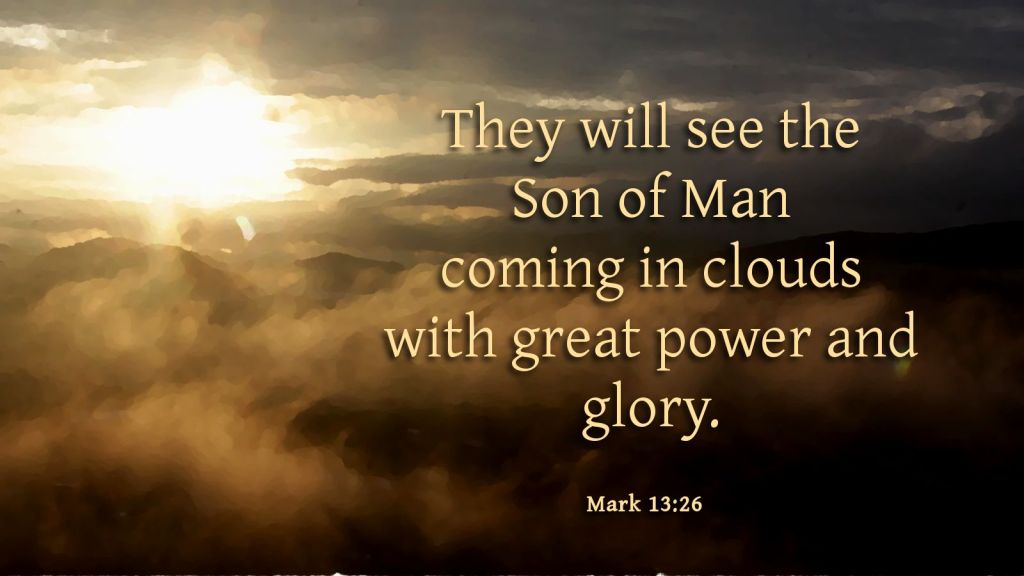
“But in those days, after that tribulation, the sun will be darkened, and the moon will not give its light, and the stars will be falling from heaven, and the powers in the heavens will be shaken. And then they will see the Son of Man coming in clouds with great power and glory.”
The most obvious interpretation of this is that the signs that herald the end will be seen in the heavens, not on the earth. But these words are almost identical to those used by Isaiah to speak about God’s judgement on Babylon. So what Jesus seems to be saying here is that there will be a time of great tribulation, a time of war and plague and natural disaster and famine which will only end when he returns to judge the world. In other words, things will carry on as they always have, there will always be trouble in the world. There will be wars and plagues and famines and natural disasters. So don’t worry about these things being signs that the end is coming. These things are not signs that the end is nigh they are just the way the world is and the way it will be until he returns in glory. But when will that be?
We have to say that Jesus’ words about this are a bit of a problem for us because he says,
Truly, I say to you, this generation will not pass away until all these things take place.”
The most obvious meaning of this is that those who were living at the time of Jesus, his contemporaries, would live to see the end and his return in glory. But we can’t take the most obvious meaning as the true meaning of his words because Jesus then says,
“But concerning that day or that hour, no one knows, not even the angels in heaven, nor the Son, but only the Father.”
So what is Jesus saying here? What does he really mean?
I think we have to accept that we simply don’t know for certain. It’s a problem of translation. Jesus spoke Aramaic, but the Gospels were written in Greek and we’re reading an English translation. We do know that, in Greek, ‘this generation’ could mean Jesus’ contemporaries, the people who were living at that time. But it could also mean, ‘this race’, in which case Jesus would seem to be saying that in spite of the great tribulation that’s coming, the Jews will not pass away before he returns. But it could also mean ‘this age or time’ and if that’s the case Jesus is simply saying that the time of tribulation won’t end until he returns. It’s perhaps significant that Jesus uses the term ‘pass away’ rather than ‘die’. The Greek words are different and when he speaks about death Jesus doesn’t use the word that we translate as ‘pass away’. So there’s no sense that Jesus is saying here that his contemporaries won’t die before the end comes.
So after all that what can we say about the end? Well, I think we have to accept that we’re still going through what Jesus called the birth pains and that these will only end when Christ returns in glory. And as terrible as they are, we shouldn’t regard war, plagues and pandemics, famines and natural disasters as signs that the end is nigh. We’ll know when the end is near because the signs will be on a cosmic scale, and they’ll be unmistakable. But we simply don’t know when those signs will appear or when end will come so it’s useless to speculate. Rather, what we should do is live as though the end is nigh, as though our generation, as though we will not pass away before the end comes. Because above all else, this is the point Jesus is trying to make in this chapter of St Mark’s Gospel. After all is said and done, his final words on the subject of the end are these;
Be on guard, keep awake. For you do not know when the time will come. It is like a man going on a journey, when he leaves home and puts his servants in charge, each with his work, and commands the doorkeeper to stay awake. Therefore stay awake—for you do not know when the master of the house will come, in the evening, or at midnight, or when the cock crows, or in the morning— lest he come suddenly and find you asleep. And what I say to you I say to all: Stay awake.”
Amen.
Propers for the 33rd Sunday of Ordinary Time (2 before Advent) 17th November 2024
Entrance Antiphon
The Lord says, my plans are peace and not disaster;
when you call to me, I will listen to you,
and I will bring you back to the place from which I exiled you.
The Collect
Heavenly Father,
whose blessed Son was revealed to destroy the works of the devil,
and to make us the children of God and heirs of eternal life:
grant that we, having this hope,
may purify ourselves even as he is pure;
that when he shall appear in power and great glory,
we may be made like him in his eternal and glorious kingdom;
where he is alive and reigns with you,
in the unity of the Holy Spirit,
one God, now and for ever.
Amen.
The Readings
Missal (St Mark’s)
Daniel 12:1-3
Psalm 16:5, 8-11
Hebrews 10:11-14, 18
Mark 13:24-32
RCL (St Gabriel’s)
Daniel 12:1-3
Psalm 16
Hebrews 10:11-25
Mark 13:1-8
 Parish Church of St Mark Chadderton