I once read that the world is made up of two kinds of people; those who have read The Lord of the Rings and those who are going to read it. I don’t know if that’s true or not and if it is, I’m somewhere on the journey between those two states because I’ve read two volumes of the trilogy but haven’t yet got around to reading the third volume. But whether you have read or are going to read The Lord of the Rings, you must know something about it. And even if you haven’t read the books, there can’t be many of you who haven’t seen at least some of the film adaptations of them that were released between 2001 and 2003.
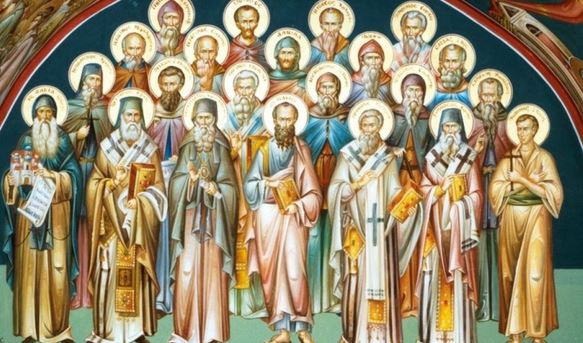
Despite many things in The Lord of the Rings being drawn from pagan mythology, it’s a work full of Christian themes; good versus evil, humility versus pride, mission, redemptive suffering, death and immortality, grace and providence. These things are all there in the work and that’s not surprising because the author, JRR Tolkien, was a devout Roman Catholic. He’s credited with being a significant influence on the great Christian author CS Lewis’ conversion to Christianity and Tolkien himself said that The Lord of the Rings is “a fundamentally religious and Catholic work”. But amongst the Christian themes and imagery in The Lord of the Rings, there’s one scene that I think is perhaps particularly suitable for today, All Saints Sunday, because it can teach us great deal about what it means to be a saint. To be the saints that we’re all called to be as disciples of Christ.
The Scene is The Council of Elrond where representatives of the various peoples of Middle Earth gather to decide what’s to be done with the One Ring. They know they have to prevent it from falling into the hands of the Dark Lord, Sauron, because if they don’t, evil will rule over the whole earth. They’re told that the ring has to be taken into Mordor and be destroyed, but some don’t want that, they want to use the ring for themselves and when they’re told that’s not possible, they belittle those who say it and refuse to acknowledge their allegiance to them. Others are willing to destroy the ring and think they know the best and easiest way to do it. Some think they’re the best ones to carry out the task and don’t want certain others to play any part at all In the mission. In the end the Council dissolves into a heated argument between those concerned, with people on their feet, shouting and pointing their fingers at one another. And while all this is going on the wizard, Gandalf, who in Christian terminology is essentially an angel, looks on and shakes his head in despair.
And isn’t that just like the Church? The Church which has its divinely ordained mission to fight against sin the world and the devil, as our baptismal liturgy puts it. And yet spends so much of its time arguing about how to carry out its mission rather than getting on with it. Which engages in so many mutually destructive internecine arguments about who knows best and who, in their opinion, is and isn’t part of the fellowship that this mission has been given to. About who’s in charge of the fellowship. Even whether they’re willing to be part of a fellowship that includes those with whom they disagree. And can we doubt that while all this goes on and evil goes unchallenged because of it, the heavenly host looks on in despair and shake their heads?
And then, into this tumult, comes a small voice, from a very small person, a Hobbit, Frodo Baggins, who says “I will take it. I will take the ring to Mordor. Though I do not know the way.” Now, Frodo Baggins isn’t perfect. By his own admission he doesn’t know how to get to the place he needs to get to. His journey there is long and hard. He often gets discouraged and thinks he can’t do this thing he knows he must. He sometimes gets lost on the journey, sometimes he’s led astray by others who lead him away from where he needs to go. Sometimes those who’ve pledged to help him try to divert him from the road he knows he has to follow. Sometimes those who’ve offered their help try to stop him from carrying out his mission. But he carries on regardless because he knows that what he’s doing is the right thing to do. And this is the way of the saints.
Saints are holy people, but they’re not perfect people. They’re people who’ve dedicated themselves to God and to carrying out God’s purpose in their lives but that doesn’t mean that they never get things wrong. It doesn’t mean they never have doubts. It doesn’t mean they’re never led astray. All these things happen to the saints but what makes them saints is that, whatever happens, they always return to their mission and carry on with it, no matter how hard it is, no matter what anyone else says or does to put them off or to try and stop them. And that’s something that we should always try to do too because we are all called to be that kind of person; we’re all called to be saints.
Just recently, I’ve been talking to a few people about vocations, and one of the questions that’s cropped up is how do we deal with being part of the Church when we disagree with what the Church is doing? What do we do when we think the Church has lost its way? Perhaps even that the Church seems to have lost sight of what its mission actually is. I’ve been asked these questions in the context of ordained ministry; what does a priest do in those circumstances? But the answer applies to both priest and people alike, and that is, we carry on following our vocation whether that be as a priest or a lay person because we’re disciples of Christ. And it’s him we follow and no other. I’m not saying that’s easy because I know that sometimes it’s not. We can be disillusioned both with what other people are doing and saying and with our own inability to follow Christ properly. We can be put off by what others do and say. We can find ourselves not knowing which way to go. But it’s in those times that we have to remember who we’re called to follow.
I’m sure that, like me, when you were young you did something you shouldn’t have done and, when you were asked why, you said it was because someone else had done it first. And no doubt the response you got from your parents or teachers was something along the lines of, “And if they’d stuck their head in the fire would you have done that too?” And that reasoning applies to us when we become disillusioned with things in the Church or find being a disciple difficult. Just because someone else in the Church is a hypocrite, does that mean we have to be one too? Just because someone else has given up because the Way of the Cross is too hard, does that mean we should give up too? Just because someone has been talked out of being a disciple of Christ, does that mean we should allow ourselves to be talked out of it as well? Just because someone else has lost their way and strayed from the Way the Cross, does that mean we have to follow them along the wrong path? The answer to all those questions is ‘No, we don’t’. Just as we wouldn’t stick our head in a fire just because someone else has done it, so we don’t have to do what other people have done when they’ve lost sight of the path they should be following as disciples of Christ. Whatever happens and whatever anyone says or does, we should always be faithful to Christ and his way. And even if we do stray at times, we should always come back to Christ’s way.
I know that, sometimes, it’s not easy to know what the right way to go is. We know we should follow Christ’s path, and we want to follow his path, but we can be confused about which path that is, especially when we have people giving us conflicting directions. That happens quite often these days as we try to deal with issues that we don’t read about in scripture.
It’s difficult to know at times which is the right way to go when one group in the Church is saying “This is Christ’s way” whilst at the same time another group is saying “No it isn’t.” And we always have to be wary of people claiming a certain way is Christ’s way when, in fact, that way is the way of the world and of those who are claiming that it’s Christ’s way. So we need a trustworthy guide, and that guide is Christ himself.
In The Lord of the Rings, Frodo is given The Light of Earendil to “…be a light … in dark paces when all other lights go out.” And when we’re in dark places and can’t see our way clearly, we have to walk by the light of Christ. We don’t carry it around in a flask, as Frodo does in The Lord of the Rings, but we do find it in scripture. And we should always carry it with us in our minds and in our hearts so that, when we’re in dark places and we’re not sure which way to turn or who to listen to, we can turn to Christ and listen to him so that he can show us the right way to go and put us back on that road again.
No matter what people say or do, no matter how confusing what they say and do is, we’re called to carry on regardless along the Way of the Cross. No matter how many times we take a wrong turning and get lost along the way, we’re called to keep going and find our way back to the right road again. This is the way of the saints and if we want to be the saints we’re called to be, this should be our way too. To travel the road of good over evil, of humility over pride, of following the Church’s mission to proclaim the gospel and teach people his commandments, the road of sacrificial love, a road we walk by faith in grace and providence, a road that we have to travel along until we come to the end of our lives but a road that, if we can travel it, will ultimately lead to eternal life.
Amen.
Propers for All Saints Sunday, 3rd November 2024
Entrance Antiphon
Let us all rejoice in the Lord and keep a festival in honour of all the saints.
Let us join with the angels in joyful praise to the Son of God.
The Collect
Almighty God,
you have knit together your elect in one communion and fellowship
in the mystical body of your Son Christ our Lord:
grant us grace so to follow your blessed saints in all virtuous and godly living,
that we may come to those inexpressible joys that you have prepared for those who truly love you;
through Jesus Christ your Son our Lord,
who is alive and reigns with you,
in the unity of the Holy Spirit,
one God, now and for ever.
Amen.
The Readings
Missal (St Mark’s)
Revelation 7:2-4, 9-14
Psalm 24:1-6
1 John 3:1-3
Matthew 5:1-12
RCL (St Gabriel’s)
Isaiah 25:6-9
Psalm 24:1-6
Revelation 21:1-6
John 11:32-44
 Parish Church of St Mark Chadderton