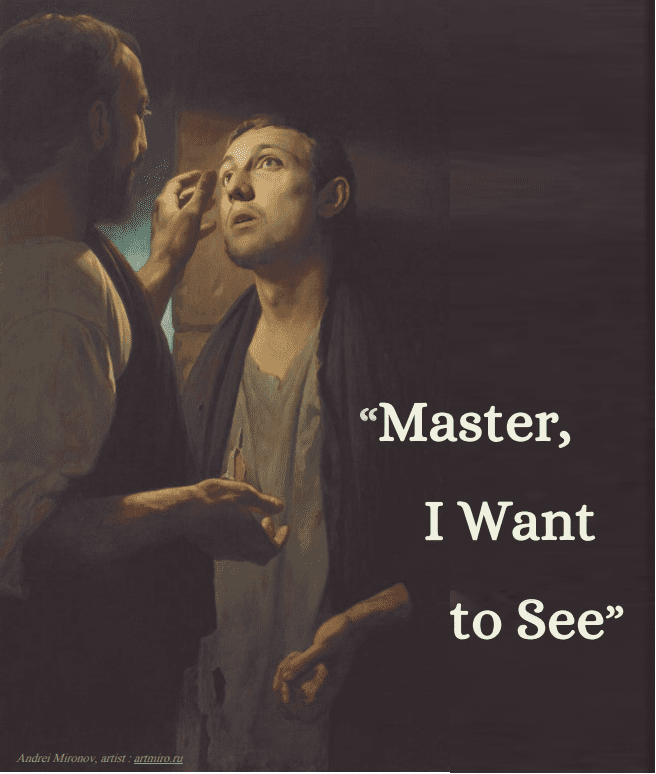
One of the things we soon realise when we start to study the Gospels rather than simply read them, is that the Gospel stories usually work on multiple levels. There’s the plain meaning of the story we read but hidden within the story there’s usually a spiritual meaning. Sometimes Jesus himself tells us what that is, usually through explaining a parable to his disciples. Sometimes though, we have to think about a story in context, why does it come where it does in the Gospel, what’s happened before this that this particular story might shed some light on. And then there’s the lesson Jesus is trying to teach us through the story, and to understand that we have to think about how the story applies to us in our own lives. And we can see all these things at work in this morning’s Gospel story, the healing of blind Bartimaeus.
On the surface, this is a simple miracle story, an account of Jesus healing a blind man who comes to him in faith. But if we think about the story a little more deeply, it’s actually a lot more than that because underlying the story of Jesus giving physical sight to Bartimaeus, is a story about spiritual blindness and, if we can see it, a lesson for us and for anyone who has ears to hear and eyes to see. In fact, we can see the story of blind Bartimaeus as one bookend of a section of St Mark’s Gospel about spiritual deafness and blindness.
One bookend of this section comes at the end of chapter 7 in the Gospel. By this time Jesus has performed many miracles and done a great deal of teaching, and he’s amazed at people’s lack of faith and lack of understanding. Then at the end of chapter 7 Jesus heals a man who was deaf and had a speech impediment. Again, on one level, this is a story about a healing miracle, but in the context of what’s gone before this is also about opening people’s ears to hear and understand what Jesus is saying. It’s no coincidence that the word Jesus uses when he restores this man’s hearing and speech is “Ephphatha”, “Be opened”, because people must hear and understand if they’re going to go out and spread the Gospel.
Then, at the start of chapter 8, we have the story of Jesus feeding the 4,000, immediately followed by a dispute with the Pharisees about their demand for ‘a sign from heaven to test’ Jesus. But it’s not only the Pharisees who still don’t understand, it’s Jesus’ disciples too.
They start ‘discussing with one another the fact that they had no bread.’ And Jesus has to ask them, “ Do you still not perceive or understand?”
Then comes another healing miracle, this time the healing of a blind man. But this seems a strange one because Jesus has to have two attempts to get it right. After the first attempt to give the man his sight back, he can see, but not clearly. The man says, “I see men, but they look like trees walking.” So Jesus has another go, and this time the man ‘saw everything clearly’. That seems a strange story until we read on and then we can see that hidden within this healing miracle, is a story about people who do see, but not clearly, about people who only understand in part what Jesus is saying and doing.
And that’s exactly what we see as we read on. We hear Peter’s great confession of faith that Jesus is “…the Christ”. But in spite of that confession of faith, as soon as Jesus speaks about his death and Resurrection, Peter rebukes Jesus, clearly thinking that he, Peter, knows better than Jesus! We read about the Transfiguration when Jesus appears in glory with Moses and Elijah, but again, when Jesus speaks about rising from the dead, Peter, James and John don’t understand what he means. And so it goes on. Jesus heals a boy with an unclean spirit that the disciples had tried and failed to drive out, and we find out that’s because the disciple’s prayer is at fault. Then Jesus again foretells his death and resurrection, and again the disciples don’t understand. Then, the disciples start arguing about greatness. They know they shouldn’t be doing it because when Jesus asks them what they were discussing, they won’t tell him. But they argued about it, nonetheless. Then they admit they’ve tried to stop someone from acting in Jesus’ name because he wasn’t one of them. And Jesus has to put them right again. He teaches about temptation and divorce , where again there’s misunderstanding. The disciples try to stop children from coming to Jesus, which makes Jesus angry. He teaches about the danger of attachment to riches, which causes at least one young man to walk away, in spite of his faith. Then we read about Jesus, yet again. foretelling his death and Resurrection. This time we’re not told that the disciples don’t understand but, just as we think that perhaps the light has started to dawn on them, James and John ask Jesus for positions of power in his kingdom, in spite of what Jesus had already told them about greatness and the need to serve and be as little children. And then we come to the story of blind Bartimaeus. But what do we read there?
That Bartimaeus cries out to Jesus, but people have a go at him and tell him to shut up. And we can probably understand why. Bartimaeus was a beggar, who was he to shout out for Jesus’ attention? Why should someone as important as Jesus be bothered about someone so unimportant as Bartimaeus? Surely there were many far more deserving people for Jesus to see than this blind beggar.
But to Jesus, Bartimaeus is important, and most importantly of all, he cries out to Jesus in faith and it’s his faith that heals him and restores his sight. We know that because Jesus says it. And so we know that this is a story about spiritual healing too, not just about physical healing. Bartimaeus can see with his eyes now, but he also understands who Jesus is and what Jesus is saying because we’re told not simply that he followed Jesus, but that he ‘followed him on the way’ and we know from what we’ve read earlier that, in answer to Peter’s rebuke, Jesus said,
“If anyone would come after me, let him deny himself and take up his cross and follow me.”
So Bartimaeus had clearly seen, in a spiritual sense, and understood something about Jesus that others were struggling to see and understand.
Once we set the story of blind Bartimaeus in the context of what’s gone before, we can see the spiritual meaning hidden within the story. And once we can see that, we can start to look at how this story applies to us and how we can apply its lessons to ourselves and our own lives.
We here today call ourselves Christians. We proclaim our faith in Jesus, in that sense, we’re just like Peter. But how often do we say that we hear and think that we see when, in fact, at best we’re like that man who was only partially healed by Jesus? We see something of what Jesus said and did, but we don’t see clearly. And because we don’t see or hear clearly, we don’t proclaim the Gospel as we should.
How often do we read the Gospel, understand the words we’re reading, but put our own spin on them to make them easier to follow, or perhaps even to make excuses for our failure to follow what we know their real meaning is? In that, again, aren’t we just like Peter, thinking that we know better than Jesus, trying to find an alternative way to follow Jesus, one that doesn’t involve the way of the cross? How often do we think that our prayers go unanswered? But when we pray, how many of us truly believe that what we’re asking has already been granted, as Jesus said we should? We know that to be great in God’s kingdom means being a servant, just as Jesus himself “came not to be served, but to serve”. And yet how many people in the Church are concerned with greatness in an earthly sense. How many are like James and John, wanting power and authority? And how many, having achieved some kind of authority in the Church use it to ‘Lord it’ over others in the Church? How often do we criticise those of other denominations of the Church, or of other traditions within our own Church, or even within our own congregations simply because they’re different, because they’re not ‘one of us’, just as the disciples tried to stop one who wasn’t one of their gang? How often do we see children treated badly in churches, being told to ‘Shut up!’, ‘Don’t do this’, ‘You can’t do that’? Or do we hear parents of children being told to keep their kids quiet and even to ‘clear off’ if they can’t? And how many of the people who say things like this then complain about the lack of children and young people coming to Church these days? But didn’t Jesus become angry and rebuke the disciples for that very attitude towards children? And how many in the Church think that worldly status somehow makes them more important in the Church (and by implication more important to Jesus) than those of lower worldly status? Isn’t that exactly the attitude people had to blind Bartimaeus? And yet the only status Jesus cared about was the status of Bartimaeus’ faith.
When we read the Gospels, if we only read the story on the page in front of us we miss out on so much that we could learn from the stories. So much that we could use in our own lives to deepen our faith and to be better Christians. If we can pray that our ears might be opened to really hear what Jesus is saying to us through the Gospel stories, our eyes will be opened to how we might follow the way of the cross more closely in our lives. And if we can do these things, our tongues will be released to proclaim the Gospel in a better way. So, when we read the Gospels, let’s not simply leave it at that but study what we’re reading, think about it, pray for understanding of what we’re reading and for the grace to live out what we’ve learned in our daily lives.
Amen.
Propers or the 30th Sunday in Ordinary Time (Last after Trinity) 27th October 2024
Entrance Antiphon
Let hearts rejoice who search for the Lord.
Seek the Lord and his strength, seek always the face of the Lord.
The Collect
Blessed Lord,
who caused all holy Scriptures to be written for our learning:
help us so to hear them,
to read, mark, learn and inwardly digest them
that, through patience, and the comfort of your holy word,
we may embrace and for ever hold fast the hope of everlasting life,
which you have given us in our Saviour Jesus Christ,
who is alive and reigns with you,
in the unity of the Holy Spirit,
one God, now and for ever.
Amen.
The Readings
Missal (St Mark’s)
Jeremiah 31:7-9
Psalm 126
Hebrews 5:1-6
Mark 10:46-52
RCL (St Gabriel’s)
Jeremiah 31:7-9
Psalm 126
Hebrews 7:23-28
Mark 10:46-52
 Parish Church of St Mark Chadderton