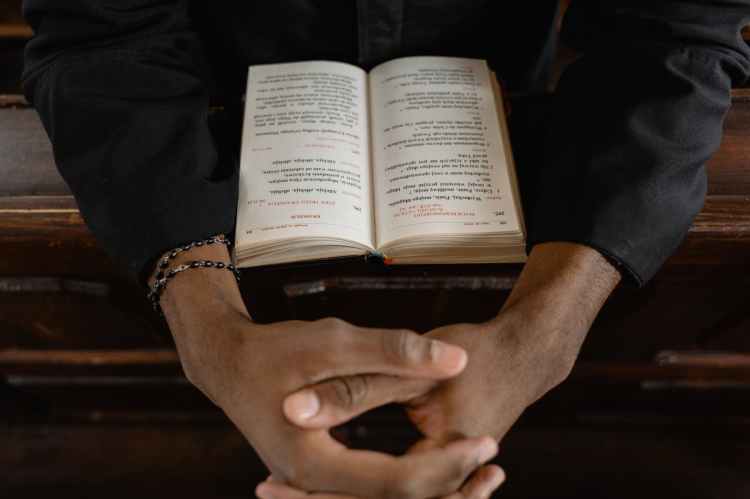
One of the problems we can often run into when we read the Bible, and I hope we all do read the Bible, regularly, is knowing how to read it. By that I mean, how do we interpret and understand what we read. How do we know, for example, what to take literally and what to take figuratively? One of the problems we can have in applying Jesus’ teaching to ourselves and in our lives, is that, at times, Jesus uses hyperbole to really emphasise a point. So how are we to interpret those things? And I think too that sometimes, we can be guilty of exploiting this difficulty for our own ends; we can of interpret things figuratively rather than literally, simply in order to make them easier to apply to ourselves and the way we live our lives. Perhaps even to excuse what we do when that’s contrary to Jesus’ teachings and commands. And this morning’s Gospel is a good example, I think, of this kind of problem.
I’m sure we’re all familiar with this Gospel story; a rich young man asks Jesus what he must do to inherit eternal life, and Jesus tells him to sell his possessions, give to the poor and follow him. But being very rich, the young man is unwilling to do this and goes away unhappy. And in response Jesus says that,
“It is easier for a camel to go through the eye of a needle than for a rich person to enter the kingdom of God.”
That’s an example of Jesus’ using hyperbole to emphasise a point. It’s quite obviously impossible for a camel to fit through the eye of a needle. But why put it in these terms? If it’s impossible for the rich to enter the kingdom of God, why not just say so plainly. And not only that, in spite of having just told this rich young man that the way to inherit eternal life was to sell his possessions and give to the poor, in answer to the question, “Who can be saved?” Jesus goes on to say that it’s impossible for anyone to be saved,
“…but not with God. For all things are possible with God.”
So how are we to interpret what Jesus is saying here, because he uses hyperbole rather than plain language, and what he says seems contradictory. Do this to inherit eternal life, but it’s impossible for the rich to enter the kingdom of heaven, and for anyone to be saved.
Some people have tried to make sense of this Gospel story is by saying that when Jesus speaks about ‘the eye of needle’, he isn’t talking about a sewing needle. They say that the eye of a needle referred to here is a small gate in a city wall. Camels, being large animals often used to carry goods, couldn’t go through such a small gate without great difficulty. But it wasn’t impossible. A camel could go through this eye of a needle but not unless it was unloaded of its baggage and made to bend down low. The point being that, just as a camel could go through the eye of a needle once it had been unburdened of its earthly goods and bent down low, so a person can enter the kingdom of heaven in a similar way, by laying aside earthly riches and bowing down before God.
Actually, there is no historical evidence to suggest that there was a small gate known as the eye of a needle. But nevertheless, reading this Gospel story in this way does, I think, probably give us a better understanding of what Jesus is really trying to say here. If we take this story as a whole, and we always must do that if we ever hope to understand these stories, Jesus doesn’t appear to be saying that it’s earthly riches per se that make it impossible for a person to enter the kingdom of God. What Jesus really seems to be saying here is that it’s our attachment to earthly riches that make it impossible for us to enter the kingdom of God. And that is in keeping with what we read more widely in scripture.
One of the most well-known sayings from scripture is that money is the root of all evil. Actually, there is no such saying in scripture. What scripture says is,
‘…those who desire to be rich fall into temptation, into a snare, into many senseless and harmful desires that plunge people into ruin and destruction. For the love of money is a root of all kinds of evils. It is through this craving that some have wandered away from the faith and pierced themselves with many pangs.’
So it’s the love of money, and the love of earthly riches generally that is the problem. It’s our desire to be rich in earthly terms that makes us get our priorities wrong. We want the good life now and in trying to achieve that, we jeopardise our chances of eternal life. We put finance before faith, lucre before love, greed before God. But what scripture tells us is that, if we can free ourselves of our greed for and attachment to earthly riches, we’ll at least be on the right path, the path that leads to eternal life.
Think of the story of Zaccheus, a chief tax-collector and another rich man. But unlike the rich young man in this morning’s Gospel, after he met and spoke to Jesus, Zaccheus changed his ways. He said,
“Behold, Lord, half of my goods I give to the poor. And if I have defrauded anyone of anything, I restore it fourfold.” And Jesus said to him, “Today salvation has come to this house…”
And this is what Jesus is saying in this morning’s Gospel. It’s not about giving away or even selling everything we own and making ourselves poor in earthly terms, It’s about getting our priorities right. The way to inherit eternal life is to put God first and have concern for our neighbour. It’s to make doing the things that lead to eternal life more important than doing the things that make us rich on earth.
But that still leaves us with what Jesus says about the impossibility of being saved. What are we to make of that?
Really, what Jesus is saying to us here is that we must accept that, whatever we do, we’ll always fall short of what we need to do in order to be saved. So we can’t achieve our own salvation. We can’t inherit eternal life and enter God’s heavenly kingdom solely through our own efforts. Ultimately, we have to rely on the love and mercy of God for our salvation. And so, as well as having to be prepared to give up our attachment to earthly riches, we also have to give up something that’s perhaps even more precious to us; we have to give up our pride and humble ourselves before God.
In many ways, our love of earthly riches is a sign of our pride. Because isn’t it true that people very often look down on those who have less in earthly terms than they do? We see it as a sign of our importance if we have more money than others, a bigger house, or even a bigger car than others, if we live in a better part of town than others, have a better job than others or more qualifications than others. But does having any of those things make us better human beings than those who don’t have them or don’t have so much or so many of them? No, it doesn’t. And does having any of those things make us better Christians than others? No, it doesn’t. And yet, in the Church, it’s usually those who do have these things who look down on those in the Church who don’t have them.
Who think that they’re better Christians than others, more worthy or more important in God’s eyes than others, simply on account of their earthly wealth and status.
But how we see ourselves is completely irrelevant when it comes to salvation. The only way we can be better than others that matters at all in those terms is by being good enough in God’s eyes and, as we see in scripture generally, and as we read in this morning’s Gospel, earthly riches are not only irrelevant when it comes to that, they can actually be a hindrance to us because we can become so focussed on getting them and so attached to them if we’ve got them, that they become more important to us than God and our neighbour.
So in this morning’s Gospel, Jesus is not saying that there’s anything wrong with wealth in itself. And in fact as we all know, we can do a lot of good with our wealth if we have it. What he is saying is that we can’t allow the pursuit of earthly riches and the desire to keep hold of those riches if we have them to prevent us from following him. We can’t allow earthly riches to become more important to us than God and the well-being of our neighbour. And we have to remember that being rich in earthly terms is no guarantee of salvation; earthly riches are irrelevant and, if we get our priorities wrong, they can even be a hindrance when it comes to inheriting eternal life. We have to remember that however good or important we might think we are, none of us are good enough to inherit eternal life through our own efforts. We have to rely on God to grant us that and so we have to lose the pride that’s so precious to us and humbly ask God that, in his love and mercy, he’ll forgive our faults and failings and allow to enter his kingdom.
Amen.
Propers for the 28th Sunday of Ordinary Time (Trinity 20) 13th October 2024
Entrance Antiphon
If you, O Lord, laid bare our guilt, who could endure it?
But you are forgiving, God of Israel.
The Collect
God, the giver of life,
whose Holy Spirit wells up within your Church:
by the Spirit’s gifts equip us to live the gospel of Christ and make us eager to do your will,
that we may share with the whole creation the joys of eternal life;
through Jesus Christ your Son our Lord,
who is alive and reigns with you,
in the unity of the Holy Spirit,
one God, now and for ever.
Amen.
The Readings
Missal (St Mark’s)
Wisdom 7:7-11
Psalm 90:12-17
Hebrews 4:12-13
Mark 10:17-30
RCL (St Gabriel’s)
Amos 5:6-7, 10-15
Psalm 90:12-17
Hebrews 4:12-16
Mark 10:17-31
 Parish Church of St Mark Chadderton