One of the things we hear a lot about in the Church these days is mission. But what is mission. Put simply, the Church’s mission is to be about the Lord’s business; to go out into the world and do the things he told his disciples to do; to care for the sick and needy, proclaim the Gospel and bring people to faith. That is the Church’s mission. But if we think about that mission, there are actually two parts to it: mission – being sent out to do the Lord’s business, and evangelism – proclaiming the Gospel and bringing people to faith. And when the Church talks about mission what it’s often doing is lumping together these two different but very closely related things. Or at least they should be because the Church doesn’t have a monopoly on doing good works so if we want people to know that we’re engaged in a mission that’s specifically Christian, it must include an element of evangelism. We need to let people know that we’re doing these things because we’re Christians. And we have to let people know that because we’re called to do things for God’s glory not for our own.
Carrying out the Church’s mission though isn’t easy for a lot of people, and the hard part of it is usually the evangelism. The difficulty with evangelism today is that we live in a secular society. Most people have very little if any knowledge of the Christian faith and if they have it’s usually a strange mixture of folk-religion and rubbish they’ve read on the internet combined with prejudices and misunderstandings they’ve picked up from a few people they know who perhaps used to go to church at some time in the distant past. Most people have never been to church in their lives, they’ve probably had no contact with the Church, and very often these days, have a very negative view of the Church because the only time they ever hear anything about it is in connection with some scandal or other. And for all these reasons it can be very difficult to speak to people about our faith. On the whole, people don’t mind doing the good works associated with mission because we can do these without having to speak about our faith. But when it comes to the evangelistic aspect of mission, people are usually far less comfortable. Sometimes they’re actually afraid to try because they’re frightened of the negative, perhaps even hostile response they might get from those they speak to.
Nevertheless, we are called to engage in mission, we’re called to do that by Christ himself, and evangelism, speaking about our faith to those who don’t share it, is an inescapable aspect of our mission. It’s something we have to do if we’re going to be authentic disciples of Christ. But how do we do it? How do we speak about our faith to people who know little to nothing about it, in ways that they’ll understand?
There is a way of doing this that we find in scripture and in Church history. It’s a way of doing mission and evangelism that’s been tried and tested, and it works. It’s not an overnight miracle cure for unbelief, it’s not going to fill our churches with new converts overnight because it’s a 3-stage process. It takes time but, in the long run, it does work.
Stage 1 is where we, in the Church, adapt to the society we live in. Not so that we can become like everyone else in society but so that we can take on board the beliefs and values and customs of the society we live in with a view to understanding how to proclaim the Gospel in that society. Stage 2 is where we take what we’ve learned about society and align the way we explain our faith with those existing beliefs and values and customs so that we can proclaim the Gospel through those things. And when people have come to an understanding of the Christian faith, we move to Stage 3 and that’s when we finally replace those existing beliefs and values and customs with Christian beliefs and values and customs. We do find this going on in scripture and in Church history and perhaps the place in scripture where we see it most easily is in St Paul’s Letters, and in his own words in his First Letter to the Corinthians;
‘… I have made myself a servant to all, that I might win more of them. To the Jews I became as a Jew, in order to win Jews. To those under the law I became as one under the law (though not being myself under the law) that I might win those under the law. To those outside the law I became as one outside the law (not being outside the law of God but under the law of Christ) that I might win those outside the law. To the weak I became weak, that I might win the weak. I have become all things to all people, that by all means I might save some. I do it all for the sake of the gospel, that I may share with them in its blessings.’
But whilst that might be the easiest place to see this process at work in scripture, it’s not the only place in scripture we find it and St Paul is not the only person in scripture to use it. In fact, we can see Jesus himself using this method of mission and evangelism in this morning’s Gospel.
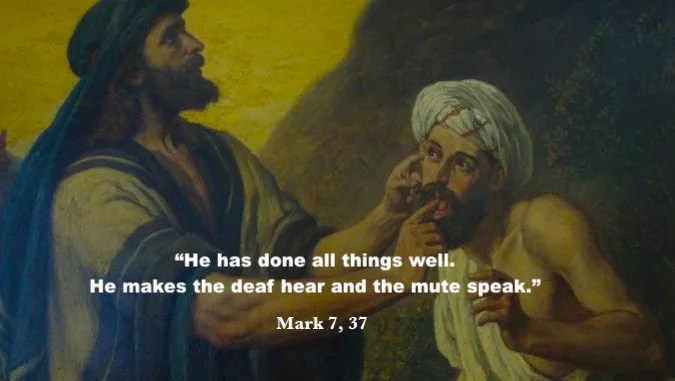
This morning’s Gospel is the story of a miraculous healing, in this case, Jesus healing a man who was deaf and mute. There’s nothing unusual about that in the Gospels but if we look at this story a little closer, there are quite a few things about it that does mark this story out as quite unusual. The first thing that’s strange about this story is that neither Matthew nor Luke mentions it in their Gospels and as they both retell almost all of Mark’s stories, that is unusual. And it’s generally thought that the reason Matthew and Luke don’t retell this story is that it portrays Jesus almost as a magician, a pedlar of magical cures.
The first thing we have to understand about this miracle is that it took place in the Decapolis, the Gentile region to the South and East of the Sea of Galilee. So Jesus was not among Jews. And the cure itself wasn’t like most of the other miracles we read about in the Gospels. Most of those took place in public, with either a simple touch or command from Jesus, or simply on account of the faith of the person who went to Jesus for help. But here things are very different. First of all Jesus takes the man away from the crowd to heal him in private. Then Jesus touches the man’s ears, he spits, touches his tongue, groans and finally gives the command “Ephphatha” which we’re told means ‘Be opened’. But while this is unusual for Jesus, there are parallels for these kinds of actions in Gentile magic and the ‘cures’ of Gentile magicians of the time.
Taking a sick person aside, perhaps to be alone or in the company of a few close relatives with the healer, was, and in some parts if the world still is, a common practice of faith healers and magicians. So too is touching the parts of the body in need of healing. Many cultures believed, and again still do believe in the healing properties of saliva too, hence the spitting. The Roman historian Tacitus, for example, tells a story of a blind man asking the emperor Vespasian to anoint his eyes with spittle so that he might be cured of his blindness. And groaning and speaking in foreign languages during healings are things we find in magical texts of the time. We have to remember here that even if “Ephphatha” is Aramaic for ‘Be opened’ (and that’s not certain), Aramaic was Jesus’ language, not necessarily the language of the Gentiles of the Decapolis. All these things are strongly suggestive of Jesus using Gentile practices to heal a Gentile in Gentile territory. In other words, of Jesus using the beliefs, values and customs of the society he was working in to proclaim the Good News that the Kingdom of God was upon them. And the end result was that people were so astonished by what Jesus had done that they believed in him and went out to spread the word about him.
As I said earlier, this 3-stage process of mission and evangelism is something we find in scripture and it’s something the Church has used throughout its history because it works. And if it worked in scripture and in history, there’s no reason why it shouldn’t work today. Of course, the beliefs, values and customs of today are different those of the past, but that’s true of every society throughout history. All that means is that we have to keep up to date with what those beliefs, values and customs are. As I’ve said in the past, there’s no point in trying to carry on as we always have been. We can’t use the methods that worked in the 1980’s or 90’s, for example, or any other time in the past either because we’re not living in the past, we’re living in the present and we have to do our mission and evangelism in the present. Society has changed and so we have to change too so that stage 1 and 2 of the mission and evangelism process is relevant to the society we live in today.
The Church does and is trying to do this. But the danger the Church is facing at this time, perhaps one of the greatest dangers the Church has ever faced, is that in its efforts to be relevant to today’s society and find a way of doing mission and evangelism in today’s society, it’s in danger of forgetting what the purpose of mission and evangelism is. To put it in terms of the process I’ve outlined, the Church is working hard at stage 1 so that it can find an effective stage 2. But it’s focussing and working so hard on this this that it seems to be in danger of neglecting the most important part of the process, stage 3. And that is the most important part of the process because that is the ultimate goal of the process.
We mustn’t ever forget that the ultimate aim of our mission and evangelism is to proclaim the Gospel and the faith of the Church and to bring people to that faith. Whatever changes happen in society and whatever changes we have to make to adapt to and assimilate those changes so that our mission and evangelism is relevant to the society we live in and works in that society, we mustn’t ever forget that the ultimate goal is not for us to change to suit society but for society to change to suit the Lord. The goal of the process is not to change what the Church teaches so that it becomes acceptable to society, but for the Church to change the way it works so that we can make society acceptable to God.
Amen.
Propers for the 23rd Sunday of Ordinary Time (Trinity 15) 8th September 2024
Entrance Antiphon
Lord, you are just, and the judgements you make are right.
Show mercy when you judge me, your servant.
The Collect
God, who in generous mercy sent the Holy Spirit upon your Church in the burning fire of your love:
grant that your people may be fervent in the fellowship of the gospel that,
always abiding in you,
they may be found steadfast in faith and active in service;
through Jesus Christ your Son our Lord,
who is alive and reigns with you,
in the unity of the Holy Spirit,
one God, now and for ever.
Amen.
The Readings
Missal (St Mark’s)
Isaiah 35:4-7
Psalm 146:7-10
James 2:1-5
Mark 7:31-37
RCL (St Gabriel’s)
Isaiah 35:4-7
Psalm 146
James 2:1-17
Mark 7:24-37
 Parish Church of St Mark Chadderton