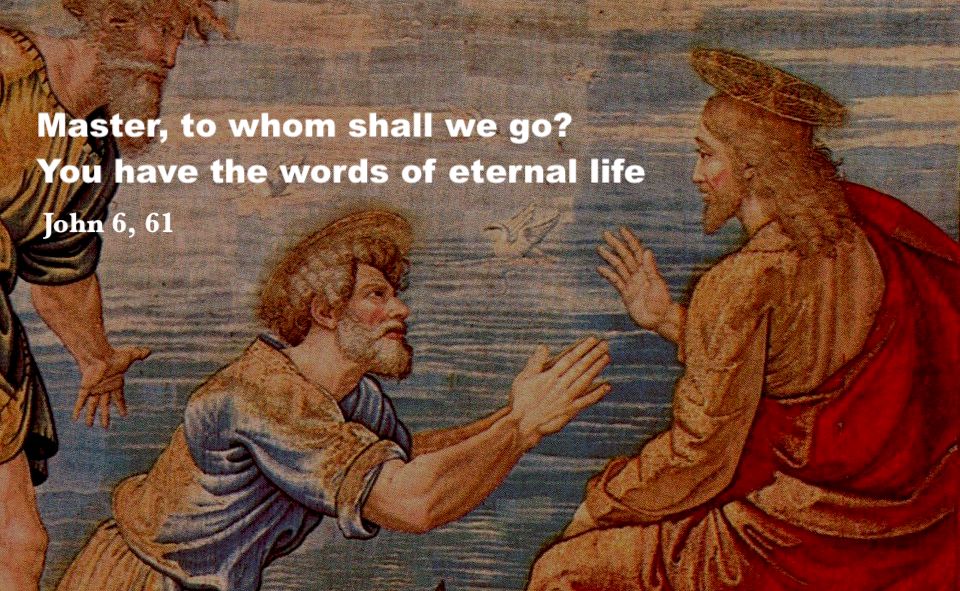
If someone were to ask us to sum up, in a few words, what it means to be a Christian, what would we say? We might think that’s quite a hard thing to do but I think we could do that very easily in just three sentences . First of all we must pay attention to those words spoken by the Father at Jesus’ Transfiguration and listen to Jesus. Next we must pay heed to Jesus’ own words and believe in him. And lastly, we must then follow Jesus, we must do our level best to live our lives in the way that he said we should. So we could sum up what it means to be a Christian very simply by saying it means listening to Jesus, believing in Jesus and following Jesus in the way we live.
I don’t think anyone could dispute that these things are essential to anyone who wants to call themselves a Christian. Isn’t it ironic then that so many people who do call themselves Christians, don’t do these things. And they don’t. Like all people, people who call themselves Christians want to live their lives in their own way rather than in Jesus’ way, especially when Jesus’ way is difficult. And to do that and still call themselves Christians, they tend to listen only to those words of Jesus that suit them, and to believe only those teachings of Jesus that fit in with their own ideas and understanding of how things should be, and how life should be lived. And what’s even more ironic is that so many people who do these things are only too ready and willing to criticise others for not listening to Jesus, for not believing in Jesus and for not following Jesus, simply because those other people aren’t doing things their way. Very often, Jesus has nothing whatsoever to do with it.
Over the last few Sundays we’ve been hearing Jesus’ words about the need to believe in him and about the need to eat his flesh and drink his blood if we want to have eternal life. We also know, by listening to Jesus, that we eat his flesh and drink blood through receiving bread and wine in remembrance of him in the sacrament of Holy Communion. And yet this is one of the ways in which people who call themselves Christians most frequently fail to listen to Jesus, to believe in Jesus and to follow Jesus.
In spite of Jesus’ words, and the most ancient belief of the Church, there are many people who simply cannot accept that the bread and wine we receive at Holy Communion is the body and blood of Jesus. And they can’t accept that for many reasons.
For some, what’s known as the real presence, the belief that the body and blood of Jesus are really present and really received in the sacrament of Holy Communion, is an invention of the medieval Catholic Church. They would argue that what Jesus really meant when he said the bread is his body and the wine is his blood wasn’t this is my body and blood, but this symbolises, my body and blood. But there are numerous problems with that interpretation. For one thing, if we start to change the words of scripture generally, and the especially the words of Jesus in scripture, to suit our own understanding, what are we left with? How can we be sure of anything? How do we know what to listen to, what to believe or what to follow? In fact, if we go down this road, we’re just left with a mess in which anything goes because everyone is free to make up their own mind about what Jesus said.
Another problem with this interpretation is that the Greek words for ‘is’ and ‘symbol’ are completely different. So surely if Jesus meant ‘symbolises’, rather than ‘is’, that’s what it would say in scripture. We know that the Scriptures were written within living memory of the events of Jesus’ life, so these words of Jesus can’t be an invention of the medieval Catholic Church. In fact the very first mention of The Lord’s Supper, and the words Jesus spoke there are found in St Paul’s First Letter to the Corinthians which was written in the mid-50s AD. St Paul even says that he received this ‘from the Lord’, in other words, from Jesus himself. And we also find a clear belief in the real presence in the writings of the Church Fathers in the late 1st and early 2nd Century, so we know that this belief goes back to the very beginning of the Church. So, unless we’re going to change the words of scripture to suit ourselves, we must conclude that these words, and the Church’s belief in the real presence that stems from them, goes back to Jesus and the words he spoke at that last supper with his disciples on the eve of his death.
I think what many people are doing when they say that belief in the real presence is a medieval invention is confusing that belief with the idea of transubstantiation. We first come across the idea of transubstantiation in the 11th Century, so we could say that is a medieval invention. But although the real presence and transubstantiation are related, they’re completely different things. The doctrine of the real presence is the belief that the bread and wine we receive at Holy Communion are the body and blood of Jesus. Transubstantiation, on the other hand, is a philosophical attempt to explain how that bread and wine becomes the body and blood of Jesus. Transubstantiation isn’t where belief in the real presence comes from, it’s an attempt to explain a belief that had already existed for over a thousand years; from the very beginning of the Church.
Another reason people sometimes give for their refusal to believe in the real presence is that it was, in fact, the early Church who invented this doctrine. They claim that Jesus would never have said such things, no Jew would have said them given the strict prohibitions in the Books of Leviticus and Deuteronomy on consuming blood. But doesn’t this morning’s Gospel deal with that very problem? Jesus had just spoken about the need to eat his flesh and drink his blood, and we’re told,
‘When many of his disciples heard it, they said, “This is a hard saying; who can listen to it?”’
The Gospel openly admits that what Jesus was saying was abhorrent to the Jews; it was sacrilegious, and, as a result,
‘After this many of his disciples turned back and no longer walked with him.’
In fact, what Jesus said was so hard to accept, he even asked the twelve if they wanted to leave too.
We have to remember that the early Church was a Messianic sect within mainstream Judaism. The early Christians were Jews themselves and they were called to proclaim the Gospel to other Jews. It would have made no sense whatsoever then, for them to have made something like this up because it would simply have made their task that much harder. In fact, if they were going to change anything in this case, it would have made more sense for them not to say anything at all about eating Jesus’ flesh and drinking his blood. The fact that they did can only mean that these words were so important that they had to say them. And what possible reason could there be for these very difficult and controversial words being so important other than that they were the words of Jesus?
Another problem people have with accepting the real presence in the Eucharist is that it goes against common sense. What I mean by that is that the bread and wine we receive at Holy Communion don’t appear to have changed at all from what they originally were. The bread still looks and tastes like bread. I’m sure none of us have ever tasted human flesh but I believe it tastes like pork. Well the bread of Holy Communion doesn’t taste like pork or any other meat either. I’m sure we all do know what blood tastes like though, because we’ll all have had blood in our mouths at some time in our lives, perhaps because of a cut or dental work . And the wine we receive at Holy Communion certainly doesn’t taste like that. It doesn’t look like blood either. But this is where belief is so important. Common sense tells us that a man can’t change water into wine, he can’t walk on water, he can’t feed 5,000 people with five loaves and two fish. A man can’t raise people from the dead and neither can he be raised from the dead either. And yet we believe all these things about Jesus. Why then can’t some people believe Jesus when he says that this bread is his body, and this wine is his blood? The Holy Communion hymn, Now, my tongue, the mystery telling puts it very well, I think, when it says;
‘faith, our outward sense befriending,
makes our inward vision clear.
It is a matter of faith. We’ve listened to Jesus, we believe in Jesus, and we want to follow Jesus. So when it comes to the sacrament of Holy Communion, no matter how difficult it is for us to understand, no matter what our senses tell us, faith tells us that this bread is Jesus’ body and faith tells us that this wine is his blood. And faith tells us these things simply because this is what Jesus said they are, and we have faith in him.
Amen.
Propers for the 21st Sunday of Ordinary Time (Trinity 13) 25th August 2024
Entrance Antiphon
Listen Lord, and answer me.
Save your servant who trusts in you.
I call to you all day long. Have mercy on me ,O Lord.
The Collect
Almighty God,
who called your Church to bear witness
that you were in Christ reconciling the world to yourself:
help us to proclaim the good news of your love,
that all who hear it may be drawn to you;
through him who was lifted up on the cross,
and reigns with you in the unity of the Holy Spirit,
one God, now and for ever.
Amen.
The Readings
Missal (St Mark’s)
Joshua 24:1-2, 15-18
Psalm 34:2-3, 16-23
Ephesians 5:21-32
John 6:60-69
RCL (St Gabriel’s)
Joshua 24:1-2, 14-18
Psalm 34:15-22
Ephesians 6:10-20
John 6:56-69
 Parish Church of St Mark Chadderton