As many of you will know, one of my favourite TV programmes was, and still is, the 1990s sitcom, Father Ted. For me, one of the things that makes Father Ted so funny is that, like all good comedy it simply takes real life and exaggerates it’s silliness, the eccentricities of people and so on for comedic effect. And, as I’ve mentioned a number of times in the past, I have met people in and through the Church who are just like some of the characters in Father Ted.
One of the jokes that appears in Father Ted from time to time is that, when there’s some kind of crisis that demands action to resolve it, the clergy appear to be completely stumped about what to do and then suddenly, a flash of inspiration with show on someone’s face and they say,
“I know what to do! Let’s say Mass!”
Which everyone thinks is a brilliant idea and so that’s what they do – repeatedly.
What lies behind this storyline is the idea of Mass intentions, the practice of saying Mass for a particular need, whether that be a person or some kind of trouble. There’s nothing funny about that, in fact it’s something that we should be doing because the idea of a Mass or Eucharistic intention, is that the graces we receive through the Mass, through the Eucharist, are applied to resolving the particular problem stated in the intention. So, for example, if the intention was for someone who’s ill, the graces we receive through the Mass or Eucharist, might be applied in aiding their recovery. But in that case, the case of illness, I’m sure we’d also take some common-sense physical steps to aid their recovery too, like getting them to the doctor or the hospital. The joke in Father Ted is that the clergy in the programme have no common-sense, that they’re so impractical and so stupid actually, that, even collectively, they can’t think of anything to do about a problem except say Mass about it, and say Mass about it again, and again and again.
But if the real-life practice of saying Mass for a particular need is what lies immediately behind this storyline, what it also shows is the real-life importance the Mass, the Eucharist, in the Church and to Christians. But, of all the things we do in Church and do as Christians, why should this be so important? As I’ve spoken about Mass intentions, perhaps the first thing we should talk about is grace.
We know that at the Mass, the Eucharist, we receive the sacrament of Holy Communion, and the definition of a sacrament is that it’s an outward and visible sign of an inward and invisible grace. We also know that although the Church recognises seven sacraments, there are only two dominical sacraments, two that were instituted specifically by Jesus; Baptism and Holy Communion. So we know that these things are very powerful sources of grace. And the Mass, the Eucharist, in particular is such a powerful source of grace because through this liturgy we receive the forgiveness of sins, we meet the Lord in the words of scripture, and through our remembrance of the Lord’s Supper we share in that sacred meal that Jesus shared with his disciples on the night before his death. And through sharing in that, we receive the grace of the sacrament of Holy Communion. And if we think about these things in the context of this morning’s Gospel, we realise just what it is that we are receiving in the sacrament of Holy Communion and just how important this is to us.
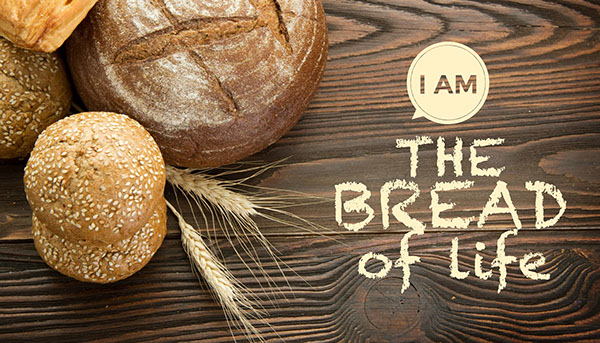
In the Gospel, Jesus tells us that what we should be looking for and working for is the bread that endures to eternal life. He tells us that this is the bread he offers us and that, in fact, he himself is this bread, the bread of life. Later in this chapter of St John’s Gospel, Jesus goes on to say that this bread is nothing other than his flesh given for the life of the world. He tells us that unless we eat his flesh and drink his blood, we will have no life in us but if we do eat his flesh and drink his blood we will be raised to eternal life. More than that, he tells us that, if we eat his flesh and drink his blood he will live in us, and we will live in him. And where is that that we eat the flesh of Jesus and drink his blood but in the sacrament of Holy Communion given to us at the Mass, at the Eucharist. So when we come here to this service we unite ourselves and our lives with Jesus in the deepest way possible to us in this life because we come here to receive the life of Jesus. This is why the Mass, the Eucharist, is so important to the Church and to us as Christians. Having said that, I think some people don’t give this service, or the sacrament we receive in it either the honour, nor the attention they should, and that it’s due.
Early on in this morning’s Gospel Jesus tells the people that they’re looking for him for the wrong reason. Only the day before he said these words, Jesus had fed 5,000 people with five loaves and two fish, and they’re looking for him now, not because they recognise who he really is, in fact they don’t even understand what he’s done because they’re still asking him for a sign that they should believe in him. No, they’re looking for him simply because he’d provided them with a good nosh-up. And I think we could say something similar of some people in the Church.
How many people come to the Mass, the Eucharist, and really don’t treat it with the honour and respect it deserves? How many people, throughout the service, chatter to the people sat next to them rather than paying attention to what’s happening and being said in the service? And how many of those people then complain that they didn’t hear something? And have you also noticed that the people who talk throughout the service are the same people who are the first to complain about other people talking during the service? And these days, how many people sit through the service with their mobile phones in their hands. I know some say they’re using their phones to follow the readings, or even the sermon, but how many are playing games on them or reading and sending messages or browsing the internet during the service? I’ve seen people get up and start watering the flowers during the service. I’ve seen people start putting books out and sort the hymn boards out for later services during the service. I’ve seen people reading papers and magazines during the service. I’ve even seen people get up, go to the back of church and make themselves a brew during the service. Is this any way to treat this most holy of services? Is this showing proper respect for the most holy sacrament of Holy Communion? I can only assume that the people who do these kinds of things are like those who followed Jesus because he’d filled their bellies, they’re more concerned with physical things than spiritual things. Too concerned with everyday trivia to look for things of eternal value. So concerned with what’s going on in this world that they can’t put those things aside even for an hour so that they direct their minds to the life of the world to come and concentrate on uniting themselves to Jesus.
At the Roman Catholic Shrine in Walsingham there’s a small tea room and a shop selling religious items. At 12 noon each day there’s a Mass and shortly before Mass is due to start, people are asked, politely, to leave the tea room and the shop so that they can close for Mass, which they do. The tea room and shop don’t reopen until the Mass has ended. The point being made is that, when Mass is being celebrated, that’s where people’s attention should be. Not on guzzling tea or coffee or filling their bellies with food, no matter how nice that food might be. And not on buying things in a shop either, even if those things are of a religious nature. Their minds should be on the Mass and on coming into the presence of the Lord and uniting themselves with him in the sacrament of Holy Communion.
And that’s just as it should be. For faithful Christians, the Mass, the Eucharist, should be something that warrants our full attention. This is where we meet the Lord in word and sacrament. This is where we receive forgiveness of sins. And this is where we receive the life giving, living bread that is Jesus himself. It’s where we unite our lives to his and he unites his life to ours. Whatever is going on around us can wait; it’ll still be there when the service is over, and we can turn our thoughts to those things then. Even if we have a Mass or Eucharistic intention, our full focus should still be on what is going on here, in church during the service. We can apply more worldly remedies to a problem when we leave church but while we’re here, our full attention should be on what’s taking place here, on the graces we’re receiving through what’s taking place here, and on praying that those graces will be applied to that problem.
So let’s not be like those who followed Jesus because they’d filled their bellies with bread but follow him because he is the living bread that will bring us eternal life. Let’s come here believing in his assurance that in receiving his body and blood, we unite our lives to his and he unites his life to ours. And let’s give this service, the Mass, the Eucharist, and the sacrament of Holy Communion we receive during the service the honour it deserves by giving it our full attention.
Amen.
Propers for the 18th Sunday of Ordinary Time (Trinity 10), 4th August 2024
Entrance Antiphon
God, come to my help.
Lord, quickly give me assistance.
You are the one who helps me and sets me free:
Lord, do not be long in coming.
The Collect
Let your merciful ears, O Lord,
be open to the prayers of your humble servants;
and that they may obtain their petitions
make them to ask such things as shall please you;
through Jesus Christ your Son our Lord,
who is alive and reigns with you,
in the unity of the Holy Spirit,
God, now and for ever.
Amen.
The Readings
Missal (St Mark’s)
Exodus 16:2-4, 12-15
Psalm 78:3-4, 23-25, 54
Ephesians 4:17, 20-24
John 6:24-35
RCL (St Gabriel’s)
Exodus 16:2-4, 9-15
Psalm 78:23-29
Ephesians 4:1-16
John 6:24-35
 Parish Church of St Mark Chadderton