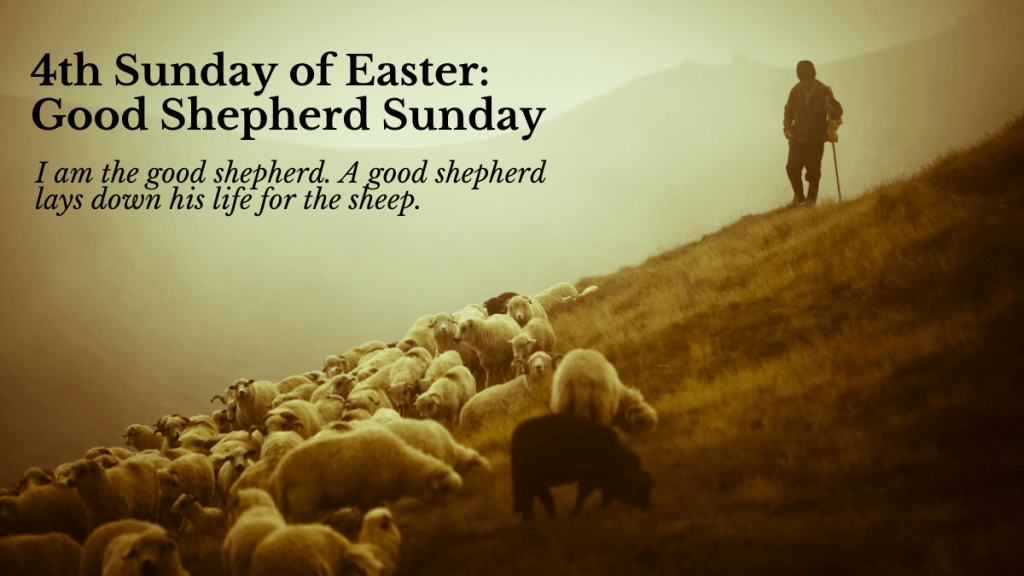
During the post Easter break which I took in the last week, I took the opportunity to visit some friends for a night out. These friends and I met through the Church a number of years ago when I was serving in their parish church. Sadly, some of my friends have stopped going to church for various reasons, but most of them still do and so, whenever we meet up, the Church always comes up in our conversations. We talk about things happening in the wider Church and they keep me up to date on what’s happening in their parish church, although these days, they don’t all go to the same parish church that we all used to. The conversation last week was no exception, but there was one story in particular that struck a chord with this morning’s Gospel reading and Jesus’ identification of himself as the ‘Good Shepherd’.
It seems that, a little while ago, one of my friends, in his role as Verger of the parish church, was approached by a member of the congregation because a couple of young lads had been seen in the church porch during a service. He was asked to go and see if he could find out what they wanted because people were worried that these lads might come into church! I think that, in a nutshell, sums up what’s wrong with the so many of our parish churches. People had noticed two young lads, whom they obviously didn’t recognise, outside the church during a service but, instead of going out and inviting them in, they sent someone out to speak to them to make sure that they didn’t come into church.
One of the things I’ve spoken about in the past is the very real and all too common problem in parishes, of people who treat the Church like a private club. People who think the Church, and the parish church in particular should only be open to people whom they think should be there. And typically that’s people whom they like, who like the things they like, want the things they want and so on. People whom they think are ‘good’ and ‘nice’ people. And they don’t want anyone who doesn’t fit their bill, or even whom they don’t like the look of in their parish church. I wonder how on earth people can read the Gospel and have an attitude like that. I wonder how people can call themselves Christians while they have attitudes like that. I wonder how people can square attitudes like that with the image of Jesus as the Good Shepherd.
Having said that, I do think that when people think of Jesus as the Good Shepherd, the idyllic image it conjures up for them is very likely to be an image very, very different to the reality of the image one Jesus intended people to have.
The image of Jesus the Good Shepherd is a very common one, in fact, it’s likely that whatever church you go into, you’ll find an image of Jesus the Good Shepherd somewhere in that church. And it’s usually an image of Jesus, in a typical English countryside, holding a lamb, either in his arms or carrying it on his shoulders. It’s a pastoral scene, an idealised image of gentle Jesus, meek and mild, caring for gentle, harmless and inoffensive creatures, and by implication, caring for people of that kind too. And as we in the Church are called to continue Jesus’ work until he returns in glory, we are called to do likewise. The problem is that if we only care for those who we find gentle, harmless and inoffensive, what about everyone else? What about those we find awkward, objectionable, and acerbic? All too often, these people aren’t cared for by those in the church who see themselves as ‘nice’ and ‘respectable’. In fact, people whom some in the church find difficult in some way are all too often not even wanted in the church. And it’s not just people’s personality that can cause them to be unwanted in a church. People can be unwanted, and made to feel unwanted, because of their social standing, how they speak, the way they dress, where they live. I have served in parishes where council tenants were not wanted and were made to feel unwelcome by self-important members of the congregation. As Christians we know this shouldn’t happen in the Church, but it does, and it happens far too often. How many times have we heard it said of someone, “We don’t want their sort here”?
How can anyone who calls themselves a Christian have attitudes like that? To be a Christian means to be a follower of Jesus Christ, it means to do in our lives what he did in his. But what did Jesus do? He called fishermen, tax collectors and Zealots to follow him. He ate with sinners, spoke to Samaritans, showed mercy to adulteresses, accepted the faith of prostitutes. And he did all this because, as the Good Sheherd, he came to seek out and save the lost, all those who’d gone astray in life and all those whom polite society shunned and regarded as unclean and beyond the pale. And, as we read in this morning’s Gospel, Jesus, the Good Shepherd, was prepared to lay down his life for these people. How then can we say that we’re Christians, disciples of Christ, if we’re not even prepared to let people we don’t like come into our churches?
I think perhaps some people in the Church need to be reminded of what we come to church for. We come to worship God and if we make people feel unwanted and unwelcome and drive them away, we’re preventing them from worshipping God. Isn’t this why Jesus threw the money changers and traders out of the temple? Not so much for what they were doing but that what they were doing in the temple precinct was preventing Gentile worshippers from using the precinct as a place to worship God. How then do we think Jesus will treat us if we, in our self-righteous pomposity turn people away from our churches?
In this morning’s Gospel, Jesus not only calls himself the Good Shepherd, but also says that he is the door of the sheepfold. Typically, the sheepfold was a dry-stone wall enclosure with an opening to allow the sheep to come and go. But there was no gate, the shepherd himself was the gate. He would have sat, or even slept in the opening to keep the sheep safe from wild animals and robbers, hence Jesus’ words,
“Truly, truly, I say to you, he who does not enter the sheepfold by the door but climbs in by another way, that man is a thief and a robber.”
And a good shepherd would have been expected to risk his life for the sheep. He was expected to protect them from thieves and wild animals and, if any of the sheep were lost, to search for them, find them and bring them back to the fold. Hence Jesus’ saying that the hired man doesn’t do these things because, as the sheep aren’t his, he doesn’t really care for them. The hired man cares more for himself and his own comfort and safety than for the comfort and safety of the sheep.
But when we apply this to ourselves in the Church, whilst we’re called to care for the sheep and to seek out and save the lost, we must always remember that Jesus is the door of the sheepfold, not us. So why is it that so many people in the Church act as though they are the door? And this is exactly what they are doing when they try to make their church a little club exclusively for people they want as members. As the poet William Blake expressed it in his poem, The Everlasting Gospel;
For what is Antichrist but those
Who against Sinners Heaven close
With Iron bars in Virtuous State
And Rhadamanthus at the Gate
Rhadamanthus, one of the judges of the dead in Greek mythology and the guardian of The Elysian Fields, the eternal home of the heroic and virtuous.
And this is exactly what those who want to keep anyone they don’t like or don’t agree with or find unpleasant or uncomfortable in any way out of the Church are doing. Setting themselves up as judge over other people. Usurping Jesus’ position as the door of the sheepfold so that they can refuse entry to any whose ‘sort’ they don’t want to join them. And this is Antichrist because it’s the very opposite of what Jesus came into the world to do and of what he did.
When we hear Jesus calling himself the Good Shepherd, and when we see an image of him as such, we might be tempted to see and think of a lovely pastoral scene and gentle Jesus meek and mild, but that’s not the image we’re meant to see. So when we hear and see this image, let’s try to imagine the reality of what being a good shepherd entailed. A good shepherd was someone who cared for the sheep. He was someone who would protect the sheep against any kind of danger, even if that meant risking or even laying down his life for the sheep. As someone who would go out to search for lost sheep and bring them back to the sheepfold. And let’s never forget that Jesus is also the door of the sheepfold; it’s his voice the sheep are called to listen to, and he is the one they’re called to follow. So, if we want people to listen to our voice, let’s make sure that our words are his words and that that, like him, we never refuse entry to the sheepfold to anyone who wants to hear his voice.
Amen.
Propers for the 4th Sunday of Easter, 21st April 2024
Entrance Antiphon
The earth is full of the goodness of the Lord;
by the word of the Lord the heavens were made,
alleluia!
The Collect
Almighty God,
whose Son Jesus Christ is the resurrection and the life:
raise us, who trust in him,
from the death of sin to the life of righteousness,
that we may seek those things which are above,
where he reigns with you in the unity of the Holy Spirit,
one God, now and for ever.
Amen.
The Readings
Missal (St Mark’s)
Acts 4:8-12
Psalm 118:1, 8-9, 21-23, 26, 28-29
1 John 3:1-2
John 10:11-18
RCL (St Gabriel’s)
Acts 4:5-12
Psalm 23
1 John 3:16-24
John 10:11-18
 Parish Church of St Mark Chadderton