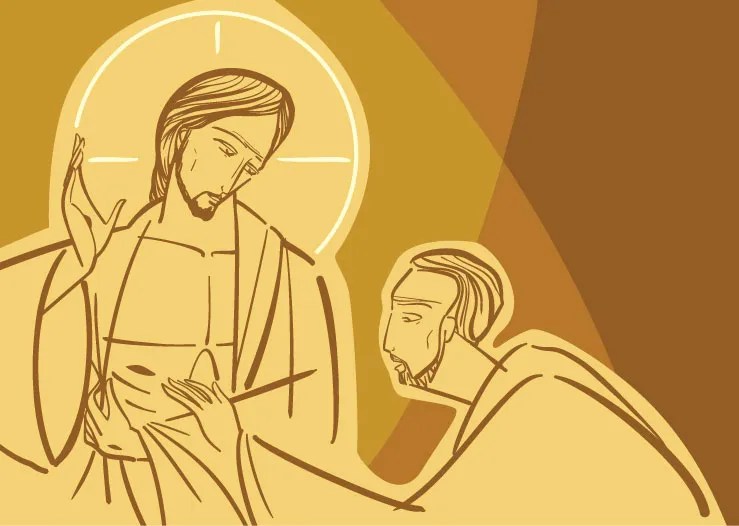
If ever there was a saint for today’s world, surely it must be St Thomas. Doubting Thomas, the man who wouldn’t believe until he’d seen it with his own eyes. Because I think today’s world is full of people just like Thomas, people who have no faith in anything they can’t see and verify for themselves. This is one of the reasons the Church is having such a hard time these days isn’t it, because we don’t deal in things that can be seen and touched, we don’t preach something that people can verify for themselves do we? We deal in faith and, as the Letter to the Hebrews says,
‘…faith is the assurance of things hoped for, the conviction of things not seen.’
So we have a hard time today in a world where there is so little faith, so little time for things that can’t be seen or touched and verified by individual experience. But is that really the case?
One of the things people say today is that they look at the world through science rather than religion because science is about facts than can be proven not about faith that can’t. But have you ever noticed how many people who espouse that view actually express it in terms of faith? They say something like ‘I don’t believe in God; I believe in science.’ But what is belief other than faith? Belief is the acceptance that something is true without proof positive that it is so. Belief is simply another word for faith. So saying ‘I believe in science’ is just as much a statement of faith as is saying ‘I believe in God’ or that we believe in any other tenet of the Christian faith.
And for the vast majority of people science is a matter of belief. If I were to ask people here today whether a baryon is made up of two or three quarks, how many people would know the answer? How many would even know what I was talking about? A baryon is a particle and science tells us that it’s made up of three of three quarks but how many people understand what that actually means or would have the slightest idea how to go about proving it for themselves? But they believe it’s so because scientists tell us it’s so. So, for the vast majority of people, when they say that they believe in science, what they’re really doing is expressing a faith, their faith in the tenets of science and in what scientists tell them.
And even when it comes to scientific ‘facts’, that everyone thinks they do understand, how many people actually do understand? If I were to ask what the Theory of Evolution says, I’d expect to get answers that have something to do with the survival of the fittest. But is that really what the Theory of Evolution says? What if I were to put to you that according to evolutionary theory it’s not necessarily the fittest that survive and that genetic drift may cause the fittest to die out and the less fit to survive? Would anyone know what I was talking about? Unless you’d studied biology or evolution for yourselves, probably not. And yet this is part of the evolutionary theory that people think that they understand so well. So, on the whole, when people say that they believe in science rather than in God or anything else that we might call religious faith, what they’re really doing is expressing a faith, their faith in science and scientists because, on the whole they don’t understand and can’t prove for themselves what it is they say that they believe in.
The point I’m making is that, in spite of what people may think and say, there is faith in today’s world. There’s just as much faith in the world today as there ever has been. The problem for the Church is that it’s not necessarily, and in our own part of the world increasingly less likely to be, Christian faith. So why should this be?
Quite frankly, in my opinion, it’s the Church’s own fault that this is the case and it’s the fault of the people, the individuals, who both lead and make up the Church. It’s our fault because we’ve allowed this to happen and, on the whole, we aren’t prepared to do anything, or at least anywhere near enough, about reversing the situation. To put that in a nutshell, it’s our fault because we don’t do anywhere near enough of the very thing Christ commissioned us to do; we don’t proclaim the Gospel as we should.
Why do so many people today say that they believe in science? I don’t think there’s any doubt that in large part that’s because scientists are always telling us that they have all the answers, and that faith is nothing more than the superstition of ill-educated and unthinking people. And they say it so often and so loudly that people believe them, no doubt in part because people don’t like to be thought of as ill-educated and unthinking. So they say that they agree with science and scientists even though, on the whole they don’t understand what scientists are saying, or the science they say they agree with. And people don’t even think that what they’re actually doing when they say that they believe in science is simply swapping one faith for another.
And what does the Church do in the face of this? All too often, rather than meeting the challenge with an equally robust defence of the faith, it looks for holes in what science says and slots its faith into them. It’s sometimes known as preaching a God of the gaps. In other words, the Church looks for gaps in scientific knowledge and says that’s where God is, in the bits that science can’t explain. And because this is what the Church does, it doesn’t equip its people to deal with this challenge when they come across it in the course of their lives. How many people here have avoided talking about their faith, or allowed their faith to be ridiculed by those who ‘believe in science’ because you didn’t really know how to respond to the challenge of what they were saying? But when we have leaders who seem more interested in politics than faith, in political correctness than truth and in not offending those of other faiths and none than in defending our own faith, whose fault is this, really?
And now to be very controversial, I constantly hear people complaining about the growth of Islam. People complaining that this is supposed to be Christian country and Muslims are taking it over. People asking what I think about such and such a place being made into a mosque? Ok. If you really want to know what I think. I think good luck to them. Why should we complain about the growth of Islam if we’re not prepared to do anything about the growth of the Church? Why should we complain about people of another faith taking over what’s supposed to be a Christian country if we’re not prepared to do anything to make it and keep it a Christian country? Why should we complain about places being turned into mosques if we can’t be bothered turning up to church in sufficient numbers to keep the churches we have open, let alone, in sufficient numbers to make building more churches necessary? As I said in my sermon last Sunday, people want and expect the Church to be here for them when they want and need the Church, but far too many can’t be bothered to lift a finger to make sure that the Church survives, let alone grows.
The growth of belief in science, and the growth of other faiths tell us that there is faith in today’s world, a great deal of faith, and if the Church isn’t benefitting from that we need to stop blaming others and look at ourselves and put our own house in order. I know at times we’re not helped by the Church leadership, but they don’t dictate what we do as individual Christians in our own lives. That’s up to us. So why do so many of us act as though we’re embarrassed by our faith or ashamed of our faith? And not just out in the world, but in church too. Sometimes, when I’m leading a service in church, I get the feeling that I’m either alone or the only one taking part in the liturgy because the responses that people make to prayers are so quiet that they’re inaudible. Sometimes I know that people aren’t responding at all because I can see them. Why? What do people think is going to happen to them if they speak? Do they think someone is going to make fun of them or criticise them if they open their mouths in prayer and praise? Why would anyone do that in church of all places? That’s what we’re here to do. We call what we do in church liturgy. Does anyone know what the word means? It comes from two Greek words that together mean public working. We call it liturgy because it’s supposed to be something that the people do in public, not what the priest does by themselves on behalf of the people.
There is faith in the world, but if we in the Church want to make sure that it becomes Christian faith then we in the Church need to need to start taking our faith more seriously, both in church and in the world. If we had 200 people coming to St Mark’s and St Gabriel’s every Sunday, we could perhaps afford to have some of them along for the ride. When we have a congregation of 30 – 40, if we’re lucky, on Sunday, we can’t afford that. And the Church can’t afford that either. We need to start speaking up for our faith and sharing our faith. We need to let people know that we believe our faith is something worth fighting for. If we want people to take us and our faith seriously, we need to show that we take our faith seriously. If we want people to make a commitment to our faith and the Church, we need to show our commitment to our faith and the Church. We can’t show them Christ’s hands and side for them to put their fingers and hands into to bring them to faith, but we can say of Jesus, ‘My Lord and my God’ and then show that we truly do believe that by what we do and say both in church and in the world.
Amen.
Propers for 2nd Sunday of Easter, 7th April 2024
Entrance Antiphon
Like new-born children you should thirst for milk,
on which your spirit can grow to strength,
alleluia!
The Collect
Almighty Father,
you have given your only Son to die for our sins and to rise again for our justification:
grant us so to put away the leaven of malice and wickedness,
that we may always serve you in pureness of living and truth;
through the merits of your Son Jesus Christ our Lord,
who is alive and reigns with you,
in the unity of the Holy Spirit,
one God, now and for ever.Amen.
The Readings
Missal (St Mark’s)
Acts 4:32-35
Psalm 118:2-4, 15-18, 22-24
1 John 5:1-6
John 20:19-31
RCL (St Gabriel’s)
Acts 4:32-35
Psalm 133
1 John 1:1-2:2
John 20:19-31
 Parish Church of St Mark Chadderton