In just a few days’ time now, we’ll celebrate Ash Wednesday and begin the season of Lent. I don’t know how many of you have decided to take on a Lenten discipline this year, but for those who haven’t or who haven’t yet made up their minds what their Lenten discipline will be, there are still a few days left to decide. But whatever that Lenten discipline might be, whether it’s giving something up or taking something on, I hope everyone does at least try to take on and stick to some kind of discipline for Lent because it’s important that we do.
Lent is a penitential season, in other words, it’s a time of the year when we think about ourselves and our lives to see how closely those things conform to Christ’s teaching and example. It’s a time when we’re called to show repentance for our sins, for the ways and the times when we haven’t and don’t live up to Christ’s teaching and example, and whatever our Lenten discipline is, we take it on both to express our sorrow and repentance for our failures to live as Christ said we should and to discipline ourselves so that we can be more closely conformed to Christ in the future.
It’s often said in the Church and by the Church that the aim of Lent is to prepare for the greatest of all Christian celebrations, the Resurrection of our Lord Jesus Christ at Easter. But whilst that’s true, the purpose of a Lenten discipline isn’t only that. We don’t, or at least we shouldn’t, take on a Lenten discipline for the six weeks of Lent and then, once we’ve celebrated Easter, simply drop the discipline and go back to the way we were before. The purpose of a Lenten discipline is to be more closely conformed to Christ in the future, but not just the short-term future, not just the six weeks that the season of Lent lasts. The purpose of a Lenten discipline is to enable us to be more disciplined in conforming our lives to Christ permanently and that’s implied in the words we use at the imposition of ashes at the start of Lent on Ash Wednesday;
‘Remember that you are dust and to dust you shall return.
Turn from sin and be faithful to Christ.’
Those words don’t urge us to be faithful to Christ just for a few weeks, they imply a continuous, unswerving loyalty to Christ throughout our lives because, as those words remind us, this life will end for all of us and what happens to us then will depend on just how faithful we have been to Christ.
We know from Christ’s own words that he didn’t come into the world to condemn anyone. On the contrary, he came into the world to save everyone. But he also told us that we do have some influence over whether we are saved or not:
“For God so loved the world, that he gave his only Son, that whoever believes in him should not perish but have eternal life. For God did not send his Son into the world to condemn the world, but in order that the world might be saved through him. Whoever believes in him is not condemned, but whoever does not believe is condemned already, because he has not believed in the name of the only Son of God. And this is the judgement: the light has come into the world, and people loved the darkness rather than the light because their works were evil.”
And we also know from Christ himself that belief is not just a matter of paying lip service to his teaching and example, but living our own lives according to his teaching and example:
“Not everyone who says to me, ‘Lord, Lord’, will enter the kingdom of heaven, but the one who does the will of my Father who is in heaven.”
God wants us to be saved and so does his Son, but we can’t leave it all in their hands. We have to join in with their plans; we have to make an effort and try to meet them part of the way and this is something we see in our Gospel readings this morning.
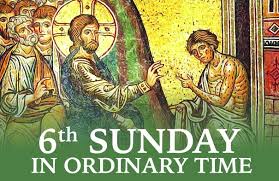
In the Gospel at St Mark’s, we read about a man with leprosy coming to Jesus and falling on his knees pleading to be cured. But when we read this story we have to remember that, in biblical times, leprosy wasn’t seen as simply a disease in the way that we see it today. In those days, illness, disability and misfortune were seen as punishment from God for sin, or perhaps as a way that God would test people’s faithfulness (this is what the Book of Job is about). So when this leper came to Jesus he came both in faith that Jesus could cure him, but also in humility as a sinner in need to forgiveness. And so he ‘came to Jesus and pleaded on his knees.’ We know, again from Christ himself that he came,
“…to proclaim good news to the poor … liberty to the captives and recovering of sight to the blind, to set at liberty those who are oppressed..”
so healing this man would certainly have fallen under thatremit. But it was the man who had to make the first move by coming to Jesus in faith. This is something we tend to find in the stories of Jesus’ miraculous healings: the one in need of healing had to come to Jesus in faith in order to be healed. And so if we want healing and forgiveness from Jesus, we have to come to him too. As we’re reminded each Ash Wednesday, we have to turn to Christ.
But having come to Christ, we then have to go with him where he leads, and this is something we see in the Gospel reading at St Gabriel’s this morning in the story of Jesus’ Transfiguration.
I’m sure we all know the story. Jesus takes Peter, James and John with him ‘up a high mountain’ where they see him transfigured and speaking with Moses and Elijah. Those disciples were privileged with a glimpse of Jesus’ true appearance and nature, dazzlingly bright, the fulfilment of the law and the prophets and as the very Son of God. There’s no doubt that this is what Jesus intended the disciples to see because he took them with him to the mountain. But in order to see it they had to go with Jesus. We’re told that the mountain they had to climb with him and to see this wonderful thing was a high one. And these things apply to us too.
There’s no doubt that Christ wants us too, to see what Peter, James and John saw on the mountain. He wants us to see him in glory, to see him as he really is, he must do because he wants us to be saved. But to do that we have to go with him up the mountain, no matter how high that mountain might seem to be or might actually be. And if we take on a Lenten discipline that we know is going to challenge us, one we know we’re going to find hard to stick to, the journey through Lent can seem like climbing a very high mountain. But if we can turn to Christ, come to Christ, and go with him up that mountain during Lent, we’ll be rewarded in so many ways. We’ll be rewarded with a sense of achievement that we have manged to keep to our Lenten discipline and come closer to Christ. We’ll be rewarded with a greater sense of celebration at our Lord’s Resurrection on Easter Day, knowing the hardships we’ve gone through to get there. And we’ll be rewarded with a sense of joy too through a deeper assurance that we will be saved and will see Christ in glory by sharing in his Resurrection.
But all that will count for nothing, if after we’ve climbed the mountain during Lent, we allow ourselves to fall back down it again after Easter. So our Lenten discipline isn’t just about being good, or being a bit better for a few weeks, it’s about being more closely conformed to Christ permanently. It’s not just about toughing it out for a few weeks until Easter so that we can go back to normal once we’ve celebrated the Resurrection of our Lord Jesus Christ, it’s about toughing it out until doing what we found tough during Lent becomes what’s normal for us. It’s about helping us to make that continuous turn away from sin and towards faithfulness to Christ so that we can celebrate Easter in the best way of all – by being more certain that Christ’s Resurrection is something that we will share in when we return to the dust at the end of our earthly lives.
Amen.
Propers for the 6th Sunday in Ordinary Time (Next before Lent) 11th February 2024
Entrance Antiphon
Lord, be my rock of safety, the stronghold that saves me.
For the honour of your name, lead me and guide me.
The Collect
Almighty Father,
whose Son was revealed in majesty before he suffered death upon the cross:
give us grace to perceive his glory,
that we may be strengthened to suffer with him,
and be changed into his likeness, from glory to glory;
who is alive and reigns with you
in the unity of the Holy Spirit,
one God, now and for ever.
Amen.
The Readings
Missal (St Mark’s)
Leviticus 13:1-2, 45-46
Psalm 32:1-2, 5, 11
1 Corinthians 10:31-11:1
Mark 1:40-45
RCL (St Gabriel’s)
2 Kings 2:1-12
Psalm 50:1-6
2 Corinthians 4:3-6
Mark 9:2-9
 Parish Church of St Mark Chadderton