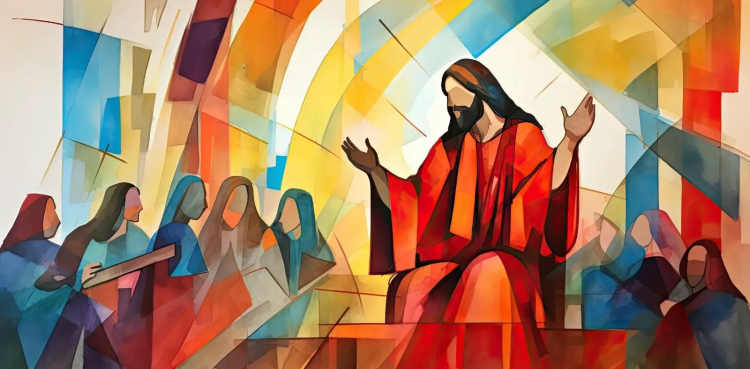
In our Gospel reading this morning we hear about Jesus teaching and healing in the early days of his earthly ministry. At the end of the reading we’re told that his reputation and fame spread rapidly throughout Galilee, and we’re left in no doubt that this was due in part to the fact that, unlike other people, Jesus taught and acted ‘with authority’.
I don’t think there can be any doubt that, if you’re going to ask people to follow you and do what you tell them to do, as Jesus did, you do have to have some kind of authority. You have to know what you’re talking about; you have to know what you’re doing, and you have to show that you know these things. And we, as Christians, are people who’ve decided that Jesus did have this kind of authority and so we’re willing to follow him and do what he says.
But for many people today, the idea of submitting to authority is repugnant because many people today think that the ultimate, and preferably only authority in their lives is, or at least should be, themselves. Many people today seem to believe that they have, or should have, the right to do exactly what they want to do. They believe that no one has the right to tell them what to do nor has the right to tell them what they can’t do. And many people try to live according to these kinds of beliefs. I’ve come across this kind of attitude in schools, especially high schools, I’ve come across it in the workplace, and I’ve spoken to people, especially in the Police Force and Prison Service who’ve come across it in their work too.
As this is a problem that people in different lines of work come across, it’s clearly a widespread problem in our society, and as it’s a widespread problem in our society, it’s a very big problem for the Church. As I’ve already said, to be a Christian involves submitting to the authority of Christ. It means doing what he said we should and not doing what he said we shouldn’t. But, if people have an aversion to authority, they’re almost certainly going to have a problem with Christianity because the central practice of the faith is living under the authority of Christ. And we see this too in the number of people who say that they’re Christians but don’t live as Christ commanded. How many people have we all met who’ve said that they don’t go to church, but they are Christians because they’re ‘good people’ who live ‘good lives’? But what do those people actually mean by that? By what standard and by who’s standard are they good? When you ask people who say these things what they mean by ‘good’, you tend to find that their ideas about what’s good and bad are very subjective because the standard they use to determine good and bad is usually their own. This doesn’t mean that they’re bad people, but it doesn’t make them Christians because the only standard a Christian uses to determine good and bad is the standard that Christ used and taught.
But if issues with authority are a problem in our society and for individuals who make up our society, I don’t think we’re alone in having this problem, because, I think, authority is very much at the heart of the trouble we see in the world today.
I don’t think anyone can help but be deeply concerned with the state of the world at this present time. There’s great unrest in the world, war and conflict in so many parts of the world, and the threat of even more war and conflict as more and more nations become involved and take sides in the fighting and the turmoil. But if we try to look at what’s happening in the world at the moment in an objective way, if we put aside our own feelings about nations and our historical disputes with them, I don’t think we have to look too far beneath the surface of the trouble in the world to see that issues of authority are very much at the heart of the world’s present troubles. Who has authority, the abuse of authority; who wants authority and who should have authority.
As we look at the world, don’t we see powerful nations exerting authority over weaker nations, and often in a very abusive and violent way? And consequently we see weaker nations trying to break free of the hegemony, the influence and authority of those powerful nations so that they can have authority over their own lives. And, because they are weak, they look to find allies in their struggle to exert their own authority. Of course, those who have hegemony want to keep it and so they take steps to preserve their authority and influence over others. And so we end up with nations at each other’s throats issuing threats and counter threats and the world becomes an ever more violent and volatile place in which even the authority of law is breaking down as nations look to criminalise those they’re hostile towards, whilst at the same time absolving or even supporting friendly nations who commit similar atrocities against their neighbours. Any objective sense of what’s right and wrong, good and bad goes out of the window and the difference between these things becomes entirely subjective and based on nothing more than ‘national interests.’ Which in itself is a euphemism for a nation’s authority over its own affairs and/or the affairs of other nations.
To be honest, there’s probably not much we, as individuals, can do to influence what’s going on in the world today, in any meaningful way. But we can perhaps try to understand what’s going on a little better by looking at the world’s troubles in an objective way and for us, as Christians, that means looking at these things through the lens of Christ’s teaching. And, as Christians, that’s what we should be doing. If we look at the world’s problems through the lenses of past and present disputes or national interest we’ll just become subjective in our opinions about the rights and wrongs of the world’s problems and then we can be swept away with the prevailing mood of our society and time which will inevitably mean being swept away from the teaching of Christ.
Let me put it this way. If someone took something of ours without our permission and with no intention of returning it, we’d call that person a thief, and quite rightly so because that’s what they’d be. But if a good friend of ours or a member of our family took something of someone else’s without their permission and with no intention of returning it, they would also be a thief. Just because what was taken wasn’t ours and the person who took it was someone we knew and liked or even loved, that would not make them any less of a thief, and it wouldn’t make what they’d done any less wrong. As Christians, as people called to live under the authority of Christ, to live according to his teaching and example, and called to encourage others to do the same by proclaim the Gospel, we’d be obliged to point out to our friend or family member that what they’d done was wrong and encourage them to make amends to whomever they’d stolen from. That would be the objective, Christian thing to do. But if on the other hand we made excuses for what they’d done, or tried to hide what they’d done, we’d be complicit in their wrongdoing. We’d be just as guilty as they were. And that would be the subjective, un-Christian thing to do. As we look at what’s going on in the world around us today, what do you think we’re seeing? I think we’re far, far more likely to see subjective responses to the world’s problem than objective responses, let alone Christian responses.
As Christians, we’re called to be in the world but not of the world, and that’s simply another way of saying that we’re called to live under the authority of Christ and to live and judge according to his standards rather than the world’s standards or our own standards. Some of the problems we can faced with in life are very complicated and it’s not always easy to see the good and the bad, the rights and wrongs of a situation so that we can decide what to do about the problem. That’s certainly true of the problems we see around us in the world today. But as long as we try look at problems through the lens of Christ’s teaching, we do, at least, have an objective way of trying to decide what is right and wrong and to choose what the right and wrong way to respond is. The alternative is to use the subjective ways that the world looks at problems and tries to solve them, and we only have to look at the world around us to see how much worse, rather than better, that can make a problem.
Many people today are fearful about the future, they’re worried, and frightened, about what’s going on in the world and the potential for even worse to follow, and that’s quite understandable. Those feelings are perhaps made worse by the knowledge that there probably isn’t very much, if anything, we as individuals can do to influence and change for better what’s going on in the world. But no matter what is happening and may happen, we must stay true to our calling as Christians and live under the authority of Christ and his teaching. If we can do that then, whatever happens, we will have made the right choice and be on the right side.
No matter how great it seems to be in its day, all earthly power and authority and influence comes to an end, eventually, but Christ’s authority never will. As he said,
“All authority in heaven and on earth has been given to me. Therefore go and make disciples of all nations, baptizing them in the name of the Father and the Son and the Holy Spirit,teaching them to obey everything I have commanded you. And remember, I am with you always, to the end of the age.”
So let’s remember and submit to his authority now because, whatever happens in the world, in the end, his will be the only authority left.
Amen.
Propers for the 4th Sunday of Ordinary Time (Epiphany 4) 28th January 2024
Entrance Antiphon
Save us Lord, and gather us together from the nations,
that we may proclaim your holy name and glory in your praise.
The Collect
God our creator,
who in the beginning commanded the light to shine out of darkness:
we pray that the light of the glorious gospel of Christ,
may dispel the darkness of ignorance and unbelief,
shine into the hearts of all your people,
and reveal the knowledge of your glory in the face of Jesus Christ your Son our Lord,
who is alive and reigns with you,
in the unity of the Holy Spirit,
one God, now and for ever.
Amen.
The Readings
Missal (St Mark’s)
Deuteronomy 18:15-20
Psalm 95:1-2, 6-9
1 Corinthians 7:32-35
Mark 1:21-28
RCL (St Gabriel’s)
Deuteronomy 18:15-20
Psalm 111
Revelation 12:1-5
Mark 1:21-28
 Parish Church of St Mark Chadderton