I’m sure that we must all know from personal experience how difficult it can be to learn something new, and that the more difficult the thing we’re trying to learn is, the longer it takes to learn, the more difficult it is to become truly proficient in that activity and the harder we have to work to become proficient at it. And if we want to be good at this thing we’re learning we know that we have to learn from someone who’s already mastered that particular activity. We can be self-taught, of course, but that usually takes longer and there’s always a danger that we don’t pick up on small errors in what we’re doing and then those faults become ingrained in us, and they stop us from becoming as good at something as we could be.
For example, I’m sure some of us here will have learned or at least tried to learn to play a musical instrument at one time. So we’ll know that when we do that, we start with simple things; we learn where the notes are on the instrument, and we usually learn how to read music so that we know what note to play when we see it on the music score. And once we’ve done that, we start to play tunes, simple tunes at first and then, as our ability improves, more difficult tunes until, if we work hard enough and for long enough, we can become good enough to play really difficult pieces, perhaps even good enough to play anything, no matter how difficult it might be.
And whatever we learn to do, we usually follow that pattern, we start simply, learn the basics and then practice, practice, practice, usually under the guidance of a teacher or coach, so that we can become better and better at what we’re doing. And if we want to become better, we have to constantly push ourselves and test our ability. If we’re learning a musical instrument, for example, we do that by playing progressively harder and harder pieces of music. If we’re learning a game or a sport, we do it by competing against people who are better than we are at that game or sport, we test ourselves and our ability against harder opposition. And no matter how good we become at something, nevertheless we still have to work hard at what we’re doing. If we want to keep our performance up to the high level we’ve reached, we still have to practice, practice, practice; we have to play the instrument or the game regularly if we don’t want our ability to perform slip back.
For example, I remember once watching a TV programme in which a concert pianist was speaking about his need to practice regularly when he wasn’t performing, even though he was such an outstanding pianist. He said,
“If I don’t play for a day, I notice. If I don’t play for two or three days, my family and friends notice. If I don’t play for a week, everybody notices.”
Something else we all need too when we’re serious about some activity is a teacher or coach. And that’s true regardless of how good we are at something. We need that in the early days, to teach us what to do and how to do it but, as we progress, we still need that guiding hand to fine tune our skills and to stop any bad habits we might be developing from becoming ingrained in us. Even people who are experts at what they’re doing still have coaches, not so much to teach them new skills or improve the skills they already have, but to pick up on and point out those little errors that, if they’re not picked up on and put right, can become bad habits, things that stop us performing to the best of our ability time and time again.
Something else that’s very often important to us when we’re learning something new is a role model, someone who’s already very good at this thing, and whom we want to emulate. We very often hear, do we not, people who’ve become very good at something saying that they were first inspired to take up the things they’ve become successful at by hearing or seeing someone perform and wanting to be able to do that themselves.
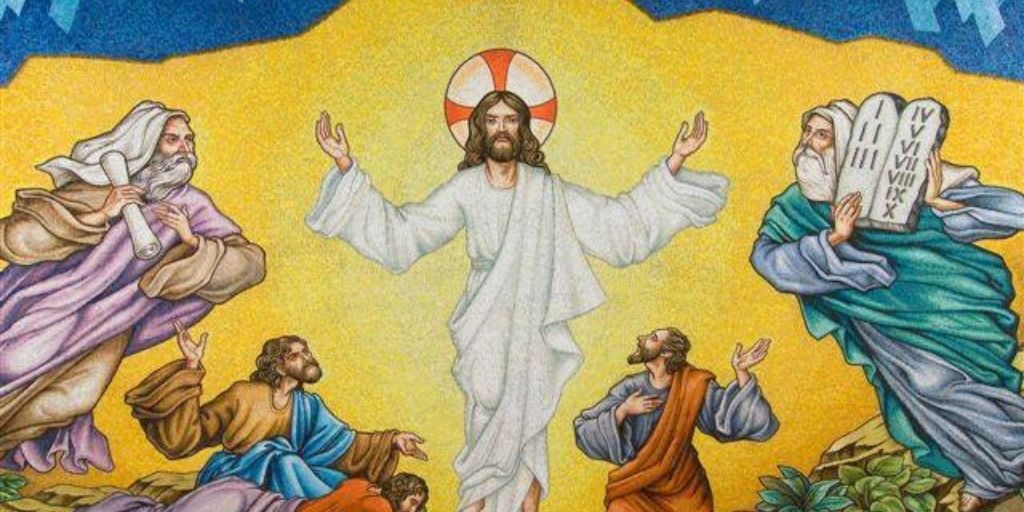
So when we want to learn some new activity or skill, all these things play a part, especially if we’re serious about wanting to learn and become good at what we’re doing. And the same thing applies when it comes to the practice of being a Christian (and being a Christian is a practice, it’s not simply something we think about and believe, it’s something we have to actually do). And we can see all these things I’ve spoken about in the Transfiguration of the Lord.
In the Transfiguration, we see what we want to be. We see Jesus in glory and ultimately, that’s our goal, to be so good at being a Christian that, when we come to the end of our earthly lives, we enter into glory with Jesus. So Jesus is our role model. He’s the one we want to emulate. We hear his words, we see what he did, and we want to be just like him, well I hope we do anyway. But we know that we’re not at his level. So we have to start simply and then work our way towards being more like him. As St Paul puts it in his Second Letter to the Corinthians,
‘And we all, with unveiled face, beholding the glory of the Lord, are being transformed into the same image from one degree of glory to another. For this comes from the Lord who is the Spirit’
But if want to do that, we have to practice, practice, practice. We can’t really afford to take time off from trying to be like Jesus because then we’ll just slip back and have to start again from farther back on the road to glory.
We know what we need to do if we want to be like Jesus, both now in our earthly lives and then, after, like him in glory. We know because we’re told what to do in the story of Jesus’ Transfiguration. We have to listen to Jesus. In other words, we have to listen to what Jesus said, and then we have to put his words into practice. As I said earlier, being a Christian is something we do, so listening to Jesus and agreeing with what he said but leaving it at that isn’t enough; that simply will not get us anywhere along the road to glory. But, for want of a better phrase, Jesus is the best there is and so we can’t simply go from where we are to his level of performance in one step. That would be like having a few piano lessons and then picking up a copy of one of Beethoven’s sonata and trying to play that. So we have to take it step by step and that’s where the Apostles come in.
As we know, Jesus spent three years teaching his disciples how to progress along the road to glory, and he chose some of them to take those lessons out into the world to teach other people how to progress along that road too. We hear about that in this morning’s reading from the Second Letter of Peter. So the Apostles were the first coaches, if you like, they were the first to teach people how to listen to Jesus and so, as well as listening to Jesus, we should listen to them too.
Of course the Apostles are no longer with us, they joined Jesus in glory long ago, but not before they appointed teaches to carry on that work that Jesus had entrusted to them. And that’s a process that’s gone on throughout the history of the Church. We still have teachers today. Ideally, the master teachers are the bishops, that’s one of their primary roles in the Church, but there are other teachers too. Priests are called to teach the faith. We have Spiritual Directors to fine tune our skill at the practice of Christianity. Some people might think the Spiritual Directors are simply there to hear confessions but whilst they do that, just as importantly, they’re there to offer spiritual counsel and advice, to point out little faults in the way we’re practicing our faith so that we can put these things right before they become bad habits that we can’t shake off. And we can have role models in addition to Jesus too; saints whose lives and example have inspired us in some way, or even other Christians whom we can look up to because they’ve progressed further along the road to glory than we have. We have all these people to help us to listen to Jesus more attentively so that we can progress in the practice of our faith; so that we can improve as Christians and take that next step towards Jesus on the road to glory.
But we have to use these people. We have to be willing to let them help us, and that seems to be something that so many people seem to be reluctant to do. Many people today won’t listen to bishops because they think the bishops are far too concerned with politics and financial matters. But that shouldn’t detract from what they say about the practice of the Christian faith. Many people only listen to priests up to a point, and that point is reached when the priest says something they either don’t understand or don’t agree with. As I said in my sermon a couple of weeks ago, whenever a priest says something that someone doesn’t agree with, it’s always the priest that’s got it wrong. I know very few people in the Church who have a Spiritual Director. How many of us have one? I’ve also mentioned, recently, the practice of people moving from church to church and denomination to denomination. There may be good reasons for that at times, but how often does that happen because people aren’t really looking to progress in the practice of their faith but simply looking for somewhere or someone who’ll confirm them in their own belief that they’re already well on the way to glory and don’t really need to change or do anything more or differently? How many are looking for affirmation rather than the truth that will help them be better Christians?
We all know what we need to do to be like Jesus both in this life and to join him in glory when this life comes to an end – we have to listen to Jesus and put his words into practice. We all want to emulate Jesus, but we know that we’re only ever going to be able to do that fleetingly at best. We know we’re never going to be as good as Jesus. So no matter how long we’ve been coming to church, no matter how long we’ve considered ourselves to be Christians, we’re all still learning, and we always will be. So let’s keep our eyes on Jesus because he is our role model, but let’s also make use of the tools we have available to us to help us to be better Christians. The teachers of the faith, the bishops and priests of the Church. Spiritual Directors, those coaches who can help us fine tune the practice of our faith. And those lesser but still important role models, the saints and our fellow Christians whose ability to put Jesus words into practice can so often be better than ours. Let’s make use of all these things and above all, listen to Jesus and then practice, practice, practice.
Amen.
Propers for the Transfiguration of the Lord 6th August 2023
Entrance Antiphon
In the shining cloud the Spirit is seen; from it the voice of the Father is heard:
This is my Son, my beloved, in whom is my delight. Listen to him.
The Collect
Father in heaven,
whose Son Jesus Christ was wonderfully transfigured before chosen witnesses upon the holy mountain,
and spoke of the exodus he would accomplish at Jerusalem:
give us strength so to hear his voice and bear our cross,
that in the world to come we may see him as he is;
who is alive and reigns with you,
in the unity of the Holy Spirit,
one God, now and for ever.
Amen.
The Readings
Missal (St Mark’s)
Daniel 7:9-10, 13-14
Psalm 97:1-2, 5-6, 9
2 Peter 1:16-19
Matthew 17:1-9
RCL (St Gabriel’s)
Daniel 7:9-10, 13-14
Psalm 97
2 Peter 1:16-19
Luke 9:28-36
 Parish Church of St Mark Chadderton