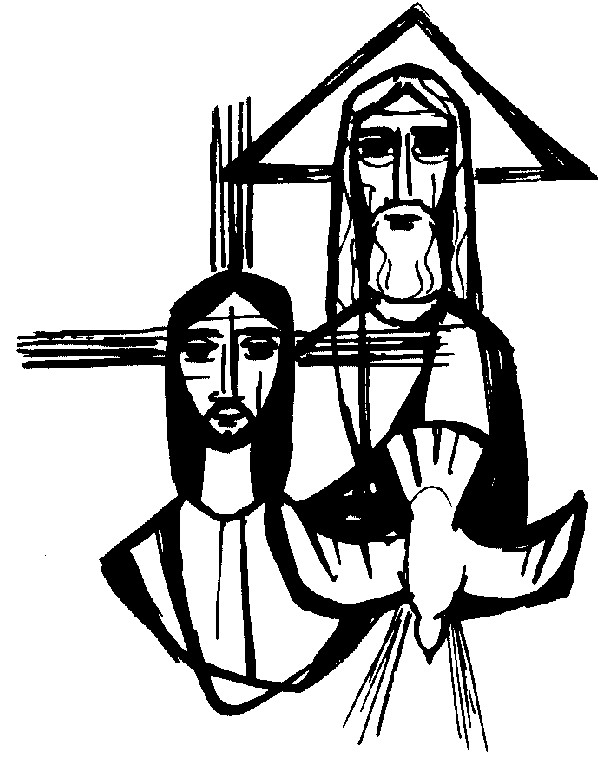
One of my favourite stories about Trinity Sunday, which we celebrate today, concerns a sermon, of sorts, that a priest once preached on this day many years ago. It seems, he climbed into the pulpit, crossed himself and began;
“The Trinity is a great mystery of the Christian faith – and I think we should leave it at that. In the name of the Father, and of the Son, and of the Holy Spirit.”
And promptly left the pulpit, sermon finished!
I don’t know whether that story’s true or apocryphal, but I do like it. I like it because I think it’s quite funny, and I like it because it does contain some truth. The Trinity, the uniquely Christian understanding that God is one and yet is, at one and the same time, three distinct persons, whom we call the Father, the Son and the Holy Spirit, is a great mystery. It’s an understanding of God that is very difficult to explain because how can something be three different things and yet, at the same time, be only one thing? We can express what we mean by the Trinity, and we do every Sunday when we say the Nicene Creed, but we can’t fully comprehend what such a God is like within God’s own self, we can’t understand the true nature of such a God, so how can we possibly explain it? So the Trinity is a mystery, something that’s difficult, if not impossible to fully understand or explain.
And it did take the Church a long time to come up with the understanding of the Trinity that we do have. We now regard the doctrine of the Trinity as one of the central and defining beliefs of our faith, but we don’t find the Trinity mentioned explicitly in Scripture. In fact, we don’t find it mentioned in any Christian writings until the end of the 2nd Century, and it wasn’t formally defined until the 4th Century, first in the Nicene Creed, that was agreed at the Council of Nicaea in 325 AD, and finally at the Council of Constantinople in 381 AD. So it took the Church almost 200 years to first speak of God as a Trinity, and another 200 years to finally agree on what they meant by that.
But having said that God isn’t spoken of as a Trinity in Scripture, the early Church did use Scripture as the basis for understanding God as Trinity because they saw many passages of Scripture as hinting at this understanding of God. For example, we see the Trinity hinted at right at the beginning of the Scriptures in the image of God before and during the act of creation.
‘The earth was without form and void, and darkness was over the face of the deep. And the Spirit of God was hovering over the face of the waters. And God said, “Let there be light”, and there was light.’
So we see God, the creating Father, the Hoy Spirit of God and God’s Word, the Word that, in his Gospel, St John later identified as Jesus, the Word made flesh, the Son of God. The early Church also saw the Trinity hinted at in the visit of the three men to Abraham which we read about in Genesis 18;
‘And the Lord appeared to him by the oaks of Mamre, as he sat at the door of his tent in the heat of the day. He lifted up his eyes and looked, and behold, three men were standing in front of him.’
In the New Testament, they saw the Trinity hinted at in the language concerning the Father, the Son and the Holy Spirit, and most especially they saw it in the baptismal formula in the Great Commission Jesus gave to the Church;
“Go therefore and make disciples of all nations, baptizing them in the name of the Father and of the Son and of the Holy Spirit…”
We can see a hint of it in the story of Jesus’ own baptism where we hear the voice of the Father speaking about his Son, Jesus, and sending the Spirit to rest on him in the form of a dove;
‘And when Jesus was baptized, immediately he went up from the water, and behold, the heavens were opened to him, and he saw the Spirit of God descending like a dove and coming to rest on him; and behold, a voice from heaven said, “This is my beloved Son, with whom I am well pleased.”’
And we also find overtones of a Trinitarian understanding of God in one of the most well-known of all Christian prayers, The Grace, which comes from the end of St Paul’s Second Letter to the Corinthians, and which we heard this morning:
‘The grace of the Lord Jesus Christ and the love of God and the fellowship of the Holy Spirit be with you all.’
So the uniquely Christian understanding of God as Trinity is based on Scripture even if this understanding of God is never explicitly stated in Scripture. It comes from contemplation on Scripture but while that can help us to express in words what we mean by the Trinity, it perhaps isn’t so helpful in helping us to understand the nature of God as Trinity.
To understand what God as Trinity is really like, what God, as God in God’s own being, is and is like, we’d have to be able to share some experience of being like that ourselves and that‘s something we can’t do, because we’re not Trinitarian beings ourselves. But nevertheless, I think we can experience something of the nature of the Trinitarian God, if only in a small way, by thinking about that prayer we know as The Grace, and trying to live out what we pray for in The Grace.
The first thing we ask for in the prayer is the grace of our Lord Jesus Christ. We know that grace, in this sense, is the assistance that God gives us to help us on our way to salvation. Grace, if you like, is the gift, or gifts, that God gives us so that we can live as Christians in the world; it’s what we need to follow Christ’s example and teaching properly, in other words. We can all have this grace, but we pray specifically for the grace of our Lord Jesus Christ, and so what we’re praying for here is the ability to use God’s grace in the way that Jesus himself did. We’re praying that we can use the grace that God gives us to take up our cross each and every day and follow Jesus along the way he followed and in the life that he led. And if we can use God’s grace in that way, we’ll be a little closer to being one with God and with Jesus, a little closer to fulfilling Jesus’ High Priestly prayer that his disciples,
“…may all be one, just as you, Father, are in me, and I in you, that they also may be in us…”
We also pray in The Grace, for the love of God. We know that the love of God is a love that encompasses all things, not only all of us, not only those who have faith and try to do his will, but all people whoever they are, whatever they are, and wherever they are. And God’s love doesn’t only embrace all people; his love embraces the whole of creation. And this is the love that we’re asking for in The Grace. We’re asking to be able to love our neighbour as ourselves, whoever, whatever and wherever those neighbours may be, to love them whether they love us or not, whether they’re good or bad towards us. And we’re asking to be able to love God’s creation too, all of it and everything in it and to treat it and everything in it accordingly. And if we can have this love and show it then we know that we’ll be experiencing something of the nature of God because, as St John tells us,
‘God is love, and whoever abides in love abides in God, and God abides in him.’
Finally in The Grace, we pray for the fellowship of the Holy Spirit.
On a number of occasions, St Paul speaks about the Spirit in terms of love. In his Letter to the Romans, for example, he says,
‘God’s love has been poured into our hearts through the Holy Spirit who has been given to us.’
And in his Letter to the Colossians he urges Christians, above all things, above all other virtues, to,
‘…put on love, which binds everything together in perfect harmony.’
When we think about the Spirit in this way, it’s not surprising that the Holy Spirit has been called the ‘bond of love’ that binds together the Father and the Son. We find this understanding of the Spirit in the writings of St Augustine. This, for example, from On the Trinity;
‘The Holy Spirit also, whether we are to call Him that absolute love which joins together Father and Son, and joins us also from beneath, that so that is not unfitly said which is written, “God is love;”’
We might say then that the Holy Spirit is what binds the Trinity together in perfect communion. So when we pray for the fellowship of the Holy Spirit, we’re praying that we might be enabled to share in the love that’s shared between the Father and the Son, in and through the Holy Spirit. In other words, the fellowship of the Holy Spirit, just like the grace of our Lord Jesus Christ, and the love of the God the Father, enables us to share in the life of God. Of course, we can’t fully know, or understand what it means to live as God lives because we’re not Trinitarian by nature, so we can’t experience that existence fully, at least in this life. But we can perhaps catch just a glimpse of that life, in this life, through the grace of our Lord Jesus Christ, the love of God and the fellowship of the Holy Spirit.
When we pray The Grace, what we’re praying for, is that we might be able to share in the life of God as God is in God’s own being; we’re praying that we can share in the life of God as a Trinity of Father, Son and Holy Spirit. We might only be able to enjoy a hint of that life, in this life, but we can have that much of it. And we can have it for one very simple reason, because we can love. And it’s only a lack of love, and can only be a lack of love, that holds us back from it.
Amen.
Propers for Trinity Sunday 4th June 2023
Entrance Antiphon
Blessed be God the Father and his only begotten Son and the Holy Spirit,
for he has shown that he loves us.
The Collect
Almighty and everlasting God,
you have given us your servants grace,
by the confession of a true faith,
to acknowledge the glory of the eternal Trinity,
and in the power of the divine majesty to worship the Unity:
keep us steadfast in this faith,
that we may evermore be defended from all adversities;
through Jesus Christ your Son our Lord,
who is alive and reigns with you,
in the unity of the Holy Spirit,
one God, now and for ever.
Amen.
The Readings
Missal (St Mark’s)
Exodus 34:4-6, 8-9
Psalm – Daniel 3:52-56
2 Corinthians 13:11-13
John 3:16-18
RCL (St Gabriel’s)
Isaiah 40:12-17, 27-31
Psalm 8
2 Corinthians 13:11-13
Matthew 28:16-20
 Parish Church of St Mark Chadderton