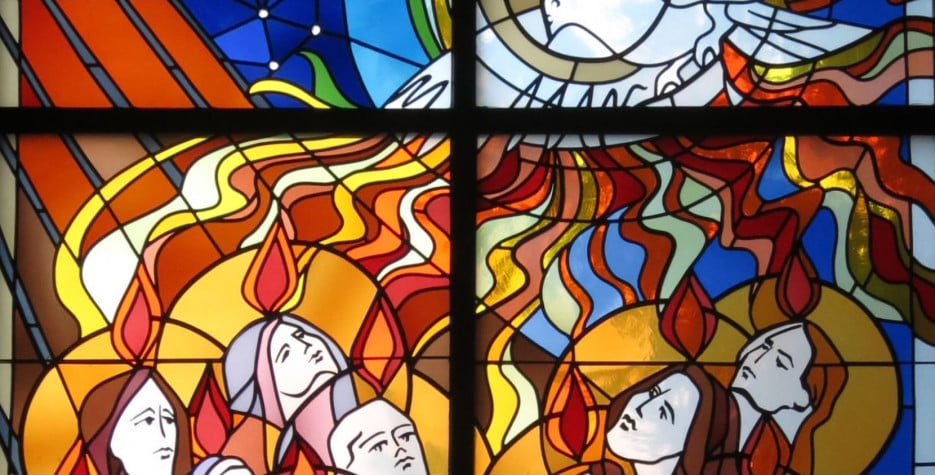
When I first started thinking about my sermon for this morning, I did think of perhaps starting by asking you to sing ‘Happy Birthday’ because today, the day of Pentecost, is, as I’m sure many of you will know, the day that many people regard as the Church’s birthday. We regard Pentecost as the Church’s birthday because the Day of Pentecost, was the day when the promised Holy Spirit was poured out on the disciples so that they could begin to carry out the Great Commission that Christ had given them to proclaim the Gospel to all nations. We hear about that in our first reading this morning as we read about the disciples speaking to people from many different nations, each in in their own language “about the marvels of God.”
The pouring out of the Spirit was something that God had promised through the prophets. As we read on a little further in Acts, we find Peter quoting the prophet Joel and saying,
“And in the last days it shall come to pass, God declares, that I will pour out my Spirit on all flesh…”
It was a promise reiterated by Jesus, and a promise fulfilled on the day of Pentecost. And if we think of the pouring out of the Spirit as a promised gift, given on the day the Church came into being, then, if you’ll forgive what might be seen as a certain irreverence, I think we can see the Spirit as the Church’s birthday present.
This present, this gift, is a very great gift indeed. It’s a gift given by God that enables us to share in the life of God. It’s a gift that reminds us of all that Jesus taught. It’s a gift that leads us into all truth and wisdom. It’s a gift that enables us to not only have the Church but to build up the Church in obedience to the Great Commission Christ gave us. It’s a gift that enables us to be the holy people we’re called to be and to live the lives that Christ called us to live. But do we actually use this great gift in these ways?
I think at times, and at many times, we treat this gift in the way that children treat the presents they receive at birthdays, or Christmas. They know the big day is coming because they’ve been told it is. They know they’re going to receive presents because they’ve been promised them. And, when the big day comes, they rush, full of anticipation and excitement to open their presents. They tear open the wrapping paper and boxes to see what they’ve been given. They look, wide eyed and perhaps even open mouthed in joy and amazement at the wonderful, and these days, often very expensive gifts they’ve received. And then they put them to one side and proceed to play with the wrapping paper and boxes and, what presents do get their attention are very often the far less eye catching and cheaper ones that they probably weren’t expecting. The gifts that, at Christmas, we call ‘stocking fillers’.
I think we can be like this with the gift of the Holy Spirit because we don’t use it in the way we’re intended to and, in fact, we very often play with the wrappings, as it were. For example, the Spirit enables us to share in the life of God, and part of sharing in that life is made possible through our regular worship of God in church. But how many people belong to the ‘You don’t have to go to church to be a Christian’ brigade? The Spirit is a gift that reminds us of all that Jesus taught, but how many people argue about what Jesus taught, and distort what Jesus taught for their own ends by putting their own interpretation on Jesus’ words? Where is the truth and wisdom that the Spirit brings in arguments like this, or in the divisions that so diminish and hinder the Church from fulfilling its Great Commission? The Spirit is a gift that enables us to build up the Church, but what we see around us is a Church that’s increasingly divided, a Church that’s struggling in our own part of the world at least, to even survive, let alone being built up and growing. And where is the Spirit in the lives of Christians who constantly bicker and argue amongst themselves, who far from being the holy people they’re called to be, live lives that are all but indistinguishable from the lives of anyone else?
The Spirit is a gift in itself, but it’s a gift that brings gifts of its own. The Church recognises seven gifts of the Spirit, and they’re named by the prophet Isaiah,
‘There shall come forth a shoot from the stump of Jesse, and a branch from his roots shall bear fruit. And the Spirit of the Lord shall rest upon him, the Spirit of wisdom and understanding, the Spirit of counsel and might, the Spirit of knowledge and the fear of the Lord. And his delight shall be in the fear of the Lord….’
The Church refers to these gifts as wisdom, the gift of knowing what the right and Godly thing to do in any given situation and doing it. Understanding, the gift of discerning God and God’s truth in all things. Counsel, the gift of being able to discern God’s will and help others to discern it too. Fortitude, the gift of courage and of being able to endure suffering for the sake of the Gospel.
Knowledge, the gift of being able to see things through God’s eyes and so to understand the greatness of God. Piety, the gift of recognising our need of God and our duty to worship him. And fear, fear of the Lord, the gift of being aware of the glory of God and of his ways and so having due reverence and respect for God and his ways. The gift of knowing this allows us to know what the right and Godly thing to do is, and so the gift of fear is the beginning of the first and greatest gift of the Spirit, wisdom.
These are the gifts of the Spirit. This is what we receive, or at least are offered, when we receive the gift of Holy Spirit. But whether we use these gifts or not, and the extent to which we use them is up to us. I use the Divine Office of the Roman Catholic Church for Morning and Evening Prayer, and in the second reading of the Office of Readings on Friday, which was from the writings of St Hilary of Poitiers, it was put this way,
‘… unless the human mind drinks in the gift of the Spirit by faith, it will have the nature for understanding God, but it will not have the light of knowledge. The gift which is in Christ is one, yet offered, and offered fully, to all. Always available, it is given in proportion to each one’s will to receive it; it remains with each according to his will to grow in merit.’
So we’ve all received this great gift of the Spirit and it’s always available for us to use. But it’s up to us whether we use and how we use it. So how do we know that we are using it and using it correctly and fully?
As well as speaking about the gifts of the Spirit, Scripture also speaks about the fruit of the Spirit. The fruit of the Spirit is what the Spirit produces when its gifts are put to use. So if we want to know if we are using the gifts the Spirit’s given us, we need only look to see if we can find the fruit of the Spirit in our lives.
St Paul speaks about the fruit of the Spirit in his Letter to the Galatians.
‘…the fruit of the Spirit,’ he says, ‘is love, joy, peace, patience, kindness, goodness, faithfulness, gentleness, self-control…’
When St Paul speaks about the fruit of the Spirit, he’s contrasting it with the works of the flesh which he’s mentioned earlier and which are,
‘…sexual immorality, impurity, sensuality, idolatry, sorcery, enmity, strife, jealousy, fits of anger, rivalries, dissensions, divisions, envy, drunkenness, orgies, and things like these.’
So, if we want to know whether or not we’re using the gift of the Spirit, we need to look at ourselves and see which of those two lists our lives most closely resemble. If our lives contain more of the works of the flesh than fruit of the Spirit, then we’re not using either the gift of the Spirit, nor the gifts the Spirit brings, well enough. If our lives contain more fruit of the Spirit than works of the flesh, we’re doing better, because we’re making more use of the Spirit and its gifts.
Something that’s quite noticeable though, in what St Pauls says here, is that although St Paul lists fifteen attributes as works of the flesh and suggests that there are more works of the flesh than just these, he doesn’t call the other nine attributes he lists the fruits of the Spirit; he calls them the fruit of the Spirit. The fruit of the Spirit is singular, and this suggests that the gifts of the Spirit, which are themselves are contained in the gift of the one Spirit, combine to produce one fruit of the Spirit which is made up of all of these nine attributes. In other words, if we’re using the gifts of the Spirit and the gift of the Spirit properly, we’ll show all these things in our lives, no just one of them, or some of them. I hope we never fail to show at least some of them in our lives, but can we honestly say that we always show all of them?
The truth is that our lives are always a mixture of the works of the flesh and the fruit of the Spirit, but we need to do our best to make sure that there’s more fruit of the Spirit in our lives than works of the flesh. And the best way to make progress in making sure that is the case is by looking at the gifts of the Spirit and trying to make sure that we cultivate and use them in our lives.
Today, we celebrate the birth of the Church, and give thanks to God for the great gift he gave us to mark that day, the pouring out of Holy Spirit on his Church and, in due time, on us. So let’s make sure that we don’t treat this gift in the same way children so often treat the gifts they receive on birthdays and at Christmas. Instead, let’s show our thanks to God for this great gift by using it as he intended it to be used, to help us be the holy people we’re called to be and for the building up of the Church.
Amen.
Propers for Pentecost, 28th May 2023
Entrance Antiphon
The Spirit of the Lord fills the whole world.
It holds all things together and hears every word spoken by man, alleluia!
The Collect
God, who as at this time
taught the hearts of your faithful people by sending to them the light of your Holy Spirit:
grant us by the same Spirit to have a right judgement in all things,
and evermore to rejoice in his holy comfort;
through the merits of Christ Jesus our Saviour,
who is alive and reigns with you,
in the unity of the Holy Spirit,
one God, now and for ever.
Amen.
The Readings
Missal (St Mark’s)
Acts 2:1-11
Psalm 104:1, 24, 29-31, 34
1 Corinthians 12:3-7, 12-13
John 20:19-23
RCL (St Gabriel’s)
Acts 2:1-21
Psalm 104:26-37
1 Corinthians 12:3-13
John 20:19-23
 Parish Church of St Mark Chadderton