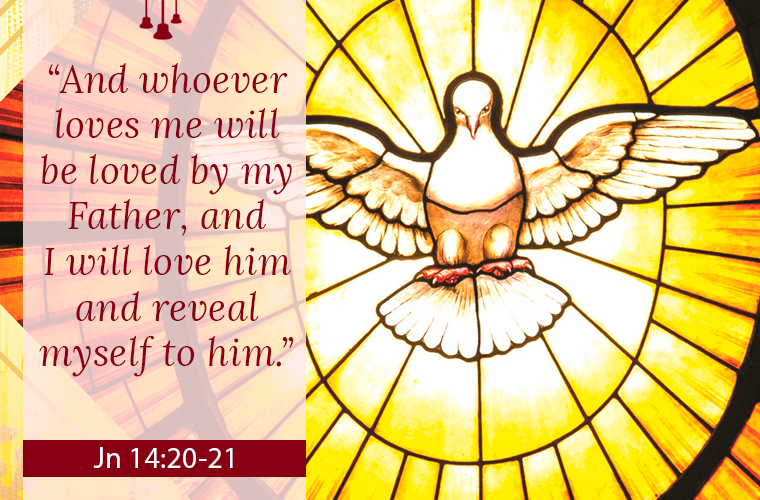
If you were to ask a Christian, any Christian, ‘Do you love Jesus?’, the answer would almost certainly be, ‘Yes’. In fact, it would be a surprise if the answer was anything other than yes. But if you were to ask, ‘Do you keep his commandments?’, and they were to answer honestly, I think the answer, at best, would be, ’I do my best’. We know that’s the honest answer because we all know that sometimes we do keep Jesus’ commandments and sometimes we don’t; and we know we don’t. And yet, in this morning’s Gospel, Jesus says that the one who loves him will keep his commandments. So how can we say we love Jesus when we know that we don’t do what he says those who love him will do?
In this morning’s Gospel, Jesus links love of him with reception of the Holy Spirit, and that’s understandable. Jesus says that those who love him will keep his commandments and, if we read on a little further in St John’s Gospel, Jesus goes on to say,
“… the Helper, the Holy Spirit, whom the Father will send in my name, he will teach you all things and bring to your remembrance all that I have said to you.”
So the Holy Spirit reminds us of what we need to do to love Jesus. And, as Christians, we believe that we have received the Holy Spirit, so we can’t plead ignorance about this. We know what Jesus said, we know what we need to do to love him, so why do we so often fail to do what Jesus told us we need to do?
In this morning’s reading from the First Letter of St Peter, the Apostle urges us to live ‘a good life in Christ’ so that anyone who slanders us may ‘be proved wrong’. But we know that the vast majority of criticism levelled at Christians is for their hypocrisy, for not practicing what they preach. Christians are criticised for speaking about what the good life in Christ is, but not living that life themselves. They’re criticised for proclaiming Christ’s commandments but not keeping those commandments. We might not like being accused of hypocrisy, but we can’t deny that we do sometimes fail, if not often fail, to keep Jesus’ commandments. And if we do deny that, or are ever tempted to deny it, we can soon put ourselves straight by recalling those words from the First Letter of St John;
If we say we have no sin, we deceive ourselves, and the truth is not in us. If we confess our sins, he is faithful and just to forgive us our sins and to cleanse us from all unrighteousness. If we say we have not sinned, we make him a liar, and his word is not in us.
Jesus’ word is in us because we have received the Holy Spirit, and to sin is to fail to keep Jesus’ commandments which the Spirit reminds us of; and yet we are all sinners. So what do we mean when we say we love Jesus?
I’m sure most, if not all of us, will know the saying, ‘You always hurt the one you love’. That is often true in life generally, and it’s just as true in our Christian lives too. In his Letter to the Ephesians, St Paul tells us something of what living the good life in Christ entails and among the things he says, he gives a warning not to ‘grieve the Holy Spirit of God.’ The word we translate as ‘grieve’ can also mean to cause pain, distress or sorrow. So we could translate this as do not hurt the Holy Spirit of God. And what does grieve, or hurt, the Holy Spirit is sin. What hurts the Holy Spirit is not living the good life in Christ; the Holy Spirit is hurt when we don’t keep Jesus’ commandments. And if we hurt the Holy Spirit then we must surely also hurt the Father who sent the Spirit to us, and the Son whose words the Spirit was sent to remind us of. And so, in grieving the Spirit through not keeping the commandments, we hurt the one we love, Jesus, who gave us the commandments.
If we think about why and how we hurt Jesus, it’s not too hard to see we do that in the same way and for the same reasons that we hurt the ones we love in general. We hurt the ones we love because we don’t listen to them. We don’t do what they want us to do because we want to do what we want to do. Sometimes, of course, what they want us to do isn’t the right thing to do, and then we’re right not to do that. But how often do we do our own thing for purely selfish reasons? How often do we hurt the ones we love by not listening to them and not doing what they want us to do simply because we want to do what we want to do, regardless of whether we’re right or not? And how often do we hurt Jesus because we don’t listen to either him or the Spirit for the same reason, simply because we want to do what we want to do rather than do what the Spirit is calling us to do and what Jesus’ commandments tell us we should do?
Life, as we all know, can be hard and stressful at times. Life can make us irritable, impatient and angry and because of that, life can lead us to acting in ways that hurt the ones we love.
How often, for example, have we had a bad day, perhaps at work, and we’ve come home and been irritable and impatient with our family or friends? How aften have we taken out our anger on our family and friends by being angry with them, and for no fault of theirs?
We do these things to our loved ones, and hurt them, very often simply because they are the ones we love, and because they are, they’re the ones who are there when we’re being irritable and impatient and angry. But when we do these things to others, we do them to Jesus too.
In speaking of the good life in Christ, in his Letter to the Ephesians, St Paul says,
I therefore, a prisoner for the Lord, urge you to walk in a manner worthy of the calling to which you have been called, with all humility and gentleness, with patience, bearing with one another in love, eager to maintain the unity of the Spirit in the bond of peace.
But we can be selfish, we can be irritable and impatient and angry with others and so, when we are these things and do these things, we don’t show humility, gentleness and patience. We don’t bear with one another in love, and we the lose the bond of peace. And we don’t only lose the bond of peace between us, our neighbours, and our loved ones, we lose that bond between ourselves and the Spirit, ourselves and Jesus, and between ourselves and God. We lose that because we stop living the good life in Christ by failing to keep his commandments, the words of the Father than he was sent to speak to us and which the Father sent the Holy Spirit to remind us of. We grieve the Holy Spirit of God and we hurt Jesus, the one we claim to love above all others.
Perhaps, to some extent at least, we can’t help having these feelings and emotions because they are part and parcel of being human. Indeed, we actually see these things in Jesus himself. We see them in his arguments with the Pharisees, and other religious leaders of the day. We see them in his exasperation at people’s hardness of heart, slowness of understanding and lack of faith. We see them in his cleansing of the temple. But in Jesus, these feelings and emotions were very targeted, they were aimed at the people who were hard of heart and slow of understanding and lacking in faith. They were aimed at those who were at least resisting, if not actually obstructing or rejecting the Gospel and the kingdom of God.
And in Jesus these feelings and emotions had a purpose, they were meant to admonish, certainly, but also to teach and to draw people to faith. With us, on the other hand, these feelings and emotions, whilst they may be caused by the same hardness of heart and slowness of understanding and lack of faith that gave rise to them in Jesus, whilst they may be caused by the evil and un-Godliness of the world, when we give vent to them, we tend to just blow our top at whoever happens to be around us at the time. We often take a scattergun approach, there’s no focus or point to our explosion of irritability, impatience and anger, we’re simply letting off steam, having a rant and rave about whatever we’re unhappy about at the time and if our loved ones happen to be the ones around at the time and we hurt them by what we do and say, that’s just too bad. We might not mean to do that, but they know what we’re like; they’ll get over it.
We might not be able to help ourselves at times because we are only human after all, but that doesn’t mean we can’t do anything about hurting those we love, or anybody else if it comes to that. If we blow our top about something and somebody gets hurt in the process, we can always say, ‘I’m sorry, please forgive me.’ can’t we? But how often are we willing to do that? How often are we willing to accept our faults and failings, to own up to them and to the consequences of our words and actions and ask for forgiveness from those we’ve hurt by them? That’s what we should do, as Christians, and not only with our neighbours and our loved ones, but with God too.
When we hurt others, we grieve the Spirit, we hurt Jesus and damage our relationship with God too. We do these things and fail to show our love of God and Jesus, but they always love us so we can always restore our relationship with them simply by being honest about our sins, the times when we don’t keep Jesus’ commandments, confessing them, and asking for God’s forgiveness. If we’re willing and able to do that then, as those words of St John remind us, we will be forgiven and restored to righteousness, to a right relationship with God.
It would be nice to be able to say that we love Jesus and show it by always keeping his commandments, but it’s more truthful to say that we try to love Jesus to the best of our ability by trying to keep his commandments to the same extent. But let’s make sure that we do try to do these things to the best of our ability and to be honest, and humble enough to confess our failures and ask for forgiveness when our best isn’t quite good enough.
Amen.
Propers for the 6th Sunday of Easter, 14th May 2023
Entrance Antiphon
Speak out with a voice of joy;
let it be heard to the ends of the earth:
the Lord has set his people free, alleluia!
The Collect
God our redeemer,
you have delivered us from the power of darkness,
and brought us into the kingdom of your Son:
grant, that as by his death he has recalled us to life,
so by his continual presence in us he may raise us to eternal joy;
through Jesus Christ your Son our Lord,
who is alive and reigns with you,
in the unity of the Holy Spirit,
one God, now and for ever.
Amen.
The Readings
Missal (St Mark’s)
Acts 8:5-8, 14-17
Psalm 66:1-7, 16, 20
1 Peter 3:15-18
John 14:15-21
RCL (St Gabriel’s)
Acts 17:22-31
Psalm 66:7-18
1 Peter 3:13-22
John 14:15-21
 Parish Church of St Mark Chadderton